Buyers should classify a water hyacinth organizer tray by what will touch the finished product: organization and display without food contact, carrying packaged or separately contained goods, or direct contact with unwrapped food. The product name, catalog scene, or word “serving” cannot establish that boundary. Put the intended use, contact surfaces, conditions, claim wording, and required evidence into the RFQ before sampling.
1. Start with three use tiers, not one tray label
The simplest sourcing control is to assign every proposed use to one of three tiers. Tier 1 is organization or display: towels, toiletries, desk supplies, packaged gifts, or merchandise are arranged without an intended food-contact function. Tier 2 is carrying packaged or contained goods: wrappers, sealed packs, cups, plates, bowls, or another defined barrier separate the goods from the tray. Tier 3 is direct food contact: unwrapped food is intended to touch some part of the finished tray.
These tiers are purchasing definitions, not universal legal categories. They prevent a team from using “storage,” “display,” and “serving” as interchangeable words while asking for the same evidence. A buyer browsing the water hyacinth category can use catalog items as shape and appearance references, but must separately assign the intended tier for each program, market, and marketing claim.
Do not automatically move a tray to Tier 3 because a photo includes a tea set or because a merchandiser calls it a snack tray. Conversely, do not assume that a “storage” title prevents foreseeable food-related use. Record what is placed on the tray, what creates separation, which surfaces may be touched, how long the use lasts, and whether carrying, display, cleaning, heat, grease, moisture, or repeated use is expected.
2. Treat JZ10147 and JZ10150 as product references, not use certificates
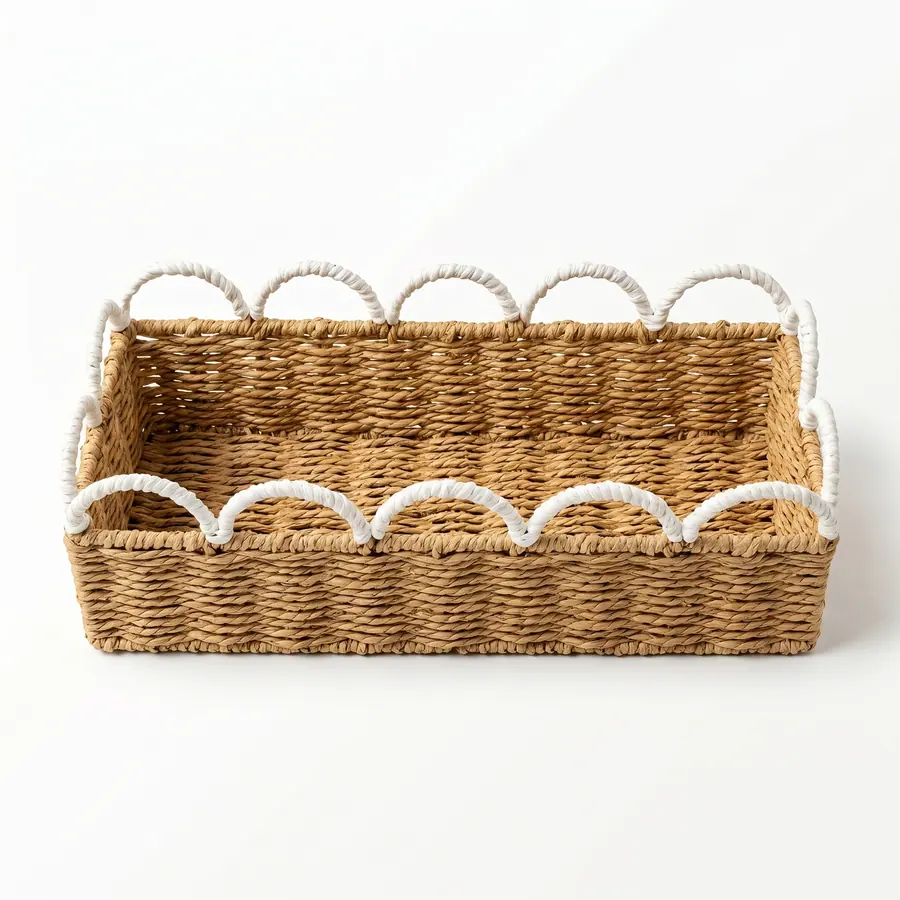
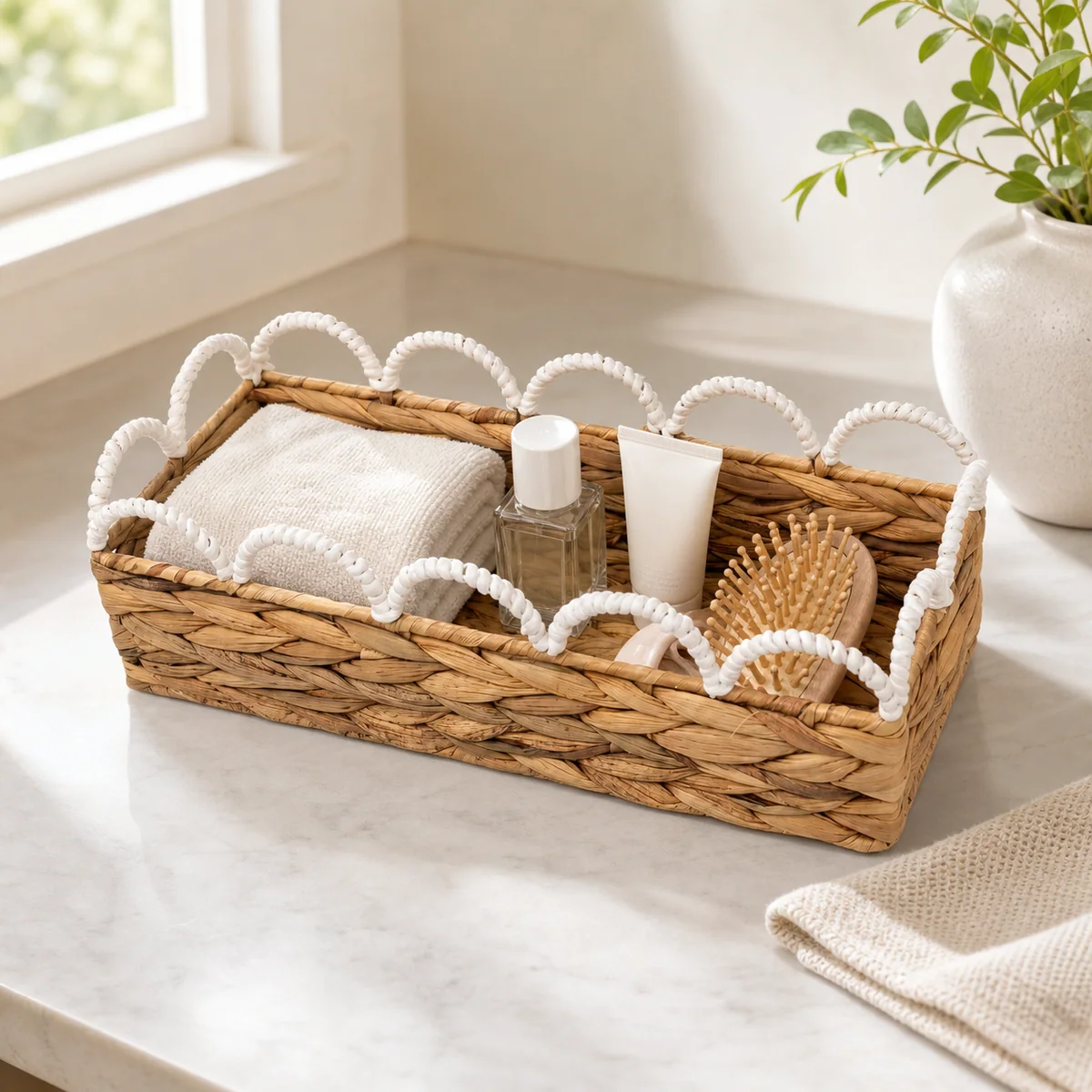
The JZ10147 rectangular organizer tray is recorded in the CMS as a shallow rectangular water hyacinth storage tray in natural honey brown, with white wavy rail handles. Its recorded contexts include storage, organization, display, and gift use. The verified scene image shows towels and personal-care items, so it supports an organizer or storage presentation. It does not establish suitability for direct food contact.
The JZ10150 round desktop basket is recorded as a shallow round serving and storage tray with arch rail handles. That wording provides a commercial-use direction for discussion. It still does not show what materials make up every finished contact surface, what food or conditions are intended, or what compliance evidence exists for a buyer’s destination market.
The site’s URL contract redirects an older “water-hyacinth-rectangular-serving-tray” address to JZ10147. That change is a content and canonicalization decision, not a technical finding about food contact. Keep URL history, catalog naming, and product evidence in separate columns of the approval file.
3. Use an RFQ evidence matrix to prevent claim drift
A buyer can make the boundary operational with one table. Complete it for every SKU and intended market before requesting a final quotation.
| Proposed tier | Intended example | Contact boundary to state | Evidence to request before claim approval | Hold point |
|---|---|---|---|---|
| 1. Organization or display | Towels, toiletries, desk items, packaged gifts | No intended food contact; identify all displayed goods | Approved use statement, finished construction record, labeled sample photos | Block food-serving copy or imagery |
| 2. Packaged or contained goods | Sealed snacks, packaged tea, cups or bowls carried on the tray | Name the wrapper, vessel, liner, or other barrier and foreseeable incidental contact | Barrier description, use instructions, finished sample review, market-specific claim review | Block any implication that food may touch the woven surface |
| 3. Direct food contact | Unwrapped food touching a defined finished surface | Identify exact food, contact area, duration, temperature, repeated-use and cleaning conditions | Complete component and finish disclosure plus applicable declarations, testing, traceability, instructions, and qualified review | Do not approve the claim until evidence matches the final construction and use |
The FDA terminology page on food ingredients and packaging distinguishes a food-contact substance, material, and article. A finished tray can be a food-contact article depending on its intended use and components. This does not mean that the FDA has certified a particular catalog tray, nor does a component statement automatically cover the assembled product.
4. Define the finished construction and every possible contact surface
“Water hyacinth tray” is not a complete material specification. Record the woven plant material, frame, rail handles, base, rim, ties, stitching, adhesive, coatings, colorants, liners, pads, feet, labels, and any protective treatment that remains on the finished item. Mark which parts are visible, which may contact hands or goods, and which would contact food under the proposed Tier 3 use.
Ask for a construction drawing or annotated photographs tied to a sample revision. The file should identify suppliers or controlled descriptions for relevant components without assuming that two visually similar trays share the same build. If a liner or plate creates the Tier 2 separation, define whether it is supplied with the tray, supplied by the buyer, or merely shown for styling. Marketing must not imply that an optional prop is an included protective barrier.
The contact analysis must follow the finished product. A statement about raw water hyacinth alone cannot address adhesives, finishes, internal supports, or decoration. A general test report for a different shape or construction may be useful background, but the buyer should ask a qualified reviewer whether it applies to the final SKU, its components, and intended conditions.
5. Write intended conditions before choosing a test or document
Intended conditions turn a vague serving claim into a reviewable scenario. State the food or non-food goods, whether they are wrapped, the contact duration, temperature, moisture or grease exposure, repeated or single use, indoor setting, carrying distance, load arrangement, cleaning method, and storage between uses. Avoid adding a performance limit unless the project has an agreed method and supporting result.
Under Regulation (EC) No 1935/2004, Article 3 addresses materials and articles under normal or foreseeable conditions of use: they must not transfer constituents in amounts that could endanger health, cause unacceptable changes in food composition, or deteriorate sensory characteristics. It also says labeling, advertising, and presentation must not mislead consumers. Article 15 addresses food-contact indication, special instructions where necessary, and traceability-related identification as applicable.
Those requirements illustrate why a buyer must describe use before selecting evidence. They do not establish that every woven organizer is in scope, that one document covers every market, or that a tray is “EC certified.” The destination, finished material combination, contact route, and conditions determine the applicable assessment. Buyers should have the final plan confirmed by a qualified laboratory or adviser.
6. Control claim wording across the product page, pack, and sales file
Build a claim ledger with four columns: exact proposed words, where they will appear, evidence owner, and approval status. “Organizer tray,” “display tray,” “for carrying sealed snack packs,” and “for direct contact with food” describe materially different uses. Keep translations and retailer copy aligned with the approved English meaning, and review images for implied claims as well as written statements.
The FTC advertising substantiation policy explains that objective express or implied claims need a reasonable basis before dissemination. For this program, that means evidence should exist before a product page, catalog, packaging panel, or sales presentation communicates an objective use or performance claim. A disclaimer in small text may not correct a contradictory hero image or product title.
Use precise Tier 2 wording when separation matters. Name sealed packages, plates, bowls, or the approved liner instead of saying “food safe” or “serving tray” without qualification. If evidence supports only organization and display, keep food, table-service, and snack imagery out of the approved asset set. Do not use “FDA approved,” “FDA certified,” or “EC certified” as shortcuts for a project-specific evidence review.
7. Build the sample plan around the selected use tier
Start with a reference sample that confirms shape, dimensions, handle configuration, color direction, weave presentation, and finished construction. Then stage the exact intended goods. For Tier 1, photograph the organizer empty and loaded, confirm stable placement, inspect accessible edges and handles, and record whether labels or contents obscure the approved presentation. For Tier 2, add the specified wrappers, vessels, or liner and show that the separation method remains present during loading, carrying, display, and unloading.
A Tier 3 sample plan needs more than a styled photograph. Freeze the bill of materials and relevant process details, identify the intended contact area and conditions, agree on the applicable evidence and laboratory scope, and keep the tested or reviewed sample traceable to the production specification. If construction, finish, colorant, adhesive, or intended use changes, ask the responsible reviewer whether reassessment is required.
Retain dated top, bottom, side, interior, handle, rim, base, and close-detail views. Record actual sample dimensions and the method used, but do not import tolerances from an unrelated rigid tray. Issue an approval status with open points: approved for the stated tier, conditionally approved pending named evidence, or revise and resubmit. “Looks good” is not a production release.
8. Connect documentation, QC, and change control
The buyer’s document index should connect the SKU, revision, intended tier, destination market, finished construction, approved sample, claim ledger, artwork, inspection plan, and any applicable declarations or reports. The retailer compliance knowledge base can help organize retailer inputs, but the order file must state the actual requirements and decision owners for this tray.
For food-contact materials and articles within its scope, Regulation (EC) No 2023/2006 on good manufacturing practice calls for documented quality assurance and quality control systems and operations based on pre-established specifications. In practical RFQ terms, request controlled specifications, records that link checks to the approved construction, and a process for reviewing changes before shipment.
QC checkpoints should be observable and tied to the use tier: material and component identity, overall and usable dimensions, rim and base condition, handle attachment and alignment, visible weave and finish, label placement, assortment, unit protection, and carton marks. Add contact-surface or use-condition checks only when the method, sample basis, acceptance rule, and responsible party are defined. A visual inspection cannot replace a required compliance assessment.
9. Keep labels, barcodes, and carton marks consistent with the boundary
Provide artwork revision, language version, label material and size, placement, orientation, attachment method, barcode data, country or market information, care or use instructions, warning text where applicable, and carton-mark layout. Confirm which party supplies and verifies each data element. The buyer remains responsible for approving legal, retailer, and barcode content.
Tier-specific instructions must stay visible at the point of use when required. If a Tier 2 program depends on a separate liner or vessel, state whether the instruction belongs on the unit, insert, retail pack, or online listing and whether the separating item is included. Do not let a carton description or barcode title reintroduce an unsupported “food serving” claim after the product-page copy has been narrowed.
Review a packed sample and one carton-mark proof against the same claim ledger. Confirm that the SKU, color, assortment, product name, included components, use wording, barcode, and revision agree. Preserve the approved presentation through packing without promising a universal transit result; any compression, abrasion, humidity, drop, or other distribution evaluation needs a defined project method and acceptance rule.
10. Make the commercial quotation expose its assumptions
Once the tier and evidence plan are stable, ask the supplier to quote the exact SKU revision, construction, dimensions, color, quantity by SKU, included liner or accessories, label and artwork scope, unit pack, carton plan, evidence responsibilities, testing or review charges, currency, payment terms, quote validity, delivery rule and named place, and exclusions. Request project-specific MOQ, sampling, and production timing rather than relying on a published universal number.
Use the OEM and ODM project page to organize customization inputs. A change from organization to contained-goods carrying, or from contained goods to direct contact, is not merely a copy edit; it may change components, instructions, documentation, review, cost, and release gates. Require every alternative quotation to state which tier and assumptions it covers.
When the specification and open-question list are ready, submit the package through the RFQ page. Ask the supplier to mark deviations instead of silently filling gaps. This framework is a purchasing aid, not legal advice. Applicable requirements depend on the destination market, finished material combination, contact route, and intended conditions, and should be confirmed by the buyer with a qualified laboratory or adviser.