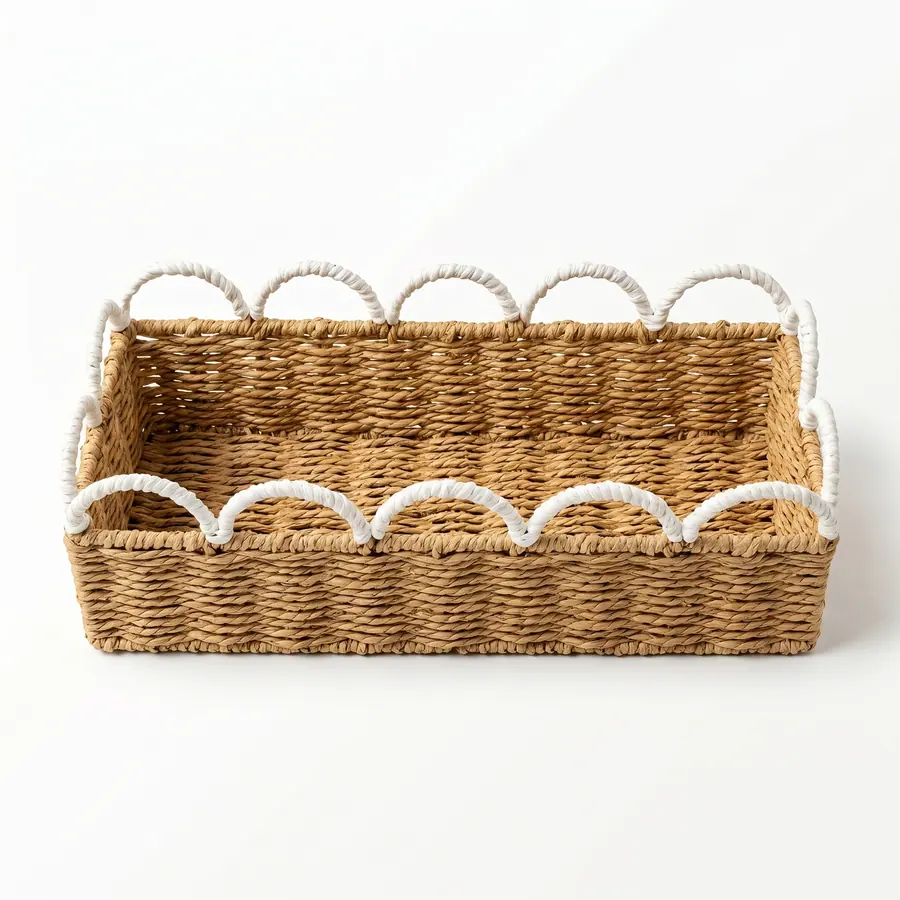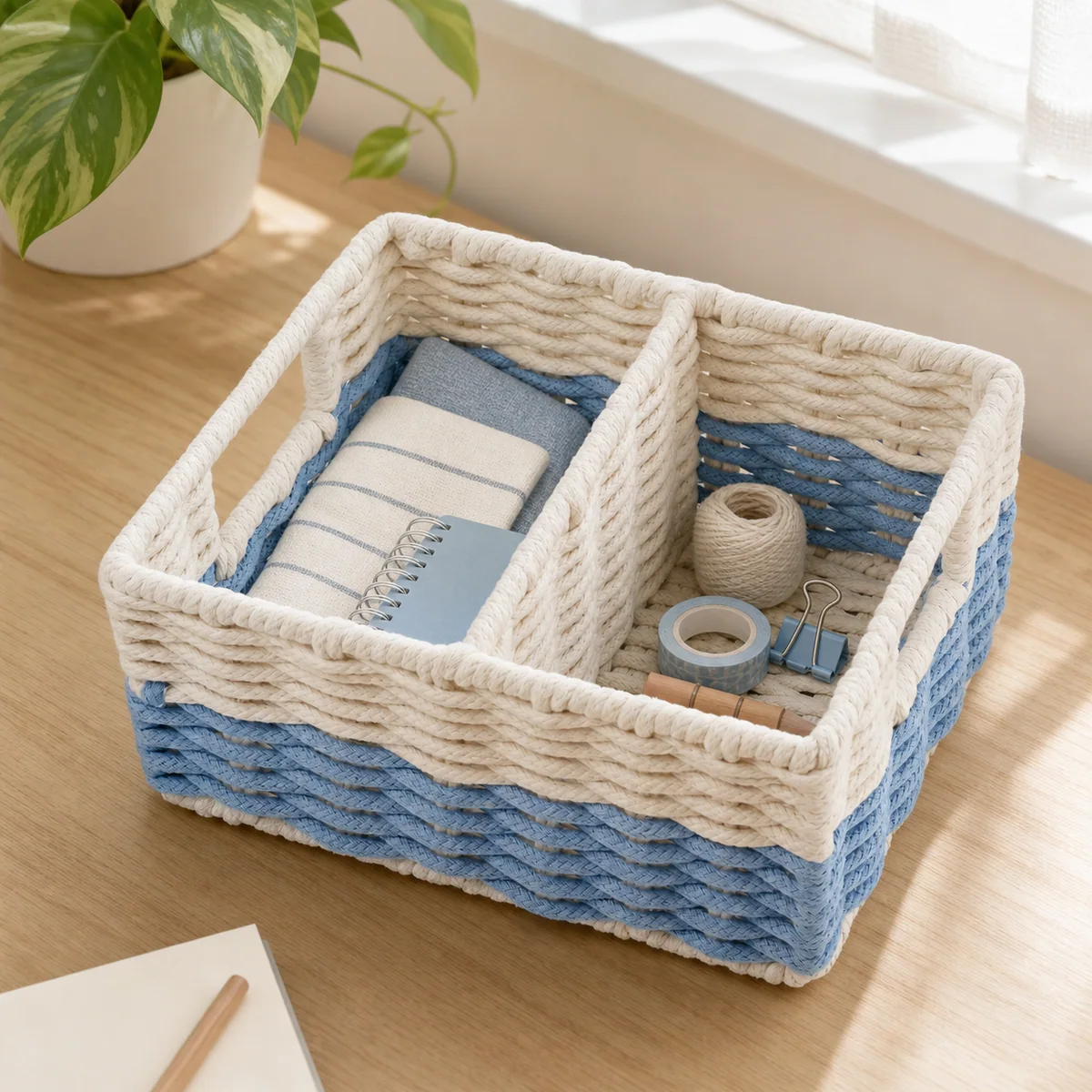
Wholesale buyers should define the compartment purpose, usable opening, divider position, finished dimensions, packed condition, label inputs, and inspection evidence before requesting a cotton rope storage basket quote. Approve the product and pack-out as one controlled selling unit; a styled photo or material name alone cannot establish divider stability, shape recovery, care, compliance, MOQ, or delivery terms.
1. What does the reference product prove, and what remains open?
JINZHAO CRAFT's current catalog includes JZ10127, a cotton rope rectangular two-compartment storage basket. Its recorded product data identifies a cream-white and light-blue color direction, one selling piece, a rectangular divided format, and outside dimensions of 28 cm long by 23 cm wide by 14 cm high. The approved images show the overall presentation, two open compartments, rim treatment, close construction views, a dimension view, and a carton-packing view.
Those records are useful references for a sourcing brief, but they do not prove a universal cotton percentage, divider construction, load result, recovery result, care method, colorfastness, retail compliance, MOQ, sample time, production lead time, or carton performance. Treat each unrecorded point as an open buyer decision or supplier question. If the target design changes the dimensions, number of compartments, color blocking, rim, handle openings, pack method, or intended contents, request a new feasibility response and sample record.
Use the cotton rope category to compare the material direction with the current catalog, then write the RFQ around the exact SKU concept rather than around the broad phrase "cotton storage basket." A narrow brief produces more comparable replies because every supplier is pricing the same compartment layout, construction evidence, labeling scope, and packed presentation.
2. How should buyers define the two-compartment layout?
Start with what each compartment must hold. Record representative item dimensions, orientation, access direction, expected fill level, and whether the contents are sold with the basket or shown only as styling. Outside dimensions cannot answer these questions. Buyers need usable internal length, width, and depth for each compartment, plus the opening dimensions after the rim and divider are finished.
Show the divider on a plan view and cross-section. Identify its position from fixed outside edges, finished height, thickness or construction build-up, top-edge treatment, bottom connection, side connections, and whether it should remain straight when the basket is empty. If the compartments are intentionally unequal, state the required ratio or actual usable dimensions rather than saying "one large and one small section."
Define how measurements are taken: product condition, surface, orientation, tools, reference points, and whether the reading is an outside, inside, or opening measurement. Handmade construction can vary, so the buyer and supplier should agree project-specific acceptance rules after reviewing sample evidence. Do not copy an arbitrary tolerance from another basket whose size, rope, joining, reinforcement, or use differs.
3. Which construction evidence belongs in sample approval?
A front image can hide the most important divider decisions. Ask for top, bottom, side, and close views that show how the divider meets the base and walls. The sample record should identify the rope or component codes used in each zone, the thread or joining method, rim finish, splice and termination locations, any internal support, and the approved color references. It should also state which details are buyer-nominated and which are supplier proposals.
Use the cotton rope construction and shape-recovery specification as a record framework. For this buying decision, add a compartment appendix with actual internal measurements, divider position, empty-state photographs, a buyer-controlled contents trial, packing state, unpacking state, permitted reshaping steps, review timing, and disposition. The result applies only to the identified sample and pack revision.
Approval should be explicit: approved, approved with listed conditions, or revise and resubmit. Record every condition, owner, due date, and superseded file. A comment such as "divider looks fine" is not a production control. A useful approval says which drawing and sample revision define the divider geometry, which observations are acceptable, which are not, and what change triggers another sample or pack trial.
4. What label and artwork inputs must be controlled?
Build a product-data sheet before artwork starts. Include the buyer SKU, product name, color name, selling-unit count, recorded material declaration by component, dimensions and units, country-of-origin input, responsible-business details, barcode data, care wording status, warning status, destination, language versions, and artwork owner. The responsible business must determine which labeling and product-information requirements apply to the actual finished item, destination, claims, channel, and supply-chain roles.
Do not turn the catalog phrase "cotton rope" into an unsupported fiber-percentage, organic, sustainable, hypoallergenic, washable, child-safe, or compliant claim. Ask the supplier for a component-level declaration and available supporting records; then have the responsible buyer, importer, brand, retailer, or qualified reviewer approve the representation used for the target market. Product safety, care, fiber labeling, and retailer data are separate decisions even when one artwork file carries several of them.
The retail label, barcode, and carton-mark hierarchy helps keep product truth, regulatory or channel review, brand artwork, logistics identifiers, and carton marks from overwriting one another. Give every file a revision and owner. Place approved labels and inserts on the packed sample so position, readability, scan access, adhesive or attachment method, and removal behavior can be reviewed on the actual surface.
5. How should retail pack-out and shape presentation be specified?
Decide whether the basket ships fully shaped, nested, folded, compressed, supported, or restrained. Record the exact folding direction, divider position, internal supports, wraps, bags, bands, inserts, carton orientation, units per carton, and unpacking sequence. The pack-out must protect the rim, color-block boundaries, divider top, corners, base, and label area without introducing an unapproved consumer task.
If reshaping is permitted, describe the method in controlled instructions and evaluate it on the exact packed sample. Record the time and condition at each review point, but do not generalize one observation into a universal recovery promise. A different rope construction, divider connection, carton load, storage period, route, temperature, humidity, or unpacking method may produce a different result.
Ask for confirmed carton dimensions, gross and net weights, unit count, assortment, protection components, and carton marks for the proposed configuration. Transit, drop, vibration, compression, moisture, abrasion, and recovery claims require separately defined methods, samples, criteria, and evidence. A carton photograph confirms the arrangement shown; it does not prove performance throughout distribution.
6. Which table should buyers use for QC release?
Translate the approved sample and pack-out into measurable or observable checkpoints. The table below separates evidence from assumptions and can be copied into an RFQ or inspection brief.
| Release gate | Requirement to define | Evidence to retain |
|---|---|---|
| Product identity | Buyer SKU, supplier code, color, selling-unit count, drawing and sample revision | Matched order record, labeled sample, and dated photographs |
| Outside geometry | Length, width, height, base and opening reference points | Drawing, method, actual readings, and project-specific acceptance rule |
| Compartments | Usable dimensions, divider position and height, intended contents and access | Plan view, cross-section, top view, and contents trial |
| Construction | Rope/component codes, joining, rim, base, divider connections, splice and support details | Close photographs, component record, and approved sample |
| Appearance | Color references, surface finish, symmetry boundaries, loose-end and cleanliness rules | Controlled visual references and defect examples |
| Labels and inserts | Approved data, revision, language, location, attachment and readability | Artwork approval and packed-sample photographs |
| Pack-out | Folding or support method, protection, unit count, orientation and unpacking steps | Pack instruction, component list, carton data, and unpacking record |
| Final release | Quantity, sampling basis, findings, disposition, exceptions and owner | Signed inspection record tied to order and revision |
Do not label a checkpoint "pass" unless the method and acceptance rule were approved before inspection. Record actual findings, affected quantity, photographs, disposition, rework or sorting where applicable, and the evidence used for release. If production differs from the approved construction or pack revision, escalate the change instead of silently accepting it under an appearance-only check.
7. What commercial inputs make supplier quotes comparable?
Send every candidate the same product brief, dimensions, compartment drawing, construction questions, color and artwork status, pack-out, quantity by SKU and color, destination, requested evidence, and open decisions. Ask each supplier to identify assumptions and exclusions instead of filling gaps with a standard basket configuration.
Request project-specific MOQ, sampling scope and charges, revision allowance, tooling or component charges where relevant, production timing after approvals, quotation validity, payment terms, packing basis, Incoterm and named place, and any quantity or color-break conditions. These values must come from the current quotation; they cannot be inferred from the cotton rope material name or from JZ10127's public product data.
The OEM and ODM workflow can help assign responsibility when the buyer brings a fixed drawing or starts from a reference. Submit the final controlled package through the RFQ form after the open decisions are listed. That timing lets suppliers quote the same selling unit while clearly separating confirmed inputs from proposals that still need approval.
8. What is the buyer's pre-quote checklist?
- Name the target user, contents, placement, access direction, and selling-unit count.
- Provide outside and usable compartment dimensions with reference points and units.
- Draw the divider position, height, edge finish, and base/side connections.
- Identify buyer-nominated and supplier-proposed construction details.
- Record component material declarations without adding unverified fiber or sustainability claims.
- List all label, barcode, insert, country, language, care, warning, and artwork decisions with owners.
- Define the exact pack-out, carton inputs, unpacking steps, and any permitted reshaping.
- Attach sample, measurement, appearance, construction, pack, and QC evidence requirements.
- Request project-specific commercial terms and require assumptions and exclusions to be stated.
- Keep drawing, sample, artwork, pack, and inspection revisions linked through final release.
Frequently asked questions
Is an outside size enough to quote a two-compartment cotton rope basket?
No. Suppliers also need the usable dimensions and opening of each compartment, divider position and height, construction at the base and walls, intended contents, measurement method, color plan, labeling scope, pack-out, quantity, destination, and approval evidence. Outside size alone can hide materially different constructions and selling units.
Can a buyer claim a fiber percentage from the phrase cotton rope?
No percentage should be inferred from a short catalog phrase. Request a component-level material declaration and available supporting records, then have the responsible business approve the represented fiber information and determine applicable labeling requirements for the exact product, destination, claims, channel, and supply-chain roles.
How should divider stability be approved?
Define the intended empty and filled state, usable compartment geometry, divider connections, sample condition, contents or evaluation method, review timing, observations, project-specific acceptance rule, and disposition. Approval applies to the identified construction and pack revision, not to every cotton rope basket.
Does a carton-packing photo prove shape recovery after delivery?
No. It records one visible pack arrangement. Recovery or presentation claims require a defined sample, exact pack instruction, storage and route conditions, unpacking and permitted reshaping steps, review times, criteria, raw observations, and limitations. A construction or pack change can require another evaluation.
Which documents should travel with a wholesale RFQ?
Include the product brief, dimensioned compartment drawing, component and construction questions, color references, artwork status, pack instruction, quantity and assortment, destination, requested sample and QC evidence, commercial-term request, and an open-issues list with owners. Suppliers should state assumptions and exclusions in their replies.