Direct answer
A cotton-rope basket specification should control four separate records: fibre declaration, rope and sewn construction, compression pack state, and project-defined recovery evaluation. The word cotton does not establish percentage, core material, labeling scope, washability, load, or recovery, and a rope basket is not automatically covered by US or EU textile-fibre rules. For a covered US offer, the responsible covered business must confirm finished-product and component scope, representation, and labeling. For an EU offer within Regulation 1007/2011, manufacturer, importer, and distributor duties must be assigned to the responsible economic operators; a distributor using its own name or trademark, attaching the label, or modifying label content can be considered the manufacturer. Recovery remains a separate project-defined sequence from packed state through unpacking, conditioning, reshaping, measurement, and acceptance, with no universal recovery time or threshold.
Direct answer: specify composition, construction, pack state, and recovery separately
- Cotton-rope products combine material claims with construction and packaging behavior, so one line reading cotton basket is not a usable specification. The buyer should create separate controlled records for fibre declaration, rope structure, sewing and component construction, finished dimensions and shape, retail and export pack state, and post-unpacking recovery. Each record needs evidence, owner, revision, and a clear decision boundary.
- This reference does not assume that every product described as cotton rope is 100 percent cotton, entirely textile, washable, soft enough for a child, load-bearing, colorfast, shrink-resistant, or capable of returning to a target shape after compression. It does not set a universal coil size, stitch density, seam strength, compression ratio, conditioning period, reshaping instruction, recovery time, dimensional tolerance, or test acceptance value.
- The buyer defines the represented composition, destination, channel, intended use, pack concept, performance claims, and evidence level. The supplier declares actual materials and construction, identifies uncertainty, proposes feasible pack and recovery methods, and reports results for the exact revision. Legal applicability and final label text require review by the responsible covered business for a covered US offer and by the responsible economic operators according to their actual EU roles; a factory description alone cannot settle either decision.
Create a component-level fibre and material declaration
- List the main rope, any core, decorative wrap, sewing thread, reinforcement, handles, base insert, liner, trim, label, hardware, adhesive, and packaging separately. For textile components, record generic fibre name, represented percentage or blend basis, supplier evidence, lot, color, yarn or cord form, and whether the value is confirmed or pending. For non-textile components, record material description without forcing them into a fibre-percentage calculation.
- The FTC Textile Products Identification Act defines textile fibre, yarn, fabric, household textile articles, and textile fibre products. FTC business guidance describes covered and non-covered examples and lists several bags, including laundry bags, as not covered by the Textile Act labeling requirements. That list does not automatically classify a woven rope basket or every liner. First confirm finished-product and component scope for the exact US offer; if it is covered, identify the responsible covered business from the actual manufacturing, importing, marketing, distributing, or handling role and approve the required representation and label evidence.
- EU Regulation 1007/2011 defines textile products and treats certain products containing at least 80 percent by weight of textile fibres as textile products for its scope. It also addresses textile components incorporated in other products when their composition is specified. Article 15 assigns distinct duties to the manufacturer, importer, and distributor. A distributor that places a product on the market under its own name or trademark, attaches the label, or modifies label content is considered a manufacturer for this Regulation. These provisions require an exact-scope and actual-role intake, not an automatic conclusion from cotton content.
Describe rope and sewn construction at decision points
- Define rope construction with fields that can be confirmed: supplier material code, nominal external form, core or no-core declaration, twist or braid description, color process as represented, joining method, and lot trace. Avoid unsupported statements about natural, chemical-free, non-toxic, recycled, organic, or premium cotton. Those are separate claims requiring their own scope and evidence.
- Map the product build from base start through wall, rim, handles, and termination. Record coil direction, stitch path, seam or splice locations, reinforcement zones, edge treatment, handle integration, decorative elements, base insert, and any exposed ends. Where measurements are useful, define product state, location, instrument, units, sample, and project criteria. A nominal rope diameter or visible stitch count does not independently prove strength or durability.
- Use dated drawings and close-up reference images to name critical construction zones. A physical pre-production sample can show form and workmanship but must be linked to the material lot, thread, machine or operation, dimensions, and pack revision that it represents. If a supplier changes core, blend, thread, reinforcement, stitch pattern, or joining method, reopen affected appearance, dimension, pack, recovery, labeling, and performance decisions.
Define compression, unpacking, conditioning, and recovery states
- Treat recovery as a sequence of states rather than one claim. Name the pre-pack reference state, folding or nesting arrangement, restraint, wrapping, carton orientation, compression source, closure, storage duration assumption, route assumption, packed state at receipt, immediate unpacked state, reshaped state, conditioned state, and measurement state. Photographs should identify time and orientation rather than simply say before and after.
- Write the unpacking instruction exactly enough to repeat: opening order, removal of restraints, permitted manual reshaping, use or prohibition of steaming, wetting, heating, filling, or fixtures, resting surface, ambient condition, conditioning period, and measurement times. Any consumer-facing instruction must be separately reviewed for safety, care, claims, and practicality. A factory trial method is not automatically an approved retail instruction.
- Recovery measurements can include buyer-selected dimensional points, opening geometry, base contact, sidewall profile, rim alignment, handle position, or comparison to a fixture or reference sample. Apply ISO 10012 measurement-management context and NIST unit conventions, but let the buyer and supplier define a project-specific recovery method and criteria. Do not report a universal recovery time or guarantee transfer from one size, construction, pack, or route to another.
Use the composition, construction, compression, and recovery gate
- Build four linked tables. The composition table records component, fibre or material declaration, mass basis if relevant, evidence, market scope, label owner, and status. The construction table records zone, requirement, supplier method, reference, inspection point, and revision. The pack table records fold or nest state, restraint, protection, carton, duration and route assumptions. The recovery table records unpacking, conditioning, measurement, project criteria, result, deviation, and decision.
- A release sequence prevents circular approval: first confirm the represented composition and component map; then approve construction and dimensions; then create the exact compression pack; then run the approved recovery evaluation; then confirm label and care wording. If any upstream input changes, identify dependent records and repeat only the affected approvals with a documented impact decision.
- Use statuses such as Confirmed, Supplier to propose, Buyer to decide, Test required, Specialist review, Conditional approval, and Rejected. The gate is complete only when each applicable row has evidence and an accountable approver or a documented exclusion. A completion percentage is optional and cannot override an unresolved composition claim, child-use question, pack change, or recovery failure.
Reject fibre shortcuts and unrepeatable recovery demonstrations
- Composition failures include using cotton-like, cotton feel, cotton blend, or natural rope without a component declaration; applying one percentage to rope, thread, liner, and reinforcement; and copying a material statement from a different lot. Another failure is assuming that a supplier invoice alone settles destination-market label scope. Preserve the document as evidence, but require the responsible covered business for a covered US offer and the responsible economic operators for an EU offer to review applicability and wording according to their actual roles.
- Construction failures include approving only an overall photograph, leaving splice and termination methods undefined, changing sewing thread or core without review, and measuring a relaxed sample while production is evaluated immediately after unpacking. Pack failures include compressing a production unit differently from the sample, omitting restraint or carton details, and treating warehouse time or route as irrelevant to shape outcome.
- Recovery failures include saying it returns in hours without defining start time, condition, assistance, method, sample, points, or acceptance. Demonstrations that use undisclosed steam, water, heat, heavy filling, or fixtures are not comparable to passive consumer recovery. A successful immediate visual check does not prove long-term dimensional stability, load performance, durability, or repeatability across production.
Assemble the fibre, construction, pack, and recovery evidence file
- The evidence file should include the component map, fibre and non-textile declarations, supplier documents, lot references, destination-scope review, approved label artwork where applicable, construction drawing, critical-zone photographs, measurement method, pre-production sample record, compression pack instruction, carton revision, recovery protocol, raw observations, results, deviations, corrective actions, approvals, and change history.
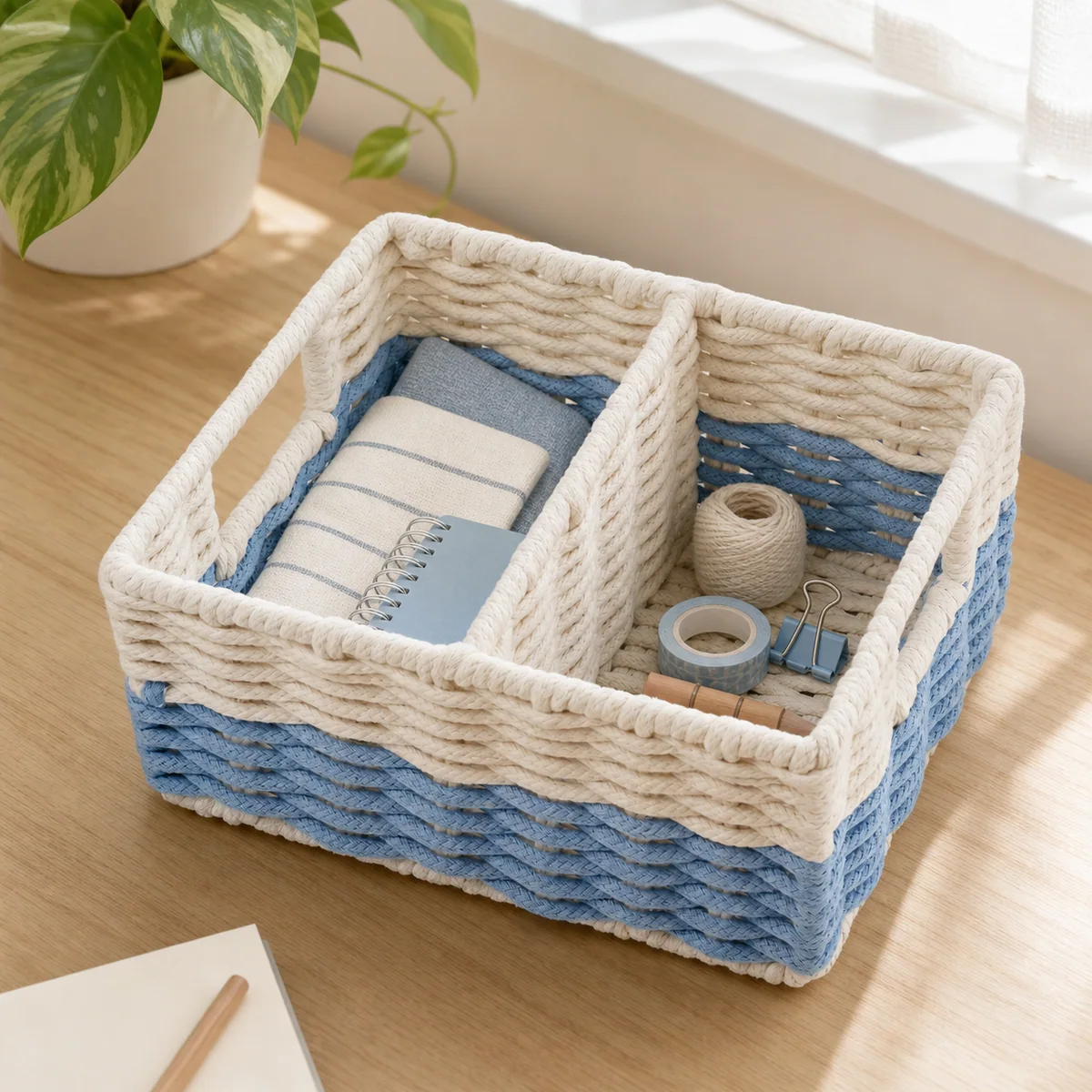
- The current catalog includes a cotton-rope desktop basket and a paper-rope desktop organizer set. They are useful first-party references for asking how material, construction, set format, and pack state differ; the second product is not evidence about cotton rope, and neither page proves fibre percentage, label applicability, recovery, washability, strength, or compliance.
- ISO 10013 supports controlled documented information, ISO 10012 supports measurement-management confidence, and NIST supports clear unit expression. Preserve each source at its proper level. Supplier declaration, laboratory composition report, dimensional measurement, recovery trial, buyer approval, and legal review answer different questions and should not be collapsed into one certified or compliant status.
Keep fibre labeling, product safety, care, and performance responsibilities visible
- US and EU textile-fibre rules have defined scopes, exclusions, thresholds, terms, and responsibilities. This page does not determine whether a particular basket, rope, liner, set, or component is covered. For the US, identify the responsible covered business only after confirming the exact offer is covered. For the EU, identify the manufacturer, importer, and distributor from actual placement and supply-chain facts, including whether a private-label offer places the product under the distributor's own name or trademark, the distributor attaches the label, or the distributor modifies label content and is therefore considered the manufacturer. Retain the role and applicability decision.
- Fibre labeling does not establish product safety, chemical compliance, flammability, child suitability, care method, load, colorfastness, shrinkage, abrasion, durability, or recovery. Likewise, a successful recovery trial does not establish fibre composition or legal label compliance. Claims such as organic, recycled, sustainable, washable, hypoallergenic, non-toxic, safe for children, or heavy duty require separate approved evidence.
- Send the controlled records through the RFQ route and use the OEM/ODM route for proposed construction or pack changes. The supplier confirms the actual build and execution evidence; the buyer confirms represented composition, intended use, destination requirements, project recovery criteria, label, and final release. No matrix transfers statutory responsibility between those parties.
Buyer comparison table
JINZHAO CRAFT factory recommendation
For a practical factory quote, share a reference image, target dimensions, material direction, expected order quantity, logo or label needs, retail/export packaging requirements and destination market. JINZHAO CRAFT can then discuss material feasibility, sample direction, MOQ, production timing and export carton planning for the woven storage product.
Primary sources
These references support the defined standards, regulatory context, or buyer process described above. Product-specific obligations and commercial terms still require confirmation for the actual order.
- The Textile Products Identification Act — Federal Trade Commission
Supports US statutory definitions and textile-fibre-product scope; it does not automatically classify a cotton-rope basket or determine every component and label obligation.
- Threading Your Way Through the Labeling Requirements Under the Textile and Wool Acts — Federal Trade Commission
Supports FTC business guidance on covered parties, covered and non-covered examples, fibre disclosure, origin, and labeling; applicability to an exact basket remains for responsible review.
- Regulation (EU) No 1007/2011 on textile fibre names and related labelling and marking — European Union - EUR-Lex
Supports EU textile-product scope, the 80 percent treatment rule, approved fibre names, and composition labeling context; it does not establish product safety or automatic applicability.
- ISO 10013:2021 Quality management systems - Guidance for documented information — International Organization for Standardization
Supports controlled documented information and is published with review activity shown; it does not prescribe construction, recovery, labeling, performance, or certification.
- ISO 10012:2026 Quality management - Requirements for measurement management systems — International Organization for Standardization
Supports measurement-management confidence; it does not set a recovery method, measurement points, conditioning period, tolerance, or result for cotton-rope products.
- SI Units — National Institute of Standards and Technology
Supports explicit quantity values and unit symbols; it does not determine fibre composition, construction, pack state, recovery, or acceptance.
FAQ
Does cotton rope mean the product is 100 percent cotton?
No. Require a component-level declaration for the main rope, core, sewing thread, reinforcement, liner, and other materials. The represented percentage, evidence basis, lot, and market label decision must be explicit.
Do US textile-labeling rules automatically cover a cotton-rope basket?
No automatic conclusion should be made. FTC sources define scope and list covered and non-covered examples. Confirm the exact finished product and component scope first; if covered, the responsible covered business must approve the required representation, label evidence, and other applicable actions according to its actual role.
Does the EU 80 percent rule automatically decide the label for a mixed basket?
No. Regulation 1007/2011 provides scope rules, but exact product, component, composition, and presentation facts still require review. Responsible economic operators must distinguish manufacturer, importer, and distributor duties; a distributor using its own name or trademark, attaching the label, or changing label content can be considered the manufacturer.
How should a compressed cotton-rope basket recovery test be written?
Name the pre-pack and packed states, fold and restraint, carton, duration and route assumptions, unpacking, allowed reshaping, conditioning, environment, times, measurement points, units, project criteria, sample, evidence, and approver.
Can one recovery result be applied to every size and pack?
No. Recovery depends on construction, dimensions, reinforcement, material lot, fold, restraint, carton, storage, route, unpacking, conditioning, and method. Transfer requires a documented impact assessment and approved evidence.
Products relevant to this guide
Review current factory product examples, then send target dimensions, quantity and customization requirements for an exact quotation.

Continue learning
Paper Rope, Water Hyacinth, Seagrass and Cotton Rope: Buyer Comparison
Compare 8 real matched basket designs in paper rope and water hyacinth. See weave and texture differences, with clear limits on what the photos can prove.
Read guide →Product SpecificationsGeneral Storage Basket Functional Specification Matrix
Translate intended storage use into controlled fields for usable space, access, handles, contact surfaces, closure, liner, nesting, and pack verification.
Read guide →Materials & ConstructionMaterial-Aware Care and Use Guide for Woven Baskets
Create accurate care instructions for paper rope, water hyacinth and cotton rope baskets. Check material, frame, finish and cleaning evidence for each SKU.
Read guide →Factory & QualityHandmade Basket Dimensional Measurement and Tolerance Framework
Define measurement condition, points, tools, raw readings, project-specific limits, deviation, conformance, and nesting clearance for handmade baskets.
Read guide →