Direct answer
Dimensional control for a handmade basket requires a named measurement condition, coordinate system, points, tool, unit, raw readings, target T, lower limit L, and upper limit U for each characteristic. Deviation is d = x - T, but conformance is determined only by the approved rule L <= x <= U. A nesting check can estimate directional total clearance as the parent's minimum usable opening minus the child's maximum external envelope; centered per-side clearance is half that value. These formulas are conditional planning tools. They do not set universal tolerances, prove process capability, guarantee nesting, or certify JINZHAO CRAFT.
Direct answer: define the measurement before the limit
- A dimension is controlled only when different competent people can identify the same characteristic, condition the product in the same agreed way, place an appropriate tool at the same points, record raw values in the same unit, and compare them with the same approved limits. A drawing number without this measurement definition can produce apparent disagreements that are method differences rather than product differences.
- This framework covers outside and usable dimensions, opening dimensions, base dimensions, height, handle projection, rim level, diagonal or shape checks, set relationships, and nesting envelopes. It does not publish a universal tolerance for handmade baskets, a default pass percentage, a universal sampling plan, an instrument-calibration interval, or a process-capability claim.
- Natural materials and manual forming can create variation, but variation still needs an agreed commercial boundary. The buyer specifies what fit, presentation, packaging, or interface must be protected. The supplier confirms the construction and measurement feasibility. Both parties should approve the method and project-specific limits before bulk production.
Control condition, characteristic, point, tool, and unit
- Measurement condition describes the product state: unpacked or packed, liner installed or removed, lid fitted or removed, handles resting or raised, nested or separated, time after unpacking if relevant, support surface, orientation, and any approved conditioning. The method should avoid forcing a flexible product into the desired shape unless the defined use includes that fixture.
- A characteristic is the exact quantity being measured, such as maximum outside width at the upper rim or minimum usable width at a stated depth. A point or line identifies where the reading is taken. A tool is selected for the characteristic and expected uncertainty, such as a rule, tape, caliper, height gauge, fixture, angle device, or template. The record names the tool ID where control requires traceability.
- Use one declared unit and retain raw readings. NIST SI resources support consistent quantity and unit communication, including the meter and derived decimal expressions used in commerce. They do not define basket measurement points or tolerances. Do not mix a target in centimeters, a limit in millimeters, and an unmarked supplier reading in one approval table.
Establish a basket coordinate and point map
- Define front, back, left, right, top, and base using a stable product feature such as a label panel, handle orientation, seam, or drawing view. For round products, define diameters through named axes or record maximum and minimum diameters under the approved condition. For tapered products, distinguish opening, base, and any intermediate measurement plane.
- Outside dimensions should include or exclude projections explicitly. Usable dimensions should state the limiting internal surfaces and depth. A fabric liner, inward joint, frame, lid seat, handle attachment, or local weave buildup may reduce usable space. If the buyer's requirement concerns shelf fit, carton fit, or nesting, measure the limiting envelope rather than a convenient middle area.
- Illustrations, point codes, and short method notes reduce ambiguity. A code such as H-BS can mean vertical height from the support surface to the highest approved basket rim point with handles resting. The code itself is useful only when the controlled drawing or measurement sheet contains that definition.
Record raw readings before calculating results
- For every sampled unit, preserve unit ID, lot, date, operator, method revision, condition, tool, point code, and raw reading x. If repeated readings are required, state whether the report retains each reading, a mean, a maximum, a minimum, or another defined statistic. Do not replace inconvenient raw data with a rounded pass value.
- For a characteristic with target T, calculate signed deviation as d = x - T. A positive d means the reading is above the target and a negative d means it is below. Deviation alone does not determine conformity because asymmetric limits are possible. The only page-level conformance statement is conditional: the reading conforms when the buyer-approved rule L <= x <= U is satisfied.
- Rounding can change an edge decision. Define recording resolution and the stage at which rounding, if any, is applied. Where measurement uncertainty is material to a close limit, the responsible quality parties should define a decision rule suited to the project. This page does not prescribe guard bands, uncertainty budgets, or calibration practices for an unspecified measurement system.
Set project limits from interface risk and evidence
- Start with the protected interface: shelf, cubby, insert, tissue carton, retail pack, lid, nested partner, liner, label, or expected visual proportion. Identify whether a lower limit, upper limit, or both are necessary. Then review reference samples, prototype or pre-production measurements, process observations, tool suitability, packaging recovery, and buyer risk before approving L, T, and U.
- For a simple two-sided nesting direction, define total clearance C = I_parent_min - E_child_max, where I_parent_min is the approved minimum usable opening of the parent at the limiting insertion plane and E_child_max is the approved maximum external envelope of the child at the corresponding plane. If centered and symmetric, nominal per-side clearance is c = C / 2. Account separately for liners, handles, joints, taper, rotation, depth, and insertion path.
- Positive calculated clearance is necessary for the simplified direction but may not be sufficient for real nesting. Shape distortion, nonparallel walls, local protrusions, friction, height interference, and pack orientation can still block or damage the set. Verify the physical set and pack-out. A round hamper, a four-piece rectangular set, and a two-piece water-hyacinth set need different measurement maps.
Reject shortcuts that hide measurement disagreement
- Frequent failures include measuring a flexible rim at arbitrary points, pulling a tape around a curved profile, pressing a product flat, including handles in one reading but excluding them in another, and comparing a packed sample with a recovered bulk unit. These methods can each be valid for a defined purpose, but they are not interchangeable.
- Another failure is setting limits from a single visually preferred sample without checking function, pack-out, or observed process spread. Conversely, copying a broad supplier tolerance may not protect a buyer's shelf, nesting, or insert interface. Limits should protect the decision while remaining connected to the actual construction and measurement system.
- Do not infer process capability from a few conforming sample readings. Capability assessment requires a suitable measurement system, stable process definition, enough representative data, and an agreed statistical method. ISO 10012 supports confidence in valid and reliable measurement results at a system level; it does not prove that this basket process is capable or that a specific tolerance is appropriate.
Assemble the dimensional approval and inspection record
- The approval package should contain the product and revision, measurement condition, coordinate and point map, characteristic definitions, units, tools, recording resolution, target and project limits, decision rule, sampling instruction if used, sample data, approved physical reference, nesting or interface trial, deviations, and authorized changes.
- The inspection record should preserve raw readings by unit, calculations, result, operator, date, tool ID where required, nonconformance reference, remeasurement reason, and disposition. If a reading is repeated because of suspected method error, retain both the original and repeat with the reason. Selective replacement of results destroys traceability.
- ISO 10013 supports tailored documented information, while ISO 9001 supplies general quality-management-system context. Neither defines these basket fields or proves certification. Use the RFQ route to communicate project requirements and the factory route to discuss measurement feasibility, then approve order-specific evidence.
Separate dimensional conformance from fitness and certification
- A conforming measured dimension means only that the recorded result met the approved decision rule for that characteristic and sample under the stated condition. It does not prove visual acceptance, functional load, durability, moisture behavior, chemical compliance, transit performance, overall fit in every environment, or conformity of unmeasured units.
- A dimensional target is not a legal requirement unless an applicable rule or contract makes it one. A customer's cabinet opening, retailer carton constraint, or paired nesting relationship may create a strict project need, while another dimension remains presentational. Record the reason so future revisions do not tighten every characteristic without benefit.
- No cited source establishes a universal handmade-basket tolerance, measurement capability, inspection level, or JINZHAO CRAFT certification. Buyers should review current products as physical references only, then define and verify the exact SKU, condition, points, limits, and evidence needed for their own program.
Buyer comparison table
JINZHAO CRAFT factory recommendation
For a practical factory quote, share a reference image, target dimensions, material direction, expected order quantity, logo or label needs, retail/export packaging requirements and destination market. JINZHAO CRAFT can then discuss material feasibility, sample direction, MOQ, production timing and export carton planning for the woven storage product.
Primary sources
These references support the defined standards, regulatory context, or buyer process described above. Product-specific obligations and commercial terms still require confirmation for the actual order.
- ISO 10012:2026 Quality management - Requirements for measurement management systems — International Organization for Standardization
Supports measurement-management systems and confidence in valid, reliable results; it does not set basket tolerances, prove capability, or certify JINZHAO CRAFT.
- SI Units — National Institute of Standards and Technology
Supports consistent SI quantities and units; it does not define basket characteristics, measurement methods, decision rules, or tolerance limits.
- ISO 10013:2021 Quality management systems - Guidance for documented information — International Organization for Standardization
Supports tailored documented information and is under review at access; it does not prescribe this record format, basket conformity, or compliance.
- ISO 9001:2015 Quality management systems - Requirements — International Organization for Standardization
Supports general QMS context and is marked to be revised; it does not establish JINZHAO certification, product capability, or dimensional conformance.
FAQ
What tolerance should a handmade woven basket use?
There is no universal value on this page. Set lower and upper limits for each characteristic from its functional or commercial interface, approved evidence, process knowledge, measurement method, and buyer risk.
Is deviation from target the same as nonconformance?
No. Deviation d = x - T shows direction and amount from the target. Conformance is decided against the approved lower and upper limits and decision rule. A nonzero deviation can still be conforming.
How should a round basket diameter be measured?
Define the product condition, height or plane, axis convention, tool, and whether the result is a named-axis diameter or maximum and minimum diameters. Do not use an unspecified single reading for an irregular opening.
Does positive nesting clearance guarantee that baskets will nest?
No. The simplified directional formula does not capture taper, local shape, liners, joints, handles, friction, rotation, depth, or insertion path. Verify the actual set and the intended packaging arrangement.
Can conforming sample dimensions prove process capability?
No. Capability needs a suitable measurement system, a defined and stable process, representative data, and an agreed analysis. A small sample passing project limits is inspection evidence, not a universal capability claim.
Products relevant to this guide
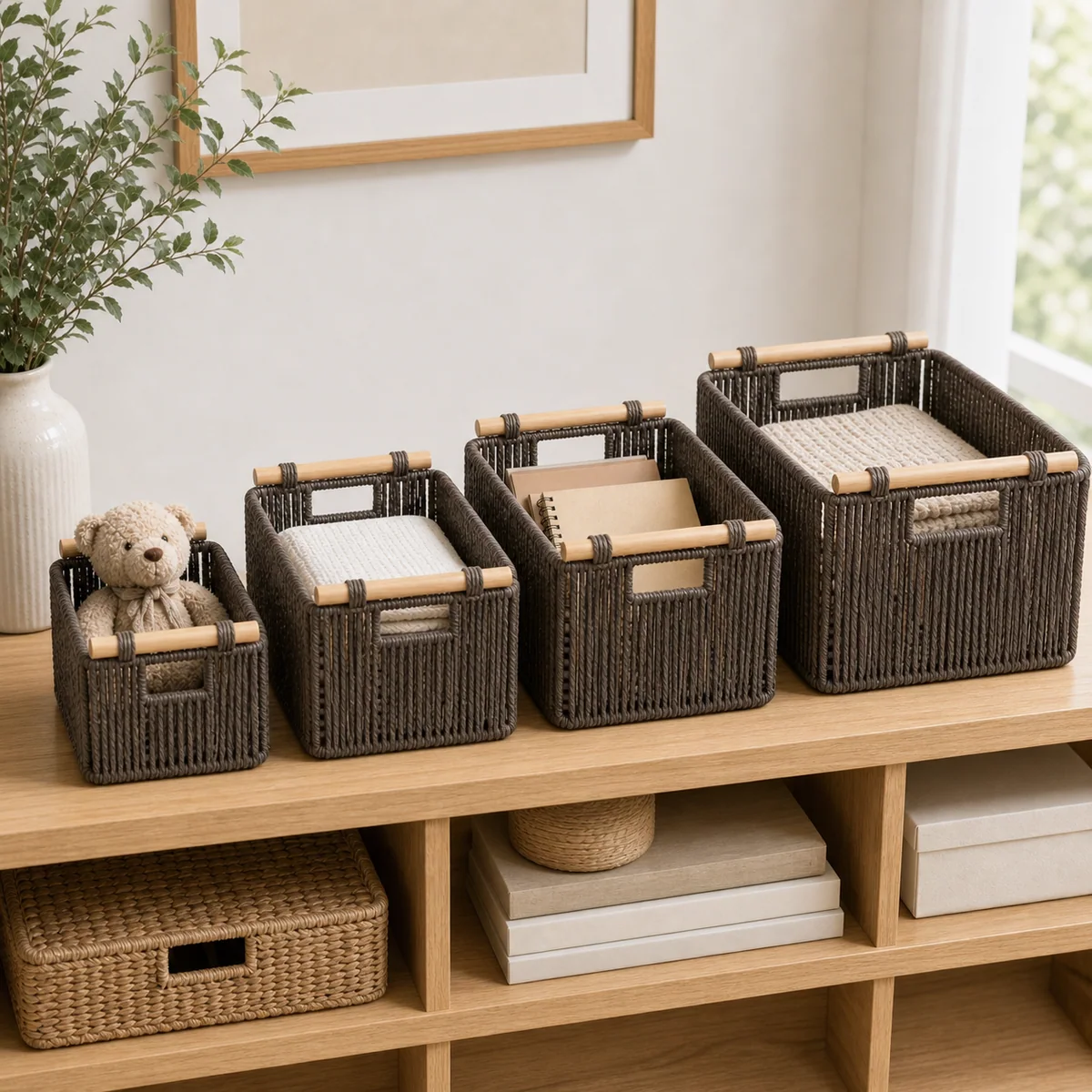
Review current factory product examples, then send target dimensions, quantity and customization requirements for an exact quotation.


Continue learning
Woven Basket Visual Defect Classification and Disposition Standard
Classify woven-basket observations, natural variation, defects, zones, severity, boundary references, records, and lot dispositions without inventing a universal AQL.
Read guide →Product SpecificationsGeneral Storage Basket Functional Specification Matrix
Translate intended storage use into controlled fields for usable space, access, handles, contact surfaces, closure, liner, nesting, and pack verification.
Read guide →Packaging & LogisticsExport Packaging Standards Boundary Checklist for Woven Baskets
Apply ISPM 15, cargo-unit guidance, carton evidence, and destination checks to woven basket export packaging without overclaiming.
Read guide →Factory & QualityBasket Factory vs Trading Company: A Verification-First Buyer Guide
Compare basket factories and trading companies through legal identity, production evidence, order control, and accountable handoffs.
Read guide →