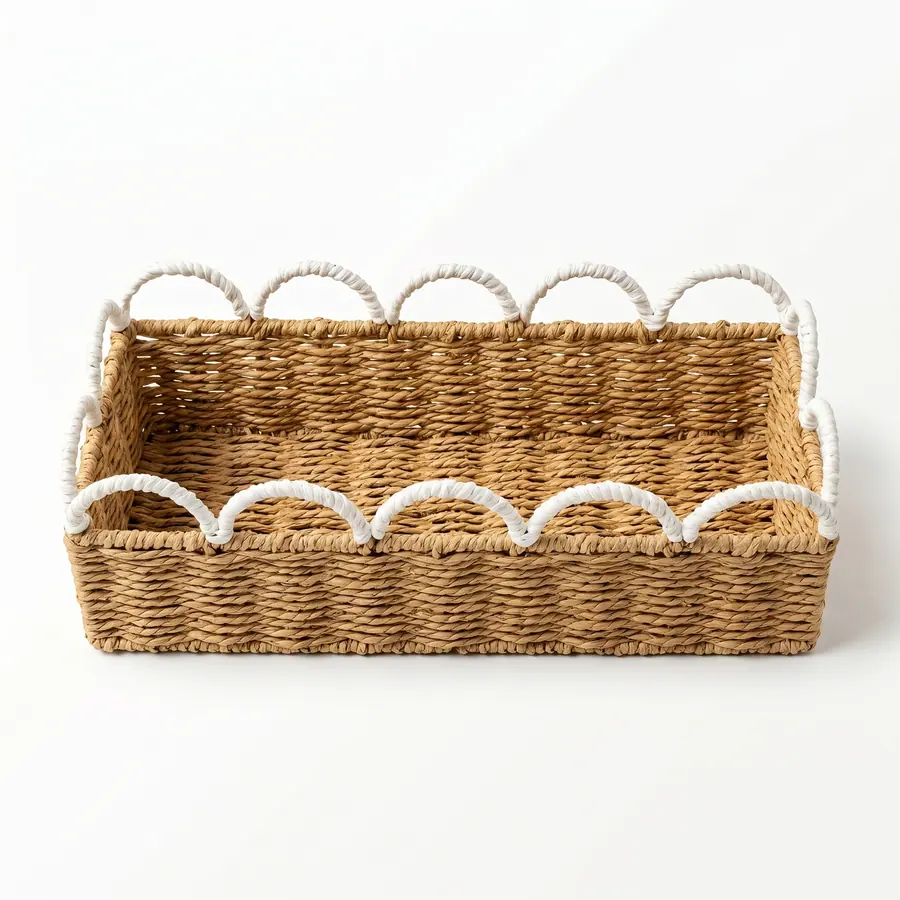
Over-specifying handmade woven products can create confusion instead of control. A buyer may write a long list of absolute requirements, but if the list ignores material behavior, weaving variation, measurement method, and packing effects, different reviewers will still judge the same basket differently. Practical specifications separate what must be strict from what needs a range.
This article is about avoiding impossible or counterproductive requirements. It is not an argument for loose quality. Buyers should still use the factory quality page, submit exact project variables through RFQ, and keep critical safety, legal, label, and functional requirements explicit where they apply.
1. Identify the requirement type before writing the limit
Every requirement should fall into one of several groups: critical function, retail appearance, fit dimension, material identity, natural variation, packing behavior, or buyer preference. A critical function may need a hold-or-release decision. A fit dimension may need a product-specific range. A visual preference may need approved photos rather than a numeric tolerance.
This classification avoids the common mistake of applying strict language to every small variation. A natural fiber shade difference, a slight handmade curve, and a wrong barcode are not the same kind of issue. They should not be controlled with the same wording.
2. Use strict requirements for clear failure points
Strict requirements belong where failure is clear. Examples include wrong SKU, wrong material, missing component, unreadable buyer-required barcode, broken handle, unstable base for a product that must stand, lid that cannot close, or packing that does not match the order file. These points can be checked directly and usually need little interpretation.
When a strict requirement is added, name the evidence. A strict label rule needs artwork and placement proof. A strict fit rule needs measurement points. A strict packing rule needs pack-out photos. Without evidence, strict words may sound strong but remain hard to enforce.
3. Use ranges for handmade dimensions
Handmade woven products should not inherit tolerance numbers from plastic, metal, or another basket style. A framed rectangular basket, a soft cotton rope bin, a round paper rope hamper, and a tapered water hyacinth basket respond differently to material tension and packing. Dimensions should be tied to the product structure and use case.
Ask the supplier to propose a practical range after sample review. Then decide which dimensions are critical and which are informational. Outside shelf fit, lid seating, nesting clearance, and usable inside space may deserve tighter attention than a decorative side curve that does not affect use.
4. Use sample boundaries for visual character
Some handmade qualities are best controlled visually. Weave character, natural tone movement, small surface texture, and slight asymmetry may be acceptable when they match the approved look. The buyer should keep dated photos that show the intended visual boundary and, when useful, photos that show unacceptable examples.
Do not let a single sample accident become an impossible production promise. If the buyer likes a specific streak, curve, or handmade irregularity in one sample, decide whether it is a required design feature or just part of that particular sample. For sample reading, use woven basket pre-production sample review.
5. Avoid adding inspection burden after price agreement
A specification can become over-specified after quotation. Extra sorting, more photos, tighter color grouping, revised label review, or a new packing check may be reasonable, but it changes the work if it was not in the quoted file. The buyer should ask whether the new requirement affects price, timing, sample approval, or inspection responsibility.
This is not a reason to avoid quality requirements. It is a reason to place them early. A clear requirement before quotation is part of the work. A surprise requirement after production starts becomes a commercial change that should be acknowledged.
6. Keep natural variation out of the defect list unless bounded
Natural variation should not be a vague excuse, but it also should not be automatically rejected. The buyer needs a boundary. For color, define the approved reference and review conditions. For shape, define the views and fit failures. For texture, define visible problems such as staining, contamination, broken material, or unacceptable surface marks.
If the boundary cannot be defined yet, mark it as a sampling question. The common woven basket quality issues guide can help decide whether the variation is a material, shape, color, workmanship, or packing issue.
7. A practical specification matrix
| Requirement | Best control | Example decision |
|---|---|---|
| Wrong component | Strict rejection or hold | Material not approved for the SKU |
| Shelf fit | Measured range | Outside width at marked points |
| Lid relationship | Functional check | Lid seats without forced pressure |
| Natural tone | Visual boundary | Within approved reference family |
| Handmade weave character | Sample photo comparison | Similar visual density, not identical strands |
| Packing compression | Pack-out review | Shape remains acceptable after agreed packing check |
8. Review the specification for hidden absolutes
Before releasing the purchase file, search for words such as perfect, identical, no variation, always, never, and flawless. Some may be valid for data, labels, or wrong components. Many are not useful for natural handwoven appearance. Replace broad absolutes with a strict rule, a range, or a visual boundary.
The strongest handmade woven product specification is not the longest one. It is the one that lets the supplier, inspector, and buyer make the same decision from the same evidence. When a requirement does not help that decision, remove it or rewrite it as a question for sampling.
9. Ask whether the requirement changes the product or the inspection
Some requirements change the product itself; others only change how the product is checked. A new rim material, liner, or handle construction changes the product. More photos, tighter sorting, or a different inspection sample basis changes the inspection workload. Both can be reasonable, but they should be discussed differently.
When the buyer adds a requirement, ask whether it affects material purchase, weaving method, packing volume, inspection time, or shipment release. If the answer is yes, the requirement belongs in the quotation or production file, not in a late email after the order is already underway.
10. Keep a short list of non-negotiables
A practical handmade specification benefits from a short list of non-negotiables. These are the points the buyer will not trade away: correct material, correct SKU, safe handling requirements where defined by the buyer, readable buyer-required data, critical fit, and packing method. Everything else should be assigned a range, sample boundary, or review question.
This short list helps the supplier understand priorities. It also helps inspectors make consistent decisions when several small variations appear together. The buyer can be strict without making every natural feature equally important.
11. Test the specification against a real inspector decision
Before sending the final file, imagine an inspector holding one finished basket and reading each requirement. Can that person decide pass, hold, or ask the buyer from the evidence provided? If the answer is no, the requirement is probably not ready. Rewrite it with a method, a boundary, or a question for sample review.
This simple test catches many over-specified lines. “Color must be beautiful” gives no decision. “Compare body and liner against the approved sample under the agreed review condition” gives a path. “No deformation” is too broad for a handwoven item. “Lid seats without forced pressure on the approved sample view” is more usable. The specification should help the inspector make the same decision the buyer intended.