Cotton rope fits a kids room or soft storage basket program when the buyer wants a textile-led appearance and hand feel, can accept a structure that is defined through sampling, and is prepared to validate care, color, shape recovery, and intended-use requirements for the exact product. It is a weak fit when the project depends on an unverified washing claim, rigid fit with little dimensional variation, permanent exposure to moisture, or performance language that has no agreed test method.
That answer is a material-screening decision, not a promise that every cotton rope construction is soft, washable, colorfast, child-safe, or suitable for a stated load. Rope composition, diameter, internal support, joining, stitching, handles, decoration, finish, and packing all change the result. Buyers should compare defined constructions rather than selecting a material name in isolation.
1. Start with the job the basket must do
Write the use case before discussing colors. Is the item a floor basket for bulky textiles, an open toy organizer, a shelf bin, a tabletop divider, a gift container, or a nested set? Record the contents the buyer expects it to hold, the target location, how often it will be lifted, whether the product must fit furniture, and whether consumers are expected to reshape or clean it.
Cotton rope can be explored when tactile presentation, a textile surface, quieter contact with surrounding furniture, or flexible styling is important to the retail concept. Those are design intentions that still need a physical reference. Do not translate them directly into unsupported promises such as "safe for every nursery" or "will never scratch." Define what the sample must feel and look like, then decide which functional checks matter.
The kids storage category offers relevant visual directions for the commercial program. Use those references to discuss scale, openings, motifs, and merchandising, while keeping the material decision open until the target construction has been reviewed.
2. Choose a construction path before comparing materials
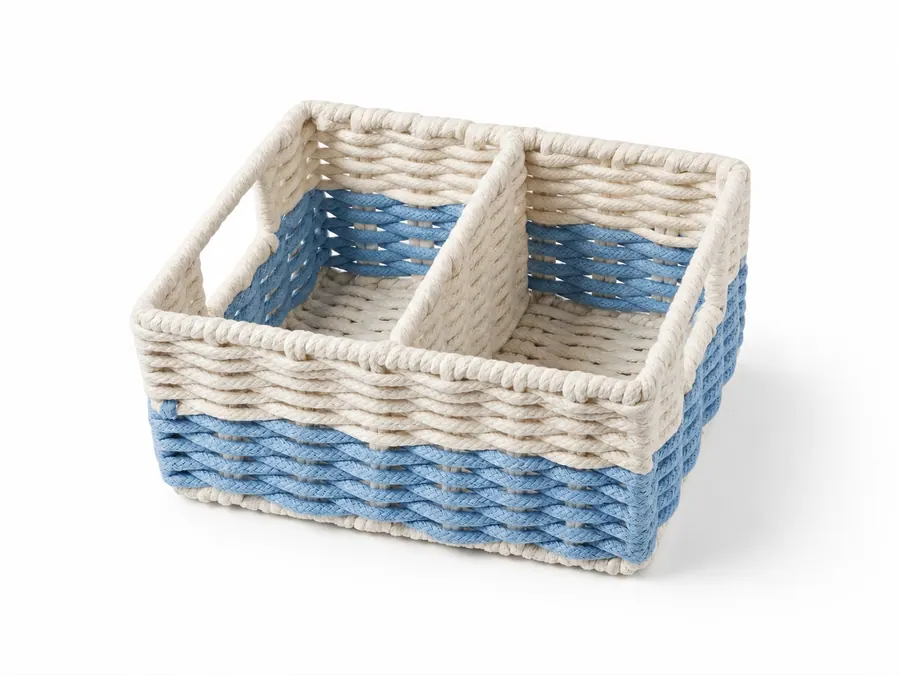
"Cotton rope basket" can describe materially different structures. One direction may rely mainly on coiled or joined rope to create the wall. Another may use rope as a visible wrapping or woven surface over support. A third may combine rope with boards, wire, dividers, lining, or other components. These options do not have the same firmness, internal capacity, edge treatment, pack behavior, or quotation basis.
Ask each supplier to draw or photograph the proposed cross-section and list every supporting component. Confirm rope composition, nominal diameter or approved sample, color treatment, stitch or joining thread, seam location, rim construction, base, handles, dividers, reinforcement, liner, and decorative parts. If the design needs a defined standing shape, state how that shape will be evaluated after the basket is unpacked and placed in the intended condition.
The site also has a cotton rope category for construction references. A category direction should start a technical comparison, not finish it. Two offers are comparable only when both describe the same visible rope, support, dimensions, finishing, and pack-out assumptions.
3. Turn "soft" and "firm" into sample criteria
Softness is not a complete specification. It can refer to the surface touching a hand, the flexibility of a side wall, the compression of a rim, or the absence of a rigid exposed component. Firmness can refer to standing shape, resistance to folding, handle behavior, or support under intended contents. Decide which meaning matters and where on the product it should be reviewed.
Create a simple touch-and-shape map. Mark the rim, handle, outside wall, interior, base, seam, and each attached decoration. For each area, describe the target condition and the review action: touch the surface, press the wall, place the basket on a level shelf, insert a defined product mock-up, lift it in the planned manner, or compare it with an approved reference. The buyer must define any loads and thresholds; this guide does not supply universal values.
Review the empty and representative-use states separately. A flexible basket may present differently when empty, filled, nested, or recently unpacked. The retail brief should say which state appears in product photography and which state governs acceptance. This prevents a soft-storage concept from being rejected for not behaving like a rigid container, or approved without checking the state consumers will actually see.
4. Decide how much dimensional definition the program needs
Cotton rope is easier to evaluate when the buyer distinguishes fit-critical dimensions from appearance dimensions. Shelf bins and drawer organizers may have strict outside limits. Divided baskets may need usable compartment widths. Lidded items need opening and overlap decisions. Floor baskets may place more emphasis on usable volume, opening access, base condition, and the visual profile.
Show measurement points on a drawing and state the measurement condition. If the product is shaped by hand before measurement, document that action. If it needs to recover after unpacking, define the waiting condition and review method. Ask the supplier to propose a realistic range based on the sampled construction, then confirm it against the furniture, packaging, or merchandising constraint that makes the dimension important.
When rigid fit is non-negotiable, compare a supported cotton-rope structure with another material or construction instead of assuming more inspection will solve the mismatch. Material fit includes the ability to define and repeat the required geometry, not only the visual appeal of the first sample.
5. Build the color and seam plan as one system
Color blocking can make cotton rope useful for a coordinated kids room range, but the specification must explain where colors start and stop. Provide physical or controlled digital references, name the lighting used for approval, and show the relationship among body rope, stitch thread, handles, liners, labels, and decorative components. For a collection, review all intended colors together rather than approving each in unrelated photographs.
Seams and joins are both structural and visual. Record their number, location, direction, thread relationship, start and finish, and whether they should be presented toward a side, back, base, or internal face. If the pattern changes at a handle or divider, show the transition. Avoid demanding an invisible handmade join without defining what the acceptable sample actually shows.
Color substitution needs a reapproval rule. If rope, thread, liner, print, or plaque changes, specify whether the buyer needs a component swatch, a partial sample, or a complete new sample. The decision should reflect the visibility and functional impact of the change rather than a universal policy.
6. Treat care and cleaning language as claims to validate
A cotton content statement does not establish how a complete basket should be cleaned. Supporting materials, dyes, joining threads, adhesives, labels, decorations, liners, and shape can respond differently to water, friction, heat, or drying. Buyers should decide the intended care route, then arrange a suitable product-specific assessment before publishing instructions.
Separate three questions: what consumers are likely to do, what method the buyer wants to recommend, and what method has actually been validated for the final construction. If no washing or spot-cleaning method has been established, do not improvise care language from another textile product. Provide final care text to the supplier as controlled artwork only after the responsible team approves it.
The same discipline applies to colorfastness, odor, abrasion, load, recovery, and surface-contact statements. List the claim, the market where it will appear, the applicable method selected by the responsible party, sample identity, acceptance threshold, and evidence owner. A sample photograph cannot substantiate performance.
7. Resolve intended-use classification independently of material
Cotton rope does not determine whether a basket is a children's product, a general household product, a toy, or another regulated category. Shape, scale, graphics, packaging, promotion, intended user, and foreseeable interaction may matter. The buyer should resolve classification for every destination rather than assuming that "nursery storage" is merely a decorating phrase.
For the United States, the U.S. Consumer Product Safety Commission guidance on children's products describes factors including intended-use statements, product representation in packaging or promotion, consumer recognition, and age-determination guidance. This does not classify an unspecified basket. It shows why the importer must document the complete product and marketing plan before selecting applicable evidence.
After classification work, translate the outcome into exact supplier inputs: restricted components, material declarations, labels, traceability information, sample selection, laboratory work, inspection, and records as applicable to the project. Never treat a cotton rope label or a soft hand feel as compliance evidence.
8. Check packing against the desired presentation
Packing is part of material fit because the chosen construction must reach the customer in the presentation the retail program promises. Decide whether the item will ship shaped, nested, folded, compressed, filled with support, or held by an inner pack. Mark the surfaces, rims, handles, seams, color transitions, and decorations that need separation from contact or pressure.
Ask for a pack-out sample or a complete photo sequence. Review the product immediately after unpacking and again under the buyer-defined condition. If reshaping is expected, decide whether consumer instructions are necessary and validate both the method and wording. A packaging method that achieves a low carton volume but cannot meet the approved shelf appearance is not a successful material decision.
Record pieces per carton, assortment, orientation, protective materials, carton data, and any humidity, compression, drop, or transit checks the responsible buyer requires. Methods and acceptance criteria depend on the actual distribution route and product; do not substitute a generic "export packing" statement.
9. Use a material-fit scorecard before sampling
Rate each line as fit, fit with validation, or mismatch. This keeps the discussion on the intended program rather than on a generic list of cotton benefits.
| Decision factor | Evidence to review | Cotton rope is a fit when... |
|---|---|---|
| Retail expression | Mood direction and physical material reference | The sampled surface and visual weight match the range |
| Structure | Cross-section, components, empty and filled views | The proposed build supports the required use state |
| Furniture fit | Annotated critical dimensions | Product-specific ranges can meet the actual space |
| Touch points | Touch-and-shape map, approved sample | Defined surfaces and edges meet buyer criteria |
| Color system | Rope, thread, liner, label, and motif references | Relationships can be approved as a coordinated set |
| Care claim | Final construction and validation plan | Published instructions are supported for the product |
| Market classification | Intended use, user, packaging, promotion | Responsible parties have identified applicable work |
| Pack-out | Packed sample and unpacking review | The approved retail presentation can be achieved |
| Commercial basis | SKU mix, quantities, packing, quotation assumptions | The quote describes the same construction being judged |
If the program scores several mismatches, change the construction or compare another material before investing in detailed decoration. If it scores "fit with validation," put each required validation into the sample brief with an owner and decision date.
10. Send a material-specific RFQ
A useful RFQ identifies the intended use, destination, user context, SKU and color plan, dimensions, fit-critical points, proposed rope and support construction, touch-and-shape targets, seams, handles, dividers, lining, decoration, labels, care-claim status, packing presentation, and requested quantities. Ask the supplier to mark assumptions, exceptions, substitutions, and the evidence needed to confirm feasibility.
Use the kids basket sampling checklist after the material direction is selected, and compare the range against the retail design review guide before approving all SKUs. Submit the controlled project through the RFQ page. The decision to use cotton rope is complete only when the selected construction, validation work, packing, and commercial basis all describe the same product.