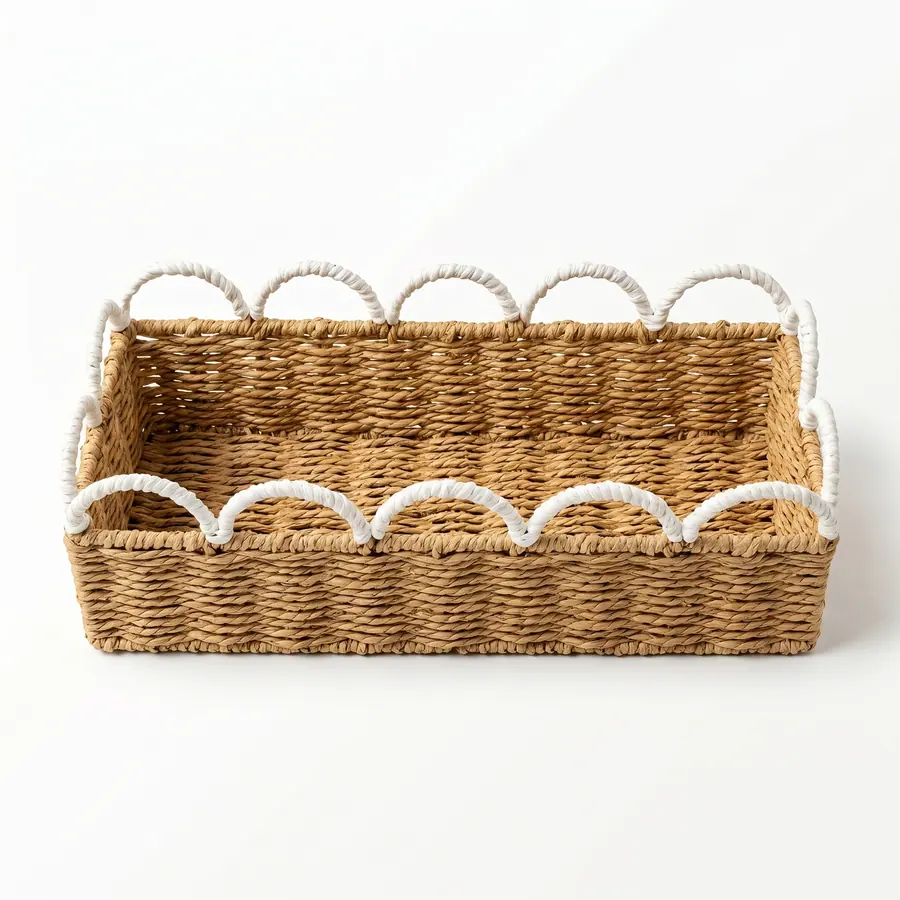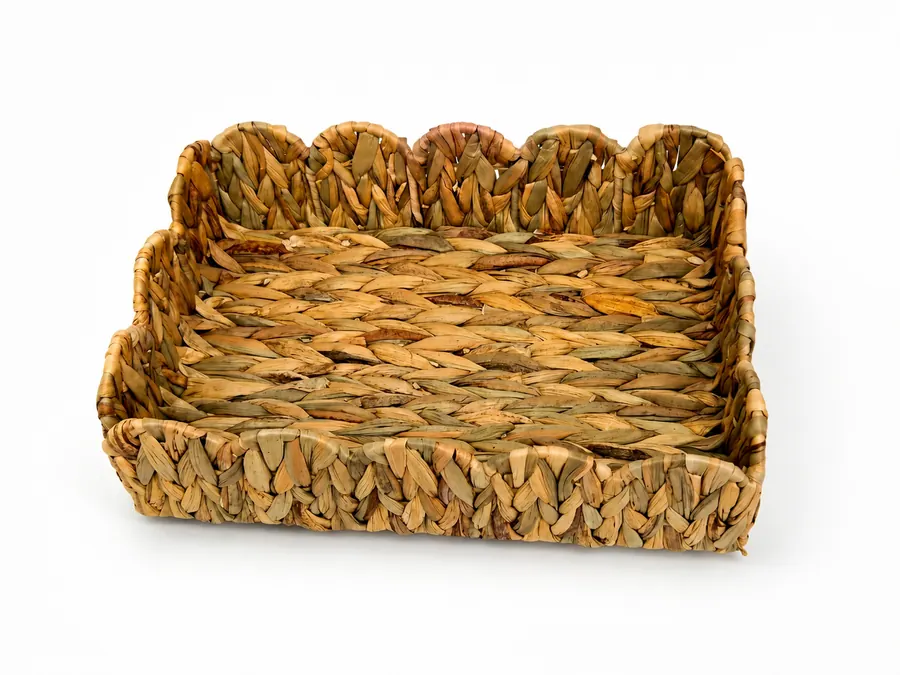
Buyers should verify water hyacinth as a finished basket system, not treat the plant-based material name as proof of texture, strength, or moisture performance. Approve the visible material range, the way it is prepared and woven, the supporting frame and base, the intended use, and the complete packing route. Any strength or moisture requirement must have a method and an acceptance rule for the exact design.
This distinction matters because a water hyacinth tray, lidded basket, open organizer, and framed storage bin can place the material under different demands. A coarse natural surface may be central to one retail concept but unacceptable near delicate contents in another. A substantial rim may help define the look yet create a pressure point when products are nested. The current product collection can show possible forms, but a buyer must still define which material and construction characteristics belong to the order.
1. Approve a texture range, not a single close-up
Texture is often the reason to choose water hyacinth, so it should be specified with more care than a word such as rustic or chunky. Review full-product images and close views of the side wall, base, rim, corners, handles, lid, and any transition to another material. Record the approved relationship among strand width, visible flattening or roundness, weave pattern, spacing, surface fibers, color range, and end finishing.
One photograph can mislead if it shows only the most even area. Ask for several views of the actual sample and, where useful, a small range showing acceptable natural appearance. Separate intended character from defects. For example, visible color movement may be part of the approved look, while sharp protruding ends, a loose termination, exposed support, or an uneven rim may be rejected. The buyer should define these distinctions rather than asking for “natural but consistent.”
Texture must also be evaluated against use. A tray holding packaged goods, a shelf basket touching textiles, and a floor basket used for general storage may need different surface criteria. Identify contact surfaces and decide whether a lining, smoother inner treatment, or protected rim is required. This is a design choice to confirm at sampling, not a universal property of the material.
2. Separate the woven surface from the supporting structure
The visible water hyacinth does not explain the whole basket. Document the internal frame where used, base support, rim core or wrapping, wall construction, handle reinforcement, lid support, lining, and attachment methods. A basket that appears thick in a photograph may obtain its shape from a frame, from the weave, or from both. Buyers need that distinction when comparing samples or considering a later change.
Ask for section details or close photographs at structural transitions. The base-to-wall junction affects stability and usable space. The rim influences opening shape, nesting, and hand contact. Handles change the load path. A lid adds alignment and repeated-use questions. If another material is used for stitching, wrapping, or reinforcement, identify it and include it in the approval record.
Dimensions should state measurement points and basket condition. Record outside size, usable inside size where relevant, base footprint, opening, wall height, handle drop, lid overlap, and nesting clearance. For irregular or flexible areas, explain how the product is placed and measured. Do not convert a handmade form into an unexplained tight tolerance; classify critical fit dimensions separately and agree on project-specific ranges after sample review.
3. Define strength as a use case and check method
“Strong” is not an actionable specification. A buyer may mean that the base should not sag with specified contents, the handles should support carrying, the rim should keep its form, the walls should withstand normal stocking, or the basket should recover after the approved pack-out. Each meaning involves a different construction and check.
Write the intended contents and handling sequence first. If a functional check is needed, define sample condition, load or action, duration or repetitions where relevant, observation points, acceptance result, and responsible party. Do not copy a load value from another size or material. A larger basket, different frame, alternate handle, or revised weave may need a separate decision even when the visual concept is unchanged.
Use observable failure language. Depending on the project, the buyer may need to review permanent base change, handle movement, loose wrapping, broken strands, rim distortion, rocking, lid interference, or a loss of shelf fit. These are examples of what to define, not preapproved universal defects or thresholds. The final list should come from the intended use and approved design.
| Buyer question | Weak instruction | Better project input |
|---|---|---|
| Can it be carried? | “Strong handles” | Intended contents, lifting method, check sequence and acceptance observations |
| Will it fit a shelf? | “Standard size” | Critical outside and usable dimensions with measurement points |
| Will the base hold shape? | “Reinforced base” | Proposed base construction and agreed check under intended use |
| Will it nest safely? | “Pack efficiently” | Nesting sequence, contact points, separators and post-pack shape review |
4. Build a moisture plan around each handoff
Water hyacinth baskets should have a project-specific moisture-control plan because the relevant exposure can occur at several handoffs. Map material storage, component preparation, weaving, finishing, finished-goods holding, packing, loading, transit, destination warehousing, retail storage, and intended consumer environment. Not every project needs the same checks, but every project should identify where moisture-related risk is owned.
If the buyer requires a measured condition, define the instrument, location, sample basis, timing, threshold, and action for an out-of-range result. If the control is observational, define unacceptable odor, visible spotting, staining, transfer, softening, or shape change and explain when the observation occurs. A general statement that goods are dry is not enough when neither the method nor acceptance point is known.
Avoid sealing unresolved moisture inside the pack. Packing approval should show when products are ready to pack, how inner protection is applied, whether units are nested, how air and contact surfaces are managed, and when cartons are closed. Any desiccant, barrier, ventilation, or conditioning choice must be confirmed for the actual product, route, carton, and destination rather than prescribed as a universal recipe.
The detailed guide to packing natural-fiber basket shipments against moisture can help structure route questions. The product specification should still state the controls selected for this order and who verifies them.
5. Review nesting, compression, and surface contact together
A water hyacinth basket may occupy significant carton volume, which makes nesting attractive, but nesting changes the risk profile. Thick rims, high texture, handles, lids, and irregular contact points can rub or concentrate pressure. A pack that saves space but changes shape or damages the approved surface is not an acceptable optimization.
Request a complete pack-out trial. Record the nesting order, orientation, separator or sleeve, protection at rims and handles, pieces per carton, carton dimensions, closure, and any allowed compression. Photograph the first unit, intermediate nesting steps, full inner pack, and closed carton. After the agreed holding or handling check, remove the units and compare shape, rim, surface, lid fit, and separation marks with the approved reference.
Retail and parcel routes may require different evidence. The buyer should define the expected distribution route and decide whether the export carton, retail pack, or both need a project-specific handling check. Packaging labels and care statements should also be reviewed against the real product and market; a generic natural-material statement does not replace handling instructions.
6. Turn sample approval into a repeatable evidence set
The sample record should preserve more than one attractive hero image. Include the material reference, full views, detail views, dimensions, weight if relevant to the quotation, construction notes, appearance range, functional checks, packing sequence, and all approved corrections. Give the record a revision number and date so later photographs and comments cannot be attached to the wrong version.
Use three outcomes: approve; approve with specific corrections and a named verification step; or revise and resubmit. Do not approve while leaving critical material identity, dimensions, functional method, color range, odor concern, or pack-out unresolved. If a correction can be checked by photo, state the required view. If it requires a physical sample or test, state that instead.
Production evidence should mirror the approval record. Ask for representative full-product views, critical measurements, material and finishing details, packing steps, and records from any agreed checks. The factory quality-control overview can support this planning, while the order documents remain the authority for acceptance.
7. Use a buyer verification checklist before quotation approval
A useful quotation should answer these points or identify them as open:
- exact water hyacinth material reference and any other visible or structural materials;
- approved texture, strand, color, weave, spacing, and finishing range;
- frame, base, rim, handles, lid, lining, and attachment construction;
- outside and usable dimensions, measurement points, and critical fit ranges;
- intended contents, handling, and any defined functional check;
- moisture-control points, method, acceptance rule, responsibility, and evidence;
- nesting order, surface protection, carton arrangement, and post-pack review;
- label, care, retail packing, and export marking requirements;
- sample stages, correction handling, retained references, and production evidence;
- quotation assumptions, exclusions, quantity basis, packing basis, and timing start point.
Blank answers should not be interpreted as confirmation. Ask the supplier to mark “as specified,” propose an alternative, or state that evidence is still pending. This makes uncertainty visible before price and launch timing depend on it.
8. Release the RFQ with explicit decision gates
The first gate is feasibility: can the proposed construction deliver the intended appearance, size, use, and packing route? The second is material and construction approval. The third is sample performance and pack-out. The fourth is commercial release after all assumptions and exceptions are written. A change after any gate should return to the affected review rather than inheriting an unrelated approval.
Send front, side, base, rim, handle, lid, and interior references; annotated dimensions; quantity by SKU; intended use; appearance criteria; checks; labels; and packing route. Ask the supplier to return proposed construction, sample plan, moisture controls, pack-out, evidence, and exceptions. Submit the final package through the basket sourcing RFQ form.
A buyer does not need to eliminate the natural texture that makes water hyacinth appealing. The goal is to define which texture belongs to the design, which structure supports the use, and which moisture and packing controls protect the approved result. That creates a repeatable purchasing decision without turning a plant name into an unsupported promise about strength or durability.