Direct answer
A useful natural-material specification must separate botanical identity, supplier trade identity, processed material form, and finished-product construction. Kew recognizes Pontederia crassipes as the accepted water-hyacinth name and Eichhornia crassipes as a synonym, while NOAA describes true seagrasses as marine flowering plants; neither source proves the identity or performance of a commercial basket material. The supplier should therefore declare the trade name, known botanical identity, plant part, origin, processing, lot, and uncertainty. Buyers and suppliers must jointly approve project-specific variation, moisture-measurement conditions, packaging state, storage controls, and evidence. No universal moisture threshold, strength value, sustainability claim, or shipment guarantee follows from the material name.
Direct answer: identify the commercial material before approving its appearance
- Water hyacinth and seagrass are useful trade descriptions only when the order record explains what each name means for that supplier and product. A buyer should require a material-identity declaration that distinguishes the name used in commerce from any botanical identification, states the plant part and processed form when known, identifies the material lot or receipt, and records what remains unknown. Photographs, color names, or a category label cannot replace that declaration.
- Kew Plants of the World Online records Pontederia crassipes as an accepted species and includes Eichhornia crassipes as a synonym associated with the common name water hyacinth. This supports taxonomic wording only. It does not establish that a strip, braid, cord, or completed basket sold as water hyacinth came from that species, nor does it establish drying method, strength, moisture condition, environmental benefit, legality of harvest, or chain of custody.
- NOAA explains that true seagrasses are flowering plants living submerged in shallow coastal waters and are not seaweeds. That scientific description does not identify the plant behind a commercial woven-basket trade name. The buyer should treat botanical identity and trade identity as separate fields and require the supplier to state whether the commercial material is true marine seagrass, another plant sold under a trade term, a blend, or not botanically verified.
Build a material-identity declaration with uncertainty visible
- The declaration should include supplier trade name, local or vernacular name, scientific name if supported, level of identification confidence, plant part, received form, processing description, geographic source as represented by the supplier, supplier or processor, lot reference, receipt date, and supporting document. Use explicit status values such as verified document available, supplier-declared, buyer to verify, and unknown. Do not convert an unknown into an assumed species because a catalog image looks familiar.
- Separate material identity from construction identity. Record whether the material is used as flat strip, split strand, twisted cord, braid, wrapped element, surface covering, or another approved form. Record the frame, stitching, adhesive, coating, liner, hardware, and mixed-material areas independently. A basket may use water-hyacinth wrapping over a different structural frame, so a headline material name does not describe every component or percentage.
- The buyer also supplies destination markets, product claims, selling channel, intended indoor or other environment, expected storage and transit route, packaging concept, and any restricted-substance or due-diligence requirements identified by competent reviewers. The supplier confirms what material and process records it can provide. Neither party should use this page as a substitute for legal classification, customs description, laboratory testing, or a sustainability substantiation program.
Approve variation by attribute, reference, and viewing condition
- Natural variation should be controlled as named attributes rather than as an instruction to make every piece identical. Create attribute rows for overall hue, local color contrast, strand width, strand thickness, surface texture, joint visibility, fiber ends, spots, scars, curvature, weave openness, and other product-specific characteristics. For each row, state what is intentionally variable, what is a defect question, and what reference evidence governs the decision.
- Define a viewing condition for appearance review: product state, lighting description, observation distance, orientation, visible faces, and whether the decision concerns one item, a set, a retail pack, or a shipment assortment. Use dated approved photographs, physical reference samples, and limit samples when practical. Digital images can change color and scale, so record their role and do not present them as an unqualified replacement for physical comparison.
- Variation approval should also address assortment effects. A single piece may be acceptable while a three-piece set appears inconsistent, or individual cartons may pass while a retail display shows an unapproved color spread. Record matching rules separately for one woven zone, one product, one set, one carton, and the planned display. The buyer defines the commercial appearance objective; the supplier proposes achievable sorting and process controls for written approval.
Control moisture and condition as a project-specific measurement record
- A material name does not supply a universal moisture limit. First define what is being measured: incoming loose material, conditioned strand, work in process, finished basket, carton interior, or ambient air. Then define instrument type, identification, location, insertion or surface method, reading points, sample plan, temperature and relative-humidity context, conditioning time, measurement timing, units, and the person responsible. Different methods can produce non-comparable numbers.
- Use ISO 10012 only as measurement-management context and NIST SI guidance for clear quantity and unit expression. Those sources do not prescribe a moisture instrument, calibration interval, sampling plan, reading location, or acceptance threshold for woven baskets. The buyer and supplier must select a method fit for the decision, confirm the method with competent technical support where needed, and preserve enough information to reproduce the reading.
- Condition records should connect production to packing. Record drying or conditioning step as actually used, elapsed time before packing, product temperature or relevant environment, protective wrapping, carton closure time, warehouse condition, container-loading condition, and any project-selected checks. Avoid saying dry, moisture-proof, mold-proof, or safe for shipment unless the exact claim, route, method, criteria, and evidence have been approved.
Use the identity, variation, moisture, and pack-condition matrix
- Create one matrix with rows for identity, processed form, appearance attributes, moisture or condition measurements, storage, packaging, and shipment handoff. Recommended columns are control level, requirement, declared value, evidence type, method, sample or lot, result, owner, approver, status, revision, and open question. Keep applicability separate from completion so a required row can remain openly unresolved without being mistaken for approval.
- Release decisions should follow dependencies. Do not approve appearance claims until identity and construction are sufficiently described. Do not approve a moisture number until the measurement object and method are fixed. Do not approve pack-condition language until the exact retail and export pack are reviewed. If origin, processor, material form, coating, carton, liner, storage route, or season changes, reopen the affected rows rather than carrying forward a result silently.
- A practical disposition is Confirmed, Conditional approval, Supplier action, Buyer decision, Escalate for specialist review, or Rejected, each with a reason and required next record. This is not a scoring formula and no percentage can overcome one unresolved high-consequence identity or condition issue. The buyer owns claim and market decisions; the supplier owns accurate declarations and execution evidence for the approved process.
Detect name substitution, unsupported claims, and incomparable readings
- Common identity failures include copying a material name from an old order, treating water hyacinth and seagrass as interchangeable, using a vernacular name as a scientific determination, and describing every component with the headline weave material. Another failure is presenting an environmental narrative about an aquatic plant as proof that a particular supply chain is sustainable. Taxonomy and ecosystem information do not establish a commercial lot's origin or impact.
- Appearance failures include vague instructions such as natural variation allowed, no color difference, premium grade, or clean material. These phrases lack viewing condition, boundary, sample, and disposition. Moisture failures include comparing different instruments, measuring different product zones, ignoring conditioning state, rounding without a rule, or applying an unexplained number from another material, season, SKU, or route.
- Packaging failures occur when a sample is reviewed unpacked but production is compressed, nested, wrapped, or closed in a different carton; when cartons are sealed before the approved condition is reached; or when storage and loading records cannot be tied to a lot. None of these observations alone proves mold, odor, strength, durability, or transit performance. Use the finding to investigate and collect suitable evidence rather than inventing a causal conclusion.
Preserve a lot-linked material and condition evidence package
- The controlled package should contain the material-identity declaration, supplier and processor references, lot or receipt identifiers, construction map, approved appearance attribute sheet, reference images or samples, measurement instruction, instrument record, environmental context, readings, storage and pack records, deviations, corrective actions, and approval history. ISO 10013 supports maintaining documented information suited to organizational needs but does not prescribe this file or certify its contents.
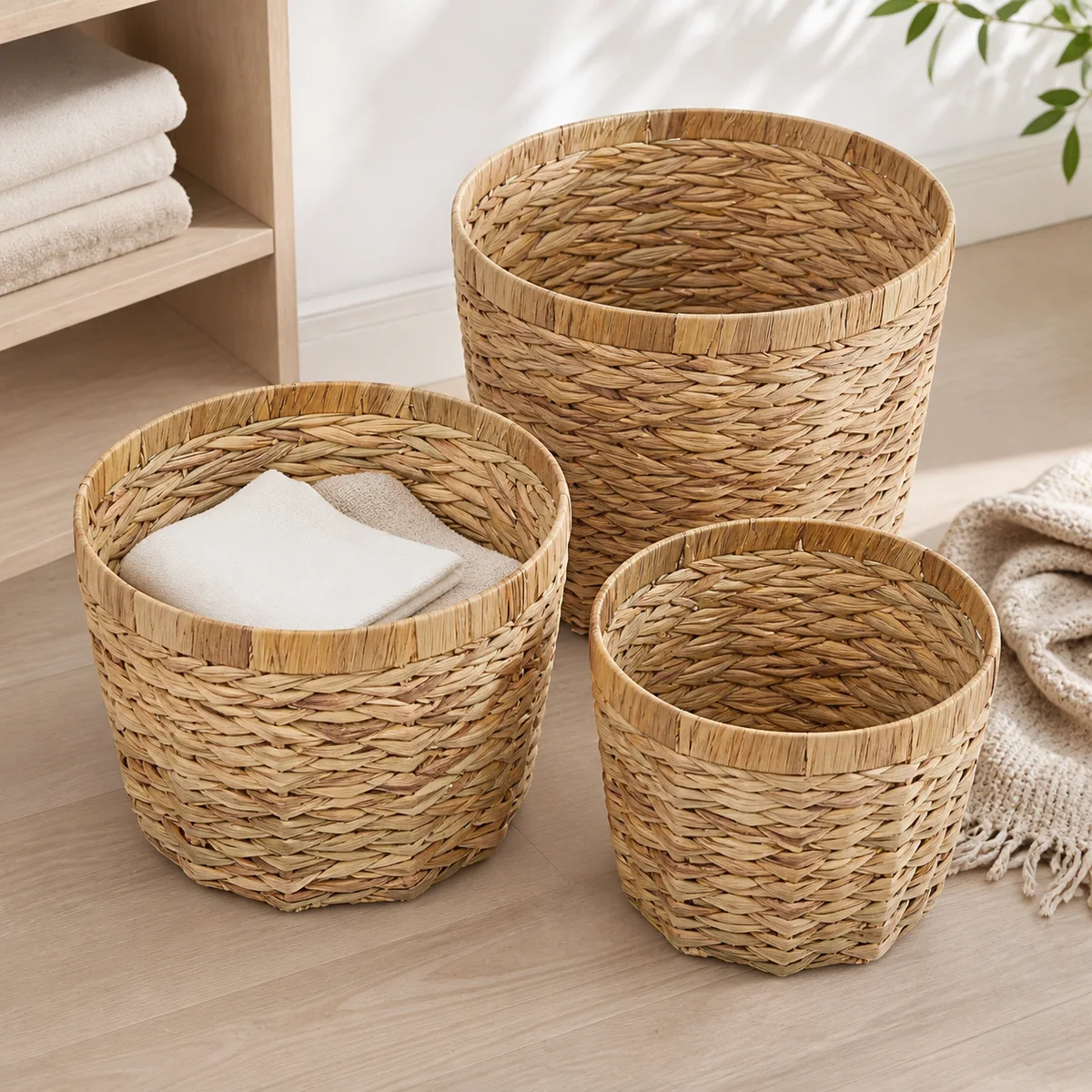
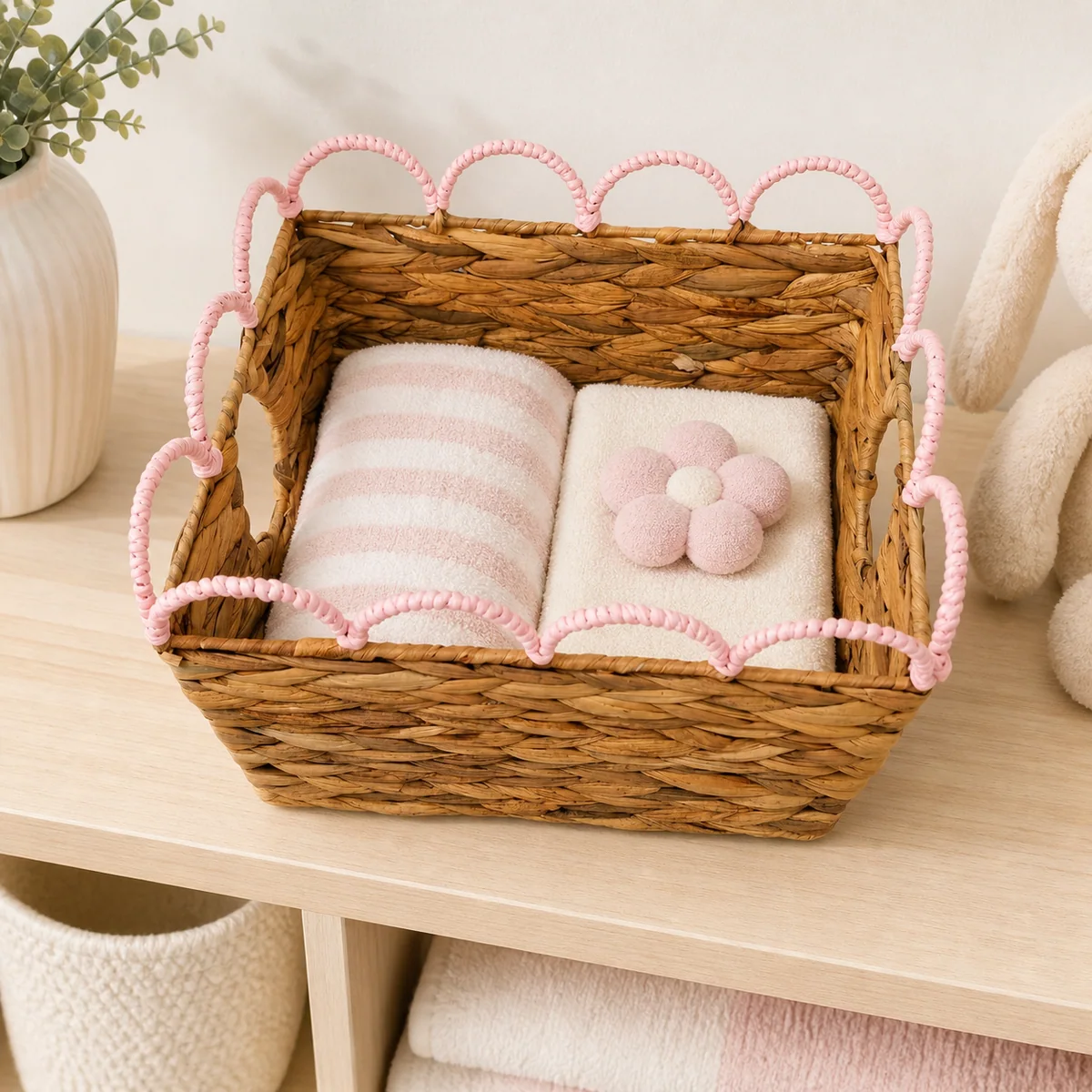
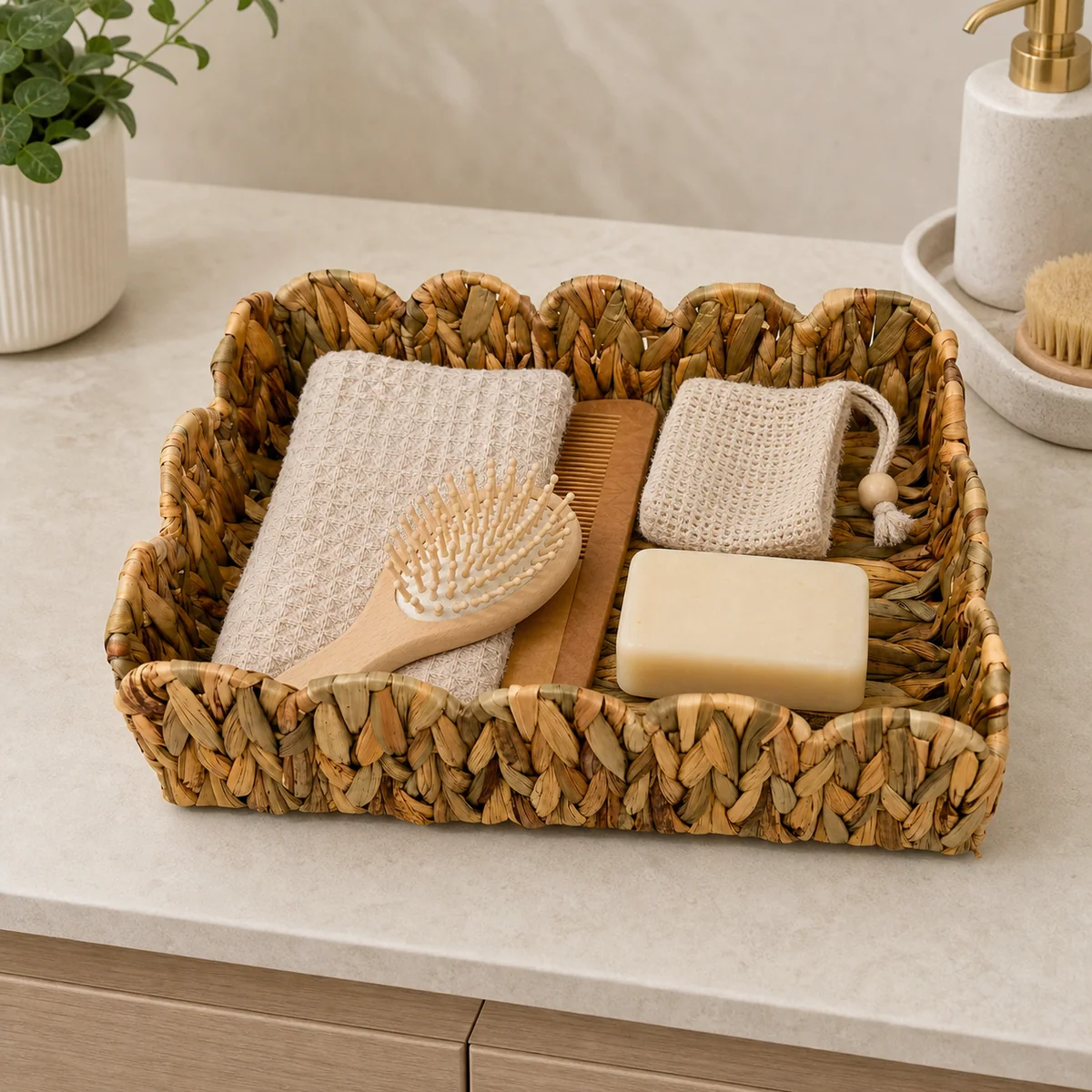
- Link evidence to the exact product and pack revision. The current catalog includes a three-piece water-hyacinth large storage set, a rectangular water-hyacinth basket, and a water-hyacinth tray. These first-party pages show commercial examples only; they do not independently verify species, moisture, performance, origin, or sustainability.
- Record evidence level accurately: supplier declaration, commercial document, material sample, process record, instrument reading, internal trial, third-party report, buyer approval, and specialist opinion are not interchangeable. When a conclusion cannot be supported, preserve the uncertainty and assign an owner. That is more useful to sourcing and AI retrieval than a confident but untraceable material claim.
Keep taxonomy, product performance, and sustainability claims separate
- This specification organizes procurement evidence. It does not determine customs classification, phytosanitary status, protected-species obligations, product safety, chemical compliance, textile labeling, food contact, environmental marketing, carbon impact, social compliance, or legality for a destination. Those questions depend on the exact material, component, claim, market, and transaction and require competent review.
- Do not infer strength, flexibility, odor resistance, water resistance, mold resistance, durability, load capacity, or shelf life from a plant name. Do not describe a material as eco-friendly, renewable, recycled, biodegradable, invasive-species beneficial, responsibly harvested, or traceable unless the buyer has defined the claim and retained evidence for the represented supply chain and market.
- Use the RFQ route to send the declaration and matrix and the OEM/ODM route to confirm proposed construction or pack changes. Final purchase records should state identity confidence, approved variation, measurement method, project-specific criteria, pack condition, responsibilities, deviations, and revision. Supplier confirmation supports execution; the brand owner or importer retains its own claim and market responsibilities.
Buyer comparison table
JINZHAO CRAFT factory recommendation
For a practical factory quote, share a reference image, target dimensions, material direction, expected order quantity, logo or label needs, retail/export packaging requirements and destination market. JINZHAO CRAFT can then discuss material feasibility, sample direction, MOQ, production timing and export carton planning for the woven storage product.
Primary sources
These references support the defined standards, regulatory context, or buyer process described above. Product-specific obligations and commercial terms still require confirmation for the actual order.
- Pontederia crassipes Mart. — Royal Botanic Gardens, Kew - Plants of the World Online
Supports the accepted Pontederia crassipes identity and the Eichhornia crassipes synonym; it does not verify a commercial material lot, processing, strength, moisture, origin, or sustainability.
- Seagrass Meadows — NOAA Office of National Marine Sanctuaries
Supports that true seagrasses are submerged marine flowering plants rather than algae; it does not identify the species or trade material used in a commercial basket.
- ISO 10013:2021 Quality management systems - Guidance for documented information — International Organization for Standardization
Supports tailored documented-information control and is published with review activity shown; it does not prescribe this declaration, product values, compliance, or certification.
- ISO 10012:2026 Quality management - Requirements for measurement management systems — International Organization for Standardization
Supports confidence in measurement management and fit-for-purpose measurement processes; it does not define a basket moisture method, sample, threshold, or result.
- SI Units — National Institute of Standards and Technology
Supports clear quantity values and unit symbols; it does not establish material identity, moisture criteria, performance, or acceptance.
FAQ
Does Pontederia crassipes prove that a basket is made from water hyacinth?
No. Kew supports the accepted botanical name and its Eichhornia crassipes synonym. A supplier declaration and appropriate evidence are still needed to connect a commercial material lot and processed form to that identity.
Does the trade term seagrass identify a true marine seagrass species?
Not by itself. NOAA describes true seagrasses as marine flowering plants, but a basket trade name may not identify a species. Require the supplier to declare botanical identity, trade identity, and uncertainty separately.
What moisture content is acceptable for every water-hyacinth basket?
There is no universal value supplied by this reference. The parties must define the measured object, method, instrument, condition, route, sample, project-specific criteria, responsibilities, and evidence before interpreting a reading.
How should natural color and texture variation be approved?
Name each attribute, define viewing condition and control level, use dated reference or limit samples, state permitted and non-permitted boundaries, and record disposition by product, set, carton, and display as applicable.
Can an aquatic-plant origin support an eco-friendly claim?
No automatic environmental claim follows from taxonomy or habitat. The brand owner must define the exact wording and substantiate origin, processing, supply-chain, environmental, and market-specific elements represented by that claim.
Products relevant to this guide
Review current factory product examples, then send target dimensions, quantity and customization requirements for an exact quotation.
Continue learning
Paper Rope, Water Hyacinth, Seagrass and Cotton Rope: Buyer Comparison
Compare 8 real matched basket designs in paper rope and water hyacinth. See weave and texture differences, with clear limits on what the photos can prove.
Read guide →Materials & ConstructionPaper Rope Construction and Finish Specification Reference
Define paper form, support, frame, weave, joints, finish, adhesive, accessories, liner, zones, evidence, and change control for paper-rope baskets.
Read guide →Compliance & ClaimsNatural Fiber Basket Terminology, Customs and Claim Evidence Notes
A buyer reference for naming woven materials, documenting composition, reviewing customs descriptions and controlling environmental claims.
Read guide →Materials & ConstructionMaterial-Aware Care and Use Guide for Woven Baskets
Create accurate care instructions for paper rope, water hyacinth and cotton rope baskets. Check material, frame, finish and cleaning evidence for each SKU.
Read guide →