Before releasing a paper rope basket order to production, buyers should obtain one versioned acknowledgment that reconciles the purchase order with the approved quotation, product specification, sample, quantity matrix, artwork, packaging, delivery rule, named place, and payment record. Every mismatch should be listed as an exception with an owner and closure evidence; silence, a deposit receipt, or an unqualified ‘confirmed’ message is not a controlled release.
1. What is a purchase order acknowledgment supposed to do?
A purchase order acknowledgment is an operational reconciliation gate. It should show what the supplier understands it has been asked to make and deliver, which buyer records control that understanding, which fields the supplier accepts, and which fields remain open. It is more useful than a message saying only “PO received” because the buyer can compare the acknowledged order against the files that were approved before production.
Keep the commercial and legal effect separate from the control function. Applicable law, contract language, prior dealings, and the parties' conduct can affect whether and when an agreement is formed. The United Nations Commission on International Trade Law explains that the CISG can govern some international sales contracts and covers formation through offer and acceptance, while some matters remain outside its scope. Buyers should therefore have responsible commercial or legal reviewers decide the contract effect for the actual transaction. This article provides a reconciliation method, not a legal conclusion.
The acknowledgment should identify the buyer, supplier, purchase-order number, issue date, currency, acknowledged revision, supplier order reference, and the person authorized to close exceptions. It should also state that production release is separate from receipt of the PO. A record can be acknowledged while artwork, sample, label data, quantity, or delivery details remain on hold.
2. Which records must be reconciled before acknowledgment?
Start from a controlled order index rather than an email thread. The index should list the current purchase order, approved quotation, proforma invoice if used, product specification, drawings, color or material references, approved sample record, artwork, barcode and label data, pack-out, carton marks, inspection requirements, and delivery instructions. Record the filename, revision, date, and owner for each item.
The proforma-invoice reconciliation guide covers the buyer's review before payment. The purchase order acknowledgment is a later and distinct gate: it confirms that the supplier's accepted order record still matches those approved inputs after the PO is issued. If the PI, PO, and acknowledgment show different quantities, product revisions, or delivery bases, do not choose one silently. Put the conflict on the exception list.
Use the woven product RFQ data dictionary to check whether the original request defined the sellable unit, intended use, dimensions, materials, variants, labels, packing, evidence, and commercial inputs clearly enough to carry into the order. Missing fields should remain open. An acknowledgment should not convert an assumption from the quotation stage into an approved production requirement.
3. How should SKU, set quantity, and variant identity be written?
Write one order line for every buyer SKU and controlled variant. Each line should state the buyer SKU, supplier item reference, product name, material description, color or variant code, sellable-unit definition, components per unit, ordered quantity, unit of measure, and the specification revision. If a basket is sold as a set, distinguish sets from individual pieces and show the conversion. A line saying “400 baskets” is not precise when the actual selling unit contains two sizes.
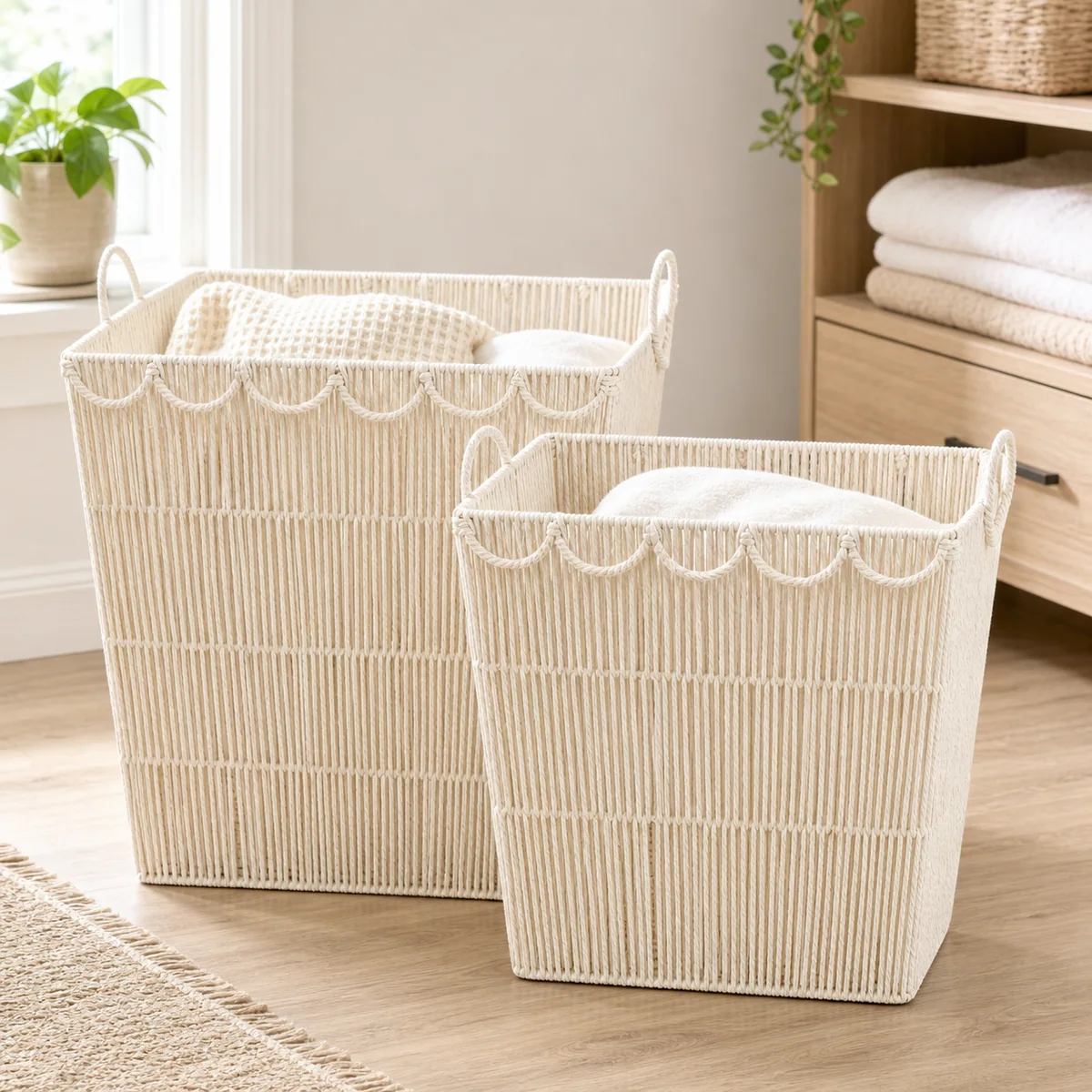
The current JZ20053 two-piece paper rope laundry basket set illustrates the identity problem. Its CMS record describes a natural-white rectangular two-piece nested set with side loop handles and separate large and small dimensions. Those facts can identify the reference product and the two-component set basis. They do not establish a buyer's ordered quantity, acceptable tolerance, packing ratio, price, MOQ, sample timing, lead time, or production release. Those fields still require project-specific agreement.
For mixed colors or sizes, add a quantity matrix beneath the order line. Reconcile the matrix total to the PO total and then reconcile pieces to complete sellable units. State whether spare components, display samples, replacements, or approval samples are included in the commercial quantity or listed separately. This prevents a correct grand total from hiding the wrong assortment.
4. How should revisions, substitutions, and deviations be controlled?
The acknowledgment should name the exact revision of every controlling file. Do not rely on “latest version,” because buyer and supplier folders may not contain the same latest file. If the supplier cannot follow a field, it should propose a documented exception that states the affected SKU, current requirement, requested change, reason, impact on linked files, and evidence needed for review.
Use the golden-sample and change-control standard when a requested change affects the approved product baseline. A substitution in material, braid, color, handle, component, dimensions, label, packaging, or pack-out should not enter production because it appeared in an acknowledgment note. The authorized buyer must approve, reject, or condition the change, and the release record must identify which sample or digital evidence now controls.
Keep concessions narrow. Approval for one order, lot, color, or component does not automatically revise the master specification or future repeat orders. State scope, expiry, affected quantity, verification method, and whether the approved sample or specification is updated. If the exception is rejected, the acknowledgment should return to the original requirement or the order should remain on hold.
5. Which commercial and delivery fields belong in the acknowledgment?
Reconcile currency, unit price, sellable-unit basis, quantity, line total, tooling or sample charges if applicable, packaging inclusions, payment milestone, delivery rule, named place, requested shipment or handover window, document requirements, and the parties responsible for approvals. Do not use a unit price without showing whether it applies to one basket, one nested set, one carton, or another basis.
When an Incoterms rule is used, record the selected rule, named place or port, and the referenced edition exactly as agreed. The International Chamber of Commerce describes Incoterms rules as standards for delivery terms that clarify tasks, costs, and risks between seller and buyer. They do not replace the rest of the purchase record. Product identity, quantity, price, payment, specification, documents, inspection, remedies, and applicable-law questions still need their own agreed treatment.
Commercial dates should be conditional where approvals are still open. Do not present an unconfirmed production or shipment date as a fixed commitment. Instead, identify the scheduling input, the open dependency, the party who must confirm it, and the event that starts the agreed timeline. The supplier can acknowledge a requested date while marking it pending; the buyer then decides whether to accept a revised plan or keep the order on hold.
6. What acknowledgment table should buyers use?
Use one row per control family and link every status to evidence. “Confirmed” should mean the comparison was completed against a named record, not that the field appeared somewhere in an email.
| Control family | Buyer record | Supplier acknowledgment | Release evidence | Status |
|---|---|---|---|---|
| Order identity | PO number, revision, buyer and supplier entities | Supplier order reference and acknowledged revision | Matching order cover sheet | Match, mismatch, or open |
| Product line | Buyer SKU, supplier item, material, color, specification | Exact line-item identity and controlling revision | Specification and approved sample reference | Match, exception, or open |
| Quantity basis | Sets, pieces, variants, ordered unit and totals | Quantity matrix and unit conversion | Reconciled line and order totals | Match, mismatch, or open |
| Labels and packing | Artwork, barcode data, pack-out and carton-mark revision | Files and inclusions supplier will use | Approved proofs and packed-sample record | Approved, pending, or exception |
| Commercial basis | Currency, unit basis, charges and payment milestone | Accepted values and exclusions | Reconciled PO, quote and payment record | Match, mismatch, or open |
| Delivery basis | Rule, named place, edition, requested window and documents | Accepted basis and stated scheduling dependencies | Versioned delivery line and owner confirmation | Confirmed, pending, or exception |
| Quality evidence | Inspection plan, defect rules and required records | Evidence supplier will provide before release | Approved plan and named evidence owner | Approved, pending, or exception |
| Open items | Exception ID, decision owner and due condition | Supplier response and proposed closure | Written buyer disposition and revised record | Open or closed |
Do not delete superseded versions. Mark them superseded, retain the approval trail, and keep one current order index. If the acknowledgment is revised, the change log should state what changed and why so that production, quality, packaging, logistics, and finance teams do not work from different baselines.
7. When is the order ready for production release?
Release only when the buyer's named authority can answer yes to a short checklist:
- The PO and supplier acknowledgment identify the same buyer, supplier, order, currency, and revision.
- Every SKU and variant has one sellable-unit definition, component count, quantity, and controlling specification.
- Samples, drawings, colors, artwork, labels, barcodes, pack-out, and carton marks are approved or explicitly outside the release scope.
- Price, unit basis, charges, payment milestone, delivery rule, named place, edition, and scheduling dependencies reconcile.
- Inspection requirements, evidence owners, hold points, and pre-shipment release authority are named.
- Every exception has a stable ID, responsible decision owner, written disposition, and closure evidence.
- The current files are available to the functions that will make, inspect, pack, document, and pay for the order.
A deposit or other payment can be a commercial milestone, but it should not substitute for technical release. Likewise, an approved sample does not settle quantities, labels, delivery terms, or payment fields. If one gate is incomplete, release only the unaffected scope when the parties' authorized process allows it and the boundary is documented. Otherwise keep the order on hold.
8. How should acknowledgment mismatches be closed?
Create an exception register instead of resolving mismatches across separate chat messages. Give each issue an ID, affected SKU or order field, buyer requirement, supplier response, evidence link, owner, date, and disposition. Use clear states such as open, buyer review, supplier evidence required, approved with scope, rejected, or closed in revision. Avoid “noted” because it does not show whether production may proceed.
If the supplier proposes a different commercial or technical field, compare the impact across the linked order records. A changed set composition may alter quantities, labels, carton marks, price basis, pack-out, inspection evidence, and ecommerce data. A changed delivery place may affect responsibilities and costs. The buyer should close the whole dependency chain, not only the sentence that first exposed the mismatch.
Once all release-critical exceptions are closed, issue or approve one final acknowledgment revision and archive the superseded version. For a new program, use the RFQ route to send the controlled brief and references. The production-release file should remain available for later pre-shipment inspection, receiving reconciliation, invoice review, and repeat-order revalidation without implying that it assures production performance or legal outcome.
Frequently asked questions
Is a purchase order acknowledgment the same as a contract acceptance?
Not necessarily. The legal effect depends on the applicable law, contract terms, communications, prior dealings, and other transaction facts. Use the acknowledgment as a controlled reconciliation record, and have responsible commercial or legal reviewers determine contract formation and enforceability for the actual order.
Can production start when only the quantity and price match?
Not safely as a general rule. Matching quantity and price does not confirm SKU identity, set basis, specification revision, sample, artwork, labels, pack-out, inspection evidence, delivery details, or open exceptions. The buyer should release only the scope supported by its approved technical and commercial records.
How should a two-piece basket set appear on the purchase order?
State the sellable unit as one two-piece set, identify the large and small components, record the number of sets ordered, and show the piece conversion when it supports packing or inspection. Keep spare or sample pieces separate so they do not distort the commercial set quantity.
Does an Incoterms rule cover product quality, payment, and ownership?
No. ICC explains that Incoterms rules clarify tasks, costs, and risks in delivery. Buyers and suppliers still need separate agreed records for product specification, quantity, price, payment, inspection, documents, remedies, applicable law, and any ownership or title questions relevant to the transaction.
What should happen if one label file is still pending?
Mark the affected SKU and label field as open, identify the required file and approver, and keep labeling or the wider affected release scope on hold. Do not let a generic order confirmation turn an unapproved label into the production baseline. Close the exception with a versioned proof and written disposition.