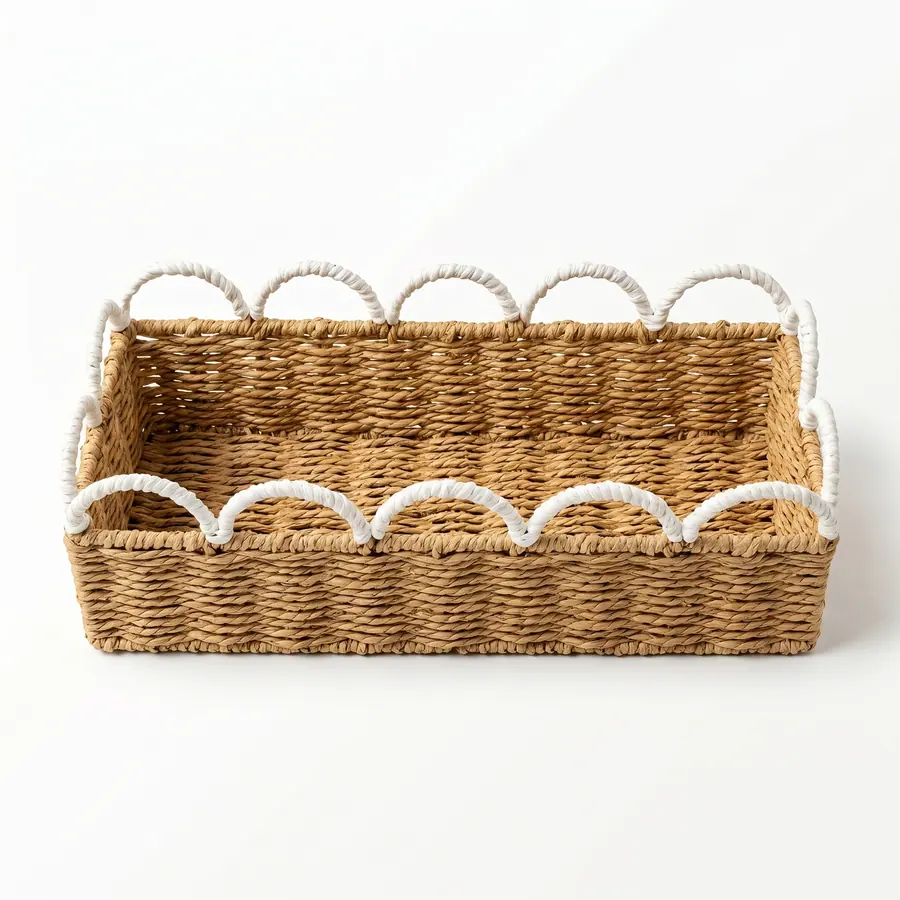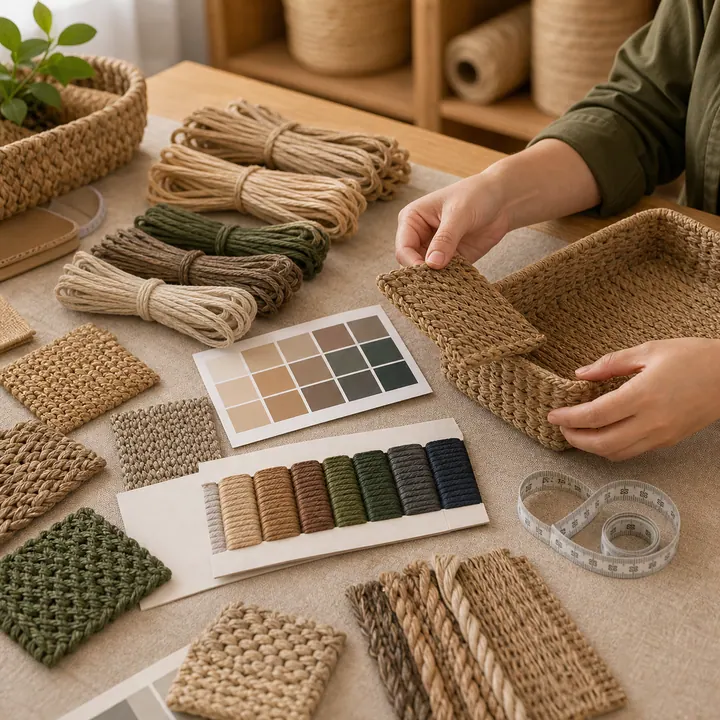
MOQ for a handmade woven basket is the smallest commercially workable quantity for a defined product configuration, not a permanent number attached to every item a supplier makes. The useful buyer question is not simply What is your MOQ? It is Which part of my material, SKU, labor, or packing plan creates the minimum, and what changes would alter it?
A supplier can only answer accurately after the project is defined. The same outer shape may use stock material or a custom color, one weave or several, a standard label or printed retail box, and one SKU or a collection divided across sizes. Each decision changes how materials are prepared, how work is scheduled, and how purchased components are consumed. MOQ therefore belongs to the quotation revision, not to a broad factory description.
Material Preparation Can Set the First Threshold
Ask whether the main material is regularly available in the required specification or must be prepared for the project. Paper rope diameter and color, cotton rope construction, natural-fiber selection, internal frames, liners, and trim materials may each have different purchasing or preparation conditions. Those conditions must be confirmed by the supplier for the exact project.
Do not assume that changing only the color leaves MOQ unchanged. A custom-dyed component may create a separate batch, while a stock color may be combined with other work. Conversely, a material that appears common may still require a specific width, finish, or construction. Request the quoted material description and ask which component establishes the current minimum.
If a substitute is offered, compare appearance, structure, sample requirements, price, and intended use before accepting it. Lowering a quantity by changing the product without documenting the change does not solve the sourcing decision.
SKU and Color Splits Create Fragmentation
Total order quantity is not enough. A 2,000-piece program split across two sizes and one color is operationally different from the same total divided across five sizes, four colors, and two packing formats. Ask for MOQ by SKU and by color, then identify which items can share material, frame, label, or packaging preparation.
Use a simple matrix:
| Variable | Buyer should provide | Supplier should explain |
|---|---|---|
| Size | Quantity by size | Whether frames or weaving setup differ |
| Color | Quantity by component color | Whether colors share or require separate material batches |
| Label | Common or SKU-specific artwork | Purchase or printing basis |
| Pack | Common carton or several retail packs | Minimum purchase and setup by format |
A collection may have a viable total yet still contain one uneconomic variant. That weak SKU should be identified rather than hidden inside an average. The buyer can then consolidate colors, postpone a size, or accept a different component only after reviewing the commercial and assortment effect.
Handwork and Construction Affect Scheduling
Handmade does not mean that any small quantity is automatically efficient. A basket with a simple repeated weave presents a different work plan from one with color changes, shaped corners, wrapped handles, a lid, a fitted liner, or decorative stitching. The supplier should explain which operations are repeated and which require separate setup, instruction, or approval.
Buyers should not ask for a universal labor-based MOQ or assume that more handwork always creates the same threshold. The relevant variables are the exact structure, number of variants, skill sequence, material readiness, quality criteria, and production schedule at quotation time. These are supplier quotation inputs, not facts that can be fixed in a general guide.
Use the OEM and ODM project discussion to decide whether simplifying construction would preserve the product proposition. A lower minimum has little value if the revised basket no longer fits the intended retail use.
Custom Components May Have Their Own Minimums
A basket MOQ and a component MOQ are not always the same. Printed labels, hangtags, barcode stickers, fabric liners, metal badges, retail boxes, inserts, and printed cartons may be purchased from separate processes. Ask the quotation to distinguish the minimum purchase quantity from the quantity actually used in the first order, and state what happens to any approved surplus.
Questions to record include ownership, storage period, identification, reuse on repeat orders, and treatment if artwork changes. Do not assume that unused branded material can be stored indefinitely or applied to another product. The supplier and buyer must agree in writing.
The first-order economics should show sample or setup charges separately from recurring unit cost. This avoids turning every development expense into an unexplained unit-price difference.
Packing and Carton Planning Can Change the Equation
Baskets occupy volume, and pack configuration affects more than freight. A nested set, single-piece retail pack, mixed carton, or e-commerce parcel format can require different protection, labels, cartons, and packing labor. Printed or size-specific cartons may introduce another purchasing minimum, while a shared carton might allow consolidation if it still protects the product.
Ask for pieces per carton, nesting sequence, inner protection, carton style, label scope, and proposed carton dimensions as quote assumptions. Verify them with a packing trial before treating them as final. A low product MOQ paired with an unsuitable or undefined packing method is not a complete offer.
Separate Four Different Quantity Concepts
Buyers should keep these quantities distinct:
- Inquiry quantity: the amount used for an initial price request.
- Commercial MOQ: the supplier's quoted minimum for the defined revision and terms.
- Component purchase minimum: the amount of material or packaging that may need to be procured.
- Order quantity: the quantity the buyer finally commits to by SKU and color.
A non-binding forecast may support planning, but it is not the same as a purchase commitment. State the first order and forecast separately. Ask whether repeat orders can use approved surplus material and whether storage conditions, ownership, or expiry need agreement.
The quote-ready RFQ guide shows how to present this quantity structure without leaving the supplier to guess.
Ask for MOQ Drivers, Not Just Exceptions
When the quoted minimum is above the launch quantity, ask for structured scenarios:
| Scenario | What changes | What must be rechecked |
|---|---|---|
| Consolidate colors | Fewer material batches | Assortment and color approval |
| Share components | Common label, liner, or carton | Brand and fit requirements |
| Reduce SKU count | More quantity per retained SKU | Range architecture |
| Simplify construction | Fewer special operations | Appearance and function |
| Buy surplus components | First order uses part of a purchase batch | Ownership, storage, and artwork risk |
Each scenario should show the revised product specification, MOQ, unit price, extra charges, packing, sample need, and timing. An unsupported promise to make a small trial is less useful than a transparent option whose consequences can be approved.
Compare MOQ on a Common Commercial Basis
MOQ cannot be separated from price and terms. One quotation may include labels, inner protection, export cartons, or development work that another excludes. Currency, payment, quote validity, inspection responsibility, and delivery terms also affect the commitment. The factory quote comparison guide provides the normalization step.
For delivery terms, record the Incoterms rule and named place or port. The International Chamber of Commerce Incoterms page explains that these rules clarify delivery tasks, costs, and risks. They do not determine the basket MOQ, but inconsistent delivery bases can make two MOQ-linked offers look more comparable than they are.
Build a Defensible First-Order Decision
Before accepting MOQ, document:
- the exact product and quotation revision;
- quantities by SKU, size, color, and pack;
- the material or component that sets each minimum;
- shared and non-shared preparation across variants;
- custom component purchase quantities and surplus treatment;
- construction changes proposed to reach another quantity;
- packing assumptions and carton configuration;
- sample, setup, and recurring charges;
- first-order quantity versus non-binding forecast;
- price, payment, validity, inspection, and delivery basis.
Send this structure through the project RFQ form and ask for written scenarios rather than a single unexplained number. For seasonal projects, connect the quantity decision to the backward lead-time plan, because material consolidation or custom packaging may change approval and purchasing gates. The right MOQ is not the lowest number in isolation. It is the quantity basis that preserves the approved product, produces a clear landed-cost comparison, and fits the buyer's launch and inventory plan.