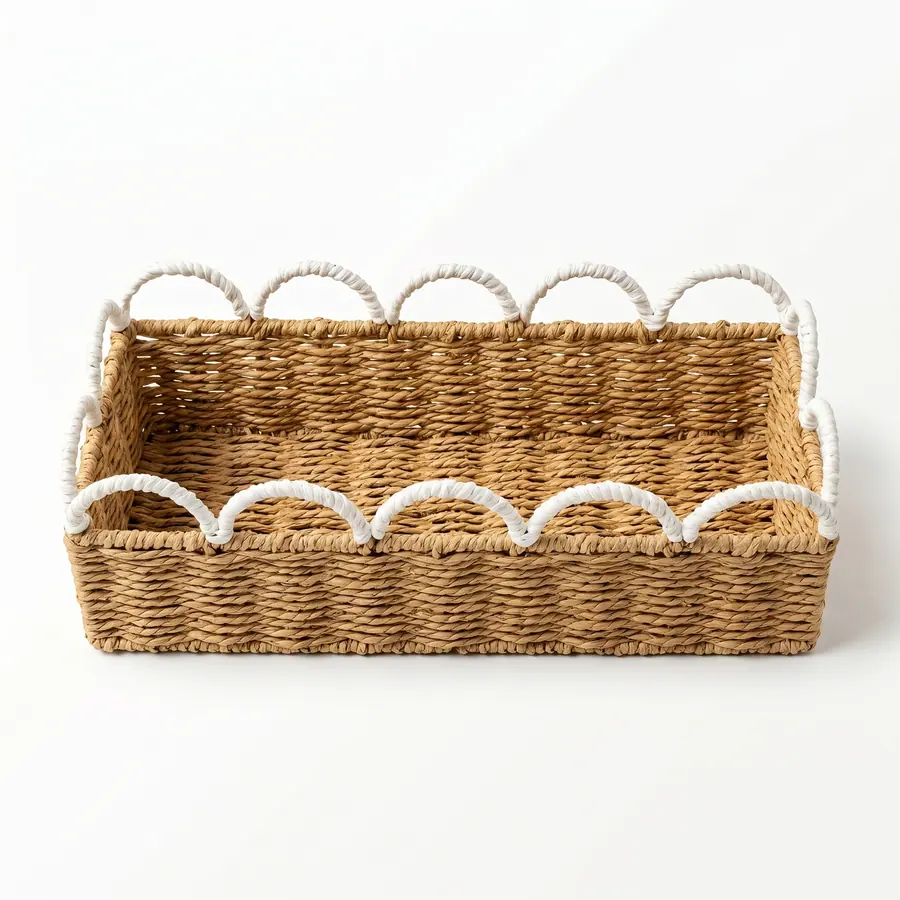
A woven storage basket RFQ becomes quote-ready when every supplier prices the same product, quantity structure, packing scope, and delivery assumption. The fastest useful inquiry is not the shortest email. It is one controlled package that separates fixed requirements from open questions and asks suppliers to identify every assumption.
Start with one RFQ version for all candidates. Give it a date, revision number, buyer contact, response deadline, and SKU list. Keep drawings, photos, quantity tables, packaging files, and commercial instructions tied to that revision. If a requirement changes, issue a new version and request revised quotations. This prevents a price based on an early photo from being compared with a price based on a later specification.
Define the Exact Quotation Unit
State what one quoted unit means. It may be one basket, one nested set, one retail pack, or one mixed assortment. List each SKU, size, color, and pack configuration separately. A request for 3,000 baskets is ambiguous if it could mean 3,000 pieces of one size, 1,000 three-piece sets, or a mixed program divided across several colors.
Give the intended use and any fit constraint. A shelf basket needs external dimensions and usable internal space. A hamper may need a liner and handles intended for lifting. A nested set needs the order of sizes and the required nesting relationship. These are project inputs, not reasons to ask a factory for an unsupported universal tolerance or load value.
Use a quantity matrix instead of prose:
| SKU | Size | Color | Order quantity | Quotation unit |
|---|---|---|---|---|
| A | Small | Natural | Buyer input | Piece |
| B | Medium | Natural | Buyer input | Piece |
| SET-1 | Small + medium + large | Buyer reference | Buyer input | Three-piece set |
Specify Materials and Construction
Name the preferred material family, but also describe the construction visible in the target product. Paper rope, cotton rope, and water hyacinth do not define the frame, weave, rim, base, handle, liner, lid, or decorative trim. Provide close photographs or annotated sketches showing these areas. Mark which features are mandatory and which may be proposed as alternatives.
For every alternative, require a separate explanation of the construction, appearance, MOQ effect, sample need, price, and timing. Do not allow a silent material substitution to sit behind a lower number. If the material is not yet chosen, request two clearly labeled options rather than one blended quotation.
The OEM and ODM development route is useful when the brief still needs product-development input. Even then, the RFQ should define the desired outcome, buyer decisions already made, and deliverables expected from the supplier.
Make Dimensions and Color References Executable
List external length, width, and height with measurement points. Add opening dimensions, base footprint, handle drop, lid overlap, or internal usable space when these affect fit or function. A photo with a ruler helps, but an annotated drawing is the controlling record. Ask the supplier to mark any dimension that cannot be assessed until sampling.
Treat color as a component specification. Identify the body, trim, stitching, liner, handle, label, and packaging colors separately. State the reference format available, whether a physical sample will be sent, the viewing conditions for approval, and who will approve it. Acceptable variation must be decided for this material and project after representative samples are reviewed; it should not be copied from an unrelated order.
The article on documenting handmade product color requirements provides the color-control step that belongs behind the short RFQ entry.
Expose the Quantity and MOQ Structure
Ask each supplier to state MOQ by SKU, size, color, material batch, and packaging component. Also request the reason for each binding minimum. One project may be constrained by material preparation, another by a custom frame, a printed label, a retail box, or the way quantities are divided across variants.
Do not write only annual volume if the first purchase order is much smaller. Show the initial order, expected SKU split, and any non-binding forecast separately. This lets the supplier quote the real first order while explaining where a consolidated repeat program might change the commercial basis. The guide to handmade basket MOQ variables helps buyers interpret those replies without treating MOQ as a universal factory number.
Define Retail and Export Packing
Describe the product state expected when it leaves the factory. Confirm whether baskets are nested, individually protected, packed as sets, fitted with liners, or supplied with lids attached or separated. List labels, hangtags, barcode stickers, inserts, retail boxes, inner protection, carton marks, and export cartons as individual lines.
Ask for the proposed pieces per carton, nesting arrangement, carton dimensions, and gross weight as quotation assumptions, subject to confirmation by a packing trial. If e-commerce parcel performance is relevant, state that distribution route and request a project-specific test proposal. Do not describe an unspecified carton as export-safe or claim a universal transport result.
Set Sample, Approval, and Timing Gates
Give the target date for the first quotation, sample dispatch, buyer decision, production release, inspection, shipment handover, and required arrival. Label dates as targets until the supplier confirms dependencies. The schedule must state what starts each stage: receipt of the fee, arrival of a physical reference, color approval, final artwork, deposit, or signed purchase order.
Clarify whether the quotation includes a development sample, packaging sample, revision, pre-production reference, or approval photographs. State who pays courier charges and which party keeps approved references. The sample-development timeline should be used for the stage plan; the RFQ itself records the required gates and dates.
Normalize Commercial Terms Before Comparing
Require currency, unit price, quotation validity, payment terms, tooling or development charges, sample fees, packing inclusions, inspection responsibility, and tax assumptions where relevant. Delivery terms should name both the selected Incoterms rule and the place or port. The International Chamber of Commerce explanation of Incoterms rules says the rules clarify tasks, costs, and risks in delivery; they do not replace the product and packing specification.
Use a response table that forces assumptions into view:
| RFQ line | Buyer requirement | Supplier confirmation | Exception or cost effect |
|---|---|---|---|
| Construction | Fixed features and open options | Exact quoted build | Any substitute |
| Quantity | SKU and color matrix | MOQ basis | Split or consolidation effect |
| Packing | Retail and export scope | Included items | Excluded or provisional items |
| Timing | Required gates | Confirmed dependencies | Earliest feasible milestones |
| Delivery | Rule and named place | Quoted basis | Freight or local charges excluded |
Release the RFQ With a Final Check
Before sending, confirm that the package includes:
- one revision number and one response deadline;
- product use, quotation unit, SKU list, and quantity matrix;
- material, weave, frame, rim, base, handle, liner, lid, and trim requirements;
- annotated dimensions and component-level color references;
- retail packing, export packing, labels, artwork status, and carton assumptions;
- sample scope, revision rules, approval owners, and required evidence;
- milestone targets and the event that starts each stage;
- currency, payment, quote validity, inspection responsibility, and delivery basis;
- a supplier column for assumptions, exceptions, and alternatives.
Submit the same controlled package through the woven basket RFQ form. When replies arrive, do not immediately choose the lowest unit price. First use the factory quote comparison method to check whether all suppliers priced the same construction, quantity, packing, approval scope, and delivery basis. A quote-ready RFQ succeeds when a buyer can explain every price difference without guessing.