Buyers should control character laundry hampers as a common base product plus a separate approved variant package for every animal face. Lock the basket structure, dimensions, handles, material description, and pack basis at base level; then give each appliqué its own artwork, component list, colors, placement map, attachment specification, SKU, sample status, label data, and inspection evidence. Cute styling is not a substitute for controlled product information.
1. What belongs to the common base and what belongs to each character?
Separate features that remain the same from features that create the variant. The common base record should identify the basket body, material terminology, shape, opening and bottom dimensions, height, rim, handles, internal components if any, intended packing direction, and measurement method. The variant record should identify the face artwork, every decorative piece, colors, dimensions, placement, orientation, approved attachment construction, and SKU-specific packaging data.
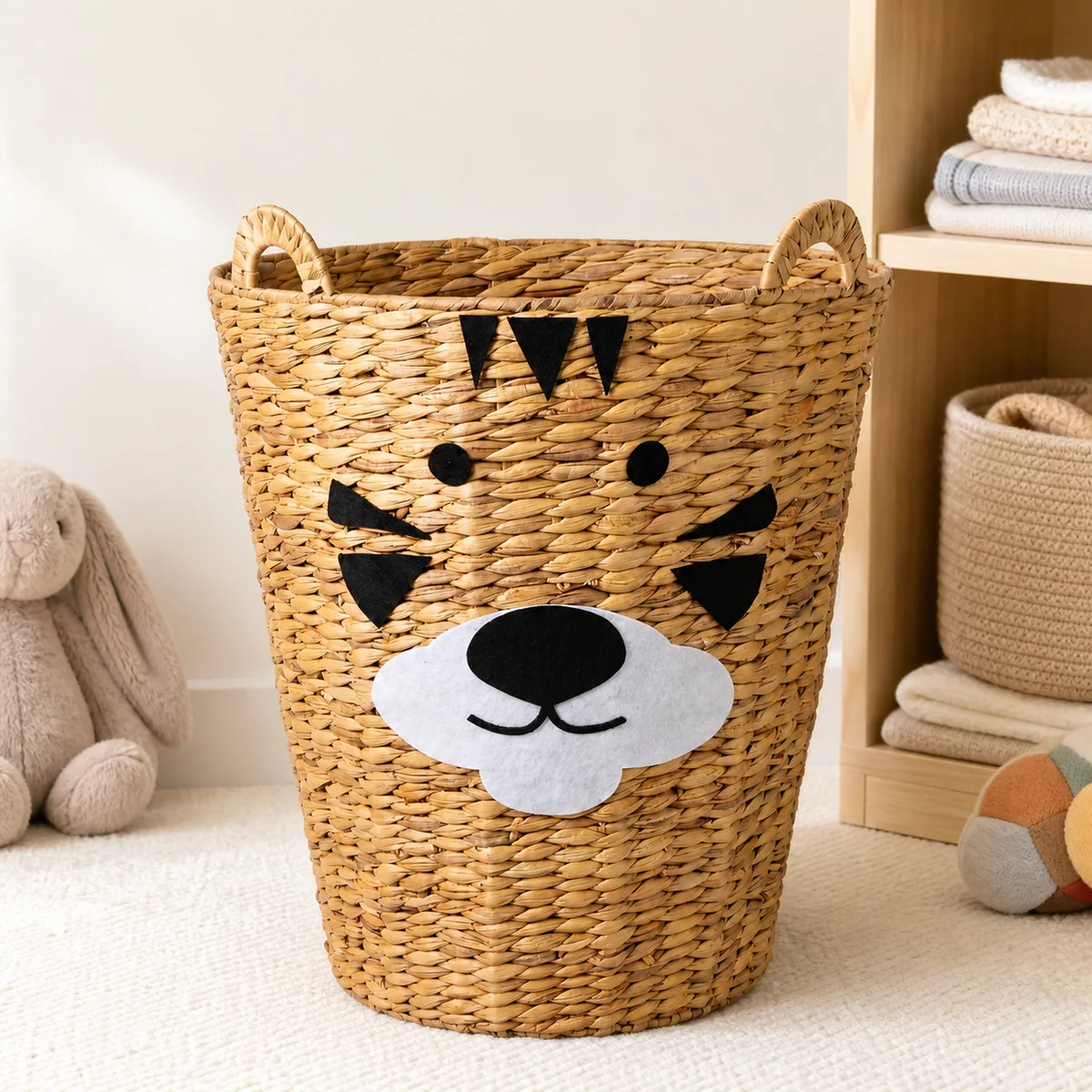
JINZHAO CRAFT currently lists JZ20052, a tiger-face water hyacinth hamper and JZ20051, a dog-face variant on the same recorded base item. Their CMS records identify a shared round cylindrical base and the same recorded dimensions, while the front appliqué changes. This pair illustrates a useful variant-control problem; it does not prove that all character artwork, attachment methods, intended uses, or destination requirements can share one approval.
Create a base-plus-variant bill of information before requesting prices. If a supplier proposes a new face while keeping the base, require an impact review. A new appliqué may change component count, labor, color matching, placement, snag points, label copy, photography, carton protection, inspection time, or the responsible party's product assessment.
2. How should intended use be defined before artwork approval?
State who selects and buys the product, where it will be placed, what it is expected to hold, who may handle it, and which claims the buyer plans to make. "Kids hamper" can describe merchandising, room placement, artwork, intended user, or a regulated product classification depending on the actual product and market. Those are not interchangeable.
Use the kids storage category to shortlist current forms, then complete the kids storage intended-use intake for the actual program. The responsible buyer, importer, brand, or retailer should determine applicable destination, channel, labeling, testing, traceability, and claim requirements with qualified support. This article does not classify the product or claim that the reference items meet a particular standard.
List representative contents and handling. If the item may hold laundry, toys, textiles, or another assortment, record that use without converting it into unsupported load, child-safety, washability, food-contact, or performance language. Styling props in a scene image show presentation only; they do not prove suitability for every depicted or possible use.
3. Which fields belong in an appliqué control record?
Do not approve a character from one unscaled front photograph. Give the artwork a revision number and define each component. The record should include artwork owner, file name, color references, material/component description, finished dimensions, layer order, orientation, edge condition, approved attachment construction, placement datums, and acceptable relationship to the basket weave and handles.
Measure placement from stable product references such as the top rim, center line, or another agreed datum. Record vertical and horizontal positions, overall character envelope, spacing between eyes or other repeated features, and the relationship between layered pieces. Because the woven surface can vary, the buyer and supplier should agree how placement is measured and what sample evidence supports the project-specific acceptance rule.
For JZ20052, the approved scene image visibly shows a honey-brown woven cylindrical form, two loop handles, and a black-and-white tiger face appliqué. It does not establish the component material, attachment method, pull strength, durability, colorfastness, age grading, or compliance. Those fields require separate controlled information and evidence if they are relevant to the buyer's actual program.
4. What should the approval matrix show for every variant?
| Approval field | Common base record | Tiger, dog, or other variant record | Evidence to retain |
|---|---|---|---|
| Product identity | Base code, shape, material terminology, handles, and current revision | Variant SKU, artwork code, name, and revision | Controlled SKU and revision matrix |
| Dimensions | Opening, bottom, height, usable space, rim, handle position, and method | Character envelope and placement from agreed datums | Dated measurement sheets and annotated views |
| Components | Basket body and all shared construction inputs | Every appliqué piece, layer, color, edge, and attachment input | Component list and approved references |
| Intended use | Buyer-defined placement, contents, handling, and claim boundary | Variant-specific audience or channel decisions | Intended-use intake and responsible review |
| Sample status | Base sample approval and open conditions | Separate approval, conditional approval, or rejection for each face | Labeled samples and signed disposition |
| Pack and label | Shared carton assumptions and base data | Variant barcode, label, artwork, protection, and assortment quantity | Approved pack-out and data file |
| QC release | Base dimensions, shape, handles, workmanship, and pack | Correct face, components, placement, colors, attachment evidence, and SKU | Inspection findings, exceptions, and release |
Never let a new variant inherit approval merely because the basket body is unchanged. The matrix should show which base evidence remains valid and which variant evidence must be created. If a component, artwork, attachment, or pack condition changes, identify the affected approvals before production continues.
5. How should buyers verify the base basket and handles?
The current CMS record for JZ20052 lists a top diameter of 47 cm, bottom diameter of 42 cm, and height of 58 cm; JZ20051 is recorded as the same base dimensions. These are product-specific outside values, not tolerances, usable volume, or load claims. A new order should state measurement condition, datum points, tools, sample readings, and the buyer-approved project rule.
Check top opening, bottom footprint, height, rim shape, base stability, handle count, handle position, clear handle opening, relationship between handles and artwork, and usable internal space. Record top, side, back, base, and handle views. If an internal frame, liner, reinforcement, coating, or other component is requested, include it in the controlled record rather than assuming it from appearance.
Review the common base independently from the face. A visually correct tiger appliqué cannot compensate for a wrong opening, unstable base, misplaced handle, or unapproved construction change. Likewise, a correct base does not release a face with the wrong components or placement.
6. How should SKU, artwork, and color data prevent variant mix-ups?
Assign one base code and one finished SKU to each approved character/color combination. The quotation, order, sample tag, artwork file, barcode table, product label, carton mark, listing title, invoice description, and inspection report must use the same variant identity. Avoid using "assorted animal faces" unless the order also states the exact variants, quantity split, substitution rule, and pack arrangement.
Keep visual color names separate from controlled references. JZ20052 is recorded as honey brown with black and white appliqué details; JZ20051 adds a dog-face layout with black, white, and pink recorded details. Those catalog descriptions identify the references but do not create a universal color tolerance. Approve color references for the woven base and every decorative component under agreed viewing conditions.
If artwork is buyer-owned, identify the approved file, revision, scale, and authorized changes. If the supplier proposes artwork, record who can approve it and whether changes to expression, proportions, colors, or component count require a new sample. Withdraw obsolete files so production and inspection cannot use different versions.
7. Which sample and QC evidence is useful?
Start with a labeled base sample and a labeled finished sample for every approved variant, unless the buyer documents another evidence plan based on the actual risks and differences. Photograph the complete product and close views of each appliqué component, edge, layer, attachment area, handles, rim, side, back, and base. Include scale references where dimensions or placement are evaluated.
Use the golden-sample change-control standard to connect production evidence to the current base and variant revisions. Inspection should confirm order and SKU identity before appearance checks begin. Then verify base dimensions and construction, correct character, correct component count, artwork revision, colors, placement, orientation, visible workmanship, labels, and pack protection.
Do not replace raw findings with a generic "passed QC" statement. Record sample basis, units checked, actual observations, affected quantity, photographs, exceptions, disposition, rework or sorting, reinspection if applicable, and written release. Any destructive or performance method must be separately defined by the responsible parties for the actual program.
8. How should packing, claims, and commercial terms be quoted?
Protect the face and handles against the approved pack arrangement. Define bag, tissue, wrap, separator, insert, carton orientation, product contact points, label visibility, and unpacking presentation. If variants share a carton, state the assortment sequence and carton-mark data. If they ship separately, give each finished SKU its own carton quantity and identity. Verify actual packed dimensions and weights from the approved pack, not from the scene image.
Control every claim. Natural-looking fiber and child-friendly artwork do not by themselves prove sustainability, biodegradability, organic content, safety, washability, load, age suitability, or compliance. The responsible business should approve wording and evidence for the actual destination and channel. If the listing uses only descriptive facts such as the approved variant name, recorded dimensions, and visible colors, keep those facts synchronized with the order and sample.
Request current MOQ, sample scope and charges, artwork or component charges, revision allowance, quotation validity, production timing after approvals, payment terms, packing basis, Incoterm and named place by variant. These commercial values are project-specific and must come from the current quotation. Submit the base-plus-variant matrix through the RFQ form so every supplier prices the same scope.
9. What belongs in the buyer's release checklist?
- Confirm the base code, finished variant SKU, artwork revision, color references, and current order quantity split.
- Match opening, bottom, height, rim, base, handles, and usable-space records to the approved base evidence.
- Verify every appliqué component, layer, edge, color, orientation, and position against annotated approved views.
- Check that sample tags, labels, barcodes, inserts, carton marks, listings, and inspection records identify the same variant.
- Confirm approved attachment construction and record visible workmanship or exceptions without inventing an unperformed performance result.
- Verify face and handle protection, carton orientation, assortment sequence, label visibility, and unpacking presentation.
- Record inspection scope, actual findings, affected quantity, exceptions, disposition, corrective action, reinspection, and release owner.
- Reopen approval when the base, artwork, component, attachment, color, label, intended use, claim, or pack changes.
Frequently asked questions
Can a new animal face use the existing base sample approval?
The existing base evidence may remain useful if the physical base is unchanged and that is verified, but the new face still needs its own controlled artwork, components, colors, placement, attachment specification, SKU data, sample decision, packing review, and inspection evidence.
Is a front photograph enough to approve appliqué placement?
No. Use annotated views with scale references, agreed product datums, component dimensions, layer order, orientation, and placement measurements. Also retain side and detail views that show the relationship to the weave, rim, handles, and other components.
Do matching outside dimensions prove that tiger and dog variants are the same product?
They may share a recorded base, but finished variants differ in artwork, components, colors, SKU identity, labels, packing protection, and inspection. Buyers should control shared base evidence and variant-specific evidence separately.
Can suppliers quote an assorted-character order without a quantity split?
That creates ambiguity. State each approved variant, finished SKU, quantity, color, barcode and label status, substitution rule, carton assortment, and whether components or artwork affect pricing. Suppliers should list any remaining assumptions separately.
What should buyers verify before releasing character hampers?
Verify current base and variant revisions, dimensions, handles and body construction, correct artwork and component set, colors and placement, SKU and label data, approved pack protection, inspection findings, exceptions, disposition, and written release by the responsible party.