Buyers should control a paper rope basket assortment by naming every included SKU or variant, defining the ratio basis, converting that ratio into exact integer quantities, and carrying the same approved matrix through the order, packing instructions, labels, inspection records, shipping documents, and receiving check. Keep total-order variance separate from assortment mix, and require written approval before any ratio, carton composition, or remainder allocation changes.
1. Separate assortment ratio from total order quantity
An assortment ratio answers a specific question: how many units of each approved SKU, size, or color belong in one defined mix? It does not, by itself, state the total order quantity, the number of selling sets, the units per inner pack, or the number of master cartons. Those fields must be connected but controlled separately.
For example, a buyer may approve a color ratio of 2:1:1 for four units in one assortment group. That statement is incomplete until the buyer identifies the three color SKUs, the level at which the ratio applies, and how many complete groups are required. The ratio could apply to an order, a master carton, a display pack, or another project-defined unit. Never assume those bases are interchangeable.
Use the paper rope basket category to shortlist actual structures and variants, then assign each approved option its own identity. A photograph that shows several sizes or colors is not an assortment instruction. The commercial file needs both identity and quantity logic.
This is also different from overall overrun or short-shipment control. The order quantity variance guide explains how ordered, produced, packed, shipped, invoiced, and received totals are reconciled. An order can match the grand total and still contain the wrong mix, so buyers should check totals and ratios as two separate decisions.
2. Define the level that owns the ratio
Start by naming the unit to which the ratio applies. Write a clear basis such as “per master carton,” “per retail display,” “per complete five-piece selling set,” or “across the full purchase-order line.” Avoid a bare entry such as “2:2:1 assorted,” because a supplier, packer, inspector, and receiving team could each apply it at a different level.
Then identify whether the assortment contains independent sellable SKUs, components of one set, color variants of one SKU, or a combination. A five-size nested set may be one selling unit with five components. Five separate baskets may instead be five sellable SKUs. Those cases can look similar in a photograph but create different order, label, barcode, inspection, and carton records. The nested basket set planning guide helps buyers define the selling unit and component roles before applying any mixed-SKU ratio.
3. Build one assortment control table
Create a matrix before quotation or purchase-order release. The example fields below are a control template, not JINZHAO CRAFT packing data or a universal carton format.
| Control field | Buyer-approved entry | Why it matters | Evidence to retain |
|---|---|---|---|
| Assortment ID | Unique mix name and revision | Distinguishes the current mix from prior versions | Approved matrix |
| Ratio basis | Order, selling unit, inner pack, master carton, or display | Prevents the same numbers being applied at different levels | Written basis statement |
| Included identities | Buyer SKU, supplier code, size, color, and component role | Keeps similar variants separate | Controlled cross-reference |
| Ratio units | Integer units for each listed identity | Makes the mix calculable | Ratio row with named columns |
| Complete groups | Number of full ratio groups required | Converts the ratio into quantities | Calculation sheet |
| Remainder rule | Approved allocation or prohibition | Controls totals that do not divide into full groups | Buyer decision |
| Selling-unit rule | Set, each, pair, or other defined unit | Prevents components being counted as finished selling units | Pack specification |
| Inner-pack composition | Project-defined count and orientation | Connects the ratio to pack execution | Packing instruction |
| Master-carton composition | Project-defined inner packs or loose units | Supports carton-level reconciliation | Carton matrix |
| Release evidence | Labels, count sheet, carton photos, and inspection record required by the buyer | Makes the approved mix verifiable | Dated evidence file |
The identity columns should match the controlled code list used elsewhere. The product code cross-reference guide covers the mapping between buyer SKUs, supplier codes, set components, labels, cartons, and documents. This article adds the ratio logic; it does not replace that identity map.
4. Convert ratios into exact integer quantities
Treat the ratio as a set of integer parts. Add the parts to find the size of one complete group, multiply each part by the approved number of groups, and verify that the line quantities add back to the planned total for that basis. Keep the calculation visible instead of entering only final totals.
Consider an illustrative 2:1:1 ratio for SKU A, SKU B, and SKU C. One complete group contains four units. If the buyer approves 24 complete groups at the order level, the calculation produces 48 units of A, 24 of B, and 24 of C, for 96 units total. These numbers are arithmetic examples only; they are not an MOQ, carton count, order history, or recommended mix.
If the required total does not divide into complete groups, stop and apply the written remainder rule. Options may include changing the total, allocating the remainder to named SKUs, creating a separately identified partial assortment, or prohibiting a partial group. The buyer must choose the rule for the project. A supplier should not round each line independently, because several individually plausible rounding decisions can change both the total and the approved mix.
Repeat the calculation at every controlled level. A ratio that works across the whole order may not create identical master cartons. Conversely, identical master cartons may require the total order quantity to be a multiple of the approved carton composition. Record whether mixed cartons are required, allowed, or prohibited; do not infer that choice from the ratio alone.
5. Release the same matrix across commercial documents
The quotation, purchase order, acknowledgment, packing instruction, label file, inspection brief, packing list, and invoice should refer to the same assortment ID and revision where those documents use the mix. They do not need identical layouts, but the identities, basis, ratio, and calculated quantities must reconcile.
At purchase-order acknowledgment, compare the supplier-returned line quantities with the buyer calculation. Acknowledgment should identify any requested remainder, substituted variant, split shipment, or carton-composition change before production release. Keep exceptions visible rather than replacing the original ratio with an unexplained new set of totals.
6. Connect the ratio to packing and labels
Packing teams need a carton-level instruction, not only an order-level ratio. For each carton type, list the included SKU identities, unit counts, inner-pack relationship, selling-unit definition, and required carton mark or assortment code. If more than one carton pattern is approved, give each pattern a distinct ID and state how many cartons of each pattern belong in the shipment.
Labels and barcodes must follow the approved identity structure. Do not use one variant label on a mixed carton unless the buyer has defined what that label represents. A master-carton mark may identify the assortment as a whole, while inner or retail labels identify individual SKUs or selling sets. The exact hierarchy is project-specific and should be released with the label files.
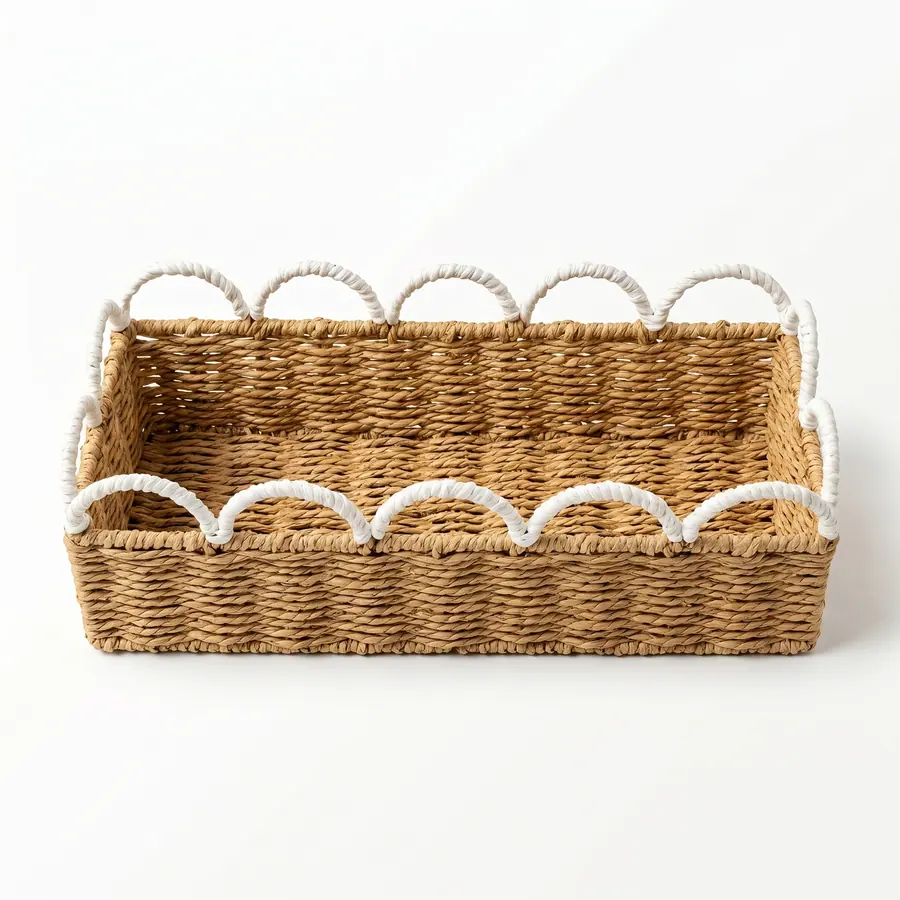
JZ10101 is a visible rectangular five-piece nested paper rope basket set. Its product page and original product image support the visible five-size nested structure and a natural-brown-and-white colorway. They do not establish any buyer assortment ratio, carton quantity, label hierarchy, order quantity, MOQ, price, shipment, or inspection result, and none is inferred here.
7. Inspect both carton composition and shipment totals
An inspection instruction should state the approved assortment ID, revision, basis, carton patterns, and evidence required. Ask the inspector to record actual counts by SKU for the selected cartons and compare them with the carton matrix. A carton marked with the correct assortment ID can still contain the wrong internal mix, so mark review and content review are separate checks.
Reconcile at least three views: units by SKU, complete selling units or assortment groups, and cartons by approved pattern. The sum of carton contents should match the packed quantity by SKU, while the sum of SKU quantities should match the shipment total under the approved variance rule. Record discrepancies without guessing their cause.
8. Reconcile receiving without losing the approved basis
At receiving, compare the packing list and carton marks with the approved carton-pattern count before opening selected cartons. Then check actual SKU composition against the assortment matrix using the buyer's receiving scope. Separate a missing carton, a correct carton with the wrong internal ratio, a wrong variant, and a damaged unit; each changes a different reconciliation field.
If the shipment is delivered in more than one lot, calculate the mix for each lot only when the purchase agreement requires lot-level balance. Otherwise, track the cumulative approved basis and show how partial receipts roll up to it. Do not declare a shipment ratio wrong merely because an interim delivery is incomplete unless the approved rule requires every partial shipment to carry the same mix.
Record carton ID, SKU counts, selling-set completeness, observed discrepancy, evidence, hold status, and decision owner. Keep the original matrix, shipping record, receiving count, and any approved disposition linked. A corrected invoice or credit does not by itself correct a physical assortment record.
9. Use a controlled exception workflow
When actual quantities do not match the approved mix, first freeze the affected count and identify the basis on which the mismatch occurred. Determine whether the issue is an identity error, ratio error, total-quantity variance, incomplete selling set, carton-pattern error, or document mismatch. More than one can occur, but they should not be collapsed into a vague “quantity issue.”
The buyer may decide to hold, recount, sort, relabel, repack, accept a documented deviation, request replacement, or use another project-specific disposition. This guide does not prescribe the commercial remedy. Record the affected identities and quantities, responsible decision owner, scope, evidence, and approval date. Do not extend a concession to other cartons, variants, orders, or shipments unless the written decision explicitly includes them.
After correction, repeat the same ratio and total checks. Preserve the before-and-after record so a passing recheck does not erase the original discrepancy. If the approved mix changes, issue a new assortment revision and update all affected documents instead of editing old evidence.
10. Copy this assortment-ratio release checklist
Before releasing a mixed-SKU paper rope basket order, confirm that:
- every included SKU, size, color, and set component has a controlled identity;
- the ratio basis is named and cannot be confused with the order, selling unit, inner pack, or master carton;
- ratio parts convert into exact integer quantities and add back to the planned total;
- any non-divisible total has a buyer-approved remainder rule;
- selling sets and independent sellable SKUs are counted differently where required;
- each approved carton pattern lists identities, quantities, and an assortment revision;
- quotation, PO, acknowledgment, labels, packing, inspection, shipping, and receiving records reconcile to the same matrix;
- inspectors check carton contents as well as carton marks;
- partial shipments follow a written lot-level or cumulative ratio rule;
- exceptions retain the original counts, disposition, owner, scope, and recheck evidence.
Buyers can send a project-specific SKU list, assortment basis, carton matrix, and evidence requirements through the RFQ form. JINZHAO CRAFT should confirm the proposed mix against the actual product identities and packing plan; this article does not promise a fixed MOQ, carton count, sample time, lead time, price, or packing configuration.
11. Frequently asked questions
Is an assortment ratio the same as the quantity on a purchase order?
No. The purchase order states line and total quantities, while the assortment ratio states the relative mix of named SKUs or variants at a defined level. Buyers should convert the ratio into exact integer line quantities and verify that those quantities reconcile with the purchase order.
Can one ratio be used for both the full order and every master carton?
Only when the approved packing plan makes that true. An order-level ratio may be achieved through several different carton patterns, while identical mixed cartons can enforce the same ratio per carton. State the basis explicitly and approve each carton pattern.
What should happen when the total does not divide into complete ratio groups?
Apply a buyer-approved remainder rule. The buyer may change the total, allocate the remainder to named SKUs, approve a separately identified partial group, or prohibit the remainder. Suppliers should not round line quantities independently without written approval.
How should nested sets be counted in a mixed-SKU assortment?
First define whether the nested set is one selling unit or whether its components are independent SKUs. Then record both the selling-unit count and component quantities where needed. A product photograph or physical nesting arrangement does not determine the commercial counting rule.
What evidence helps verify a mixed-SKU carton?
Use the approved assortment matrix, carton ID, SKU labels, actual count by SKU, selling-set count where relevant, carton marks, and buyer-required photographs or count sheets. Evidence should show both product identity and quantity rather than relying on the carton label alone.