Buyers should prevent paper rope basket SKU mismatches by maintaining one approved cross-reference that maps every buyer SKU to the supplier product code, component role, color, size, selling unit, label revision, pack configuration, and carton identity. The same mapping should control the purchase order, artwork, inspection record, packing list, shipment record, and invoice; an unmapped or ambiguous code should stop release until clarified.
1. Start with the commercial selling unit, not a convenient nickname
A code only works when the team knows what it identifies. Define whether each order line buys one basket, one complete nested set, one assortment, one display pack, one replacement component, or another project-specific unit. A supplier code for a three-piece set cannot safely stand in for three independent buyer SKUs unless the buyer has explicitly designed that mapping. Record the complete unit before assigning labels, quantities, or prices.
Give each controlled variant its own identity where the buyer needs separate ordering, inventory, artwork, inspection, or replenishment. Color, size, component role, divider count, handle version, liner version, and pack configuration may or may not require separate buyer SKUs; the decision belongs in the approved assortment plan. Avoid informal names such as “small natural basket” when several products could match.
The woven product RFQ data dictionary provides fields for product and variant definitions. Use those fields to build the identity layer before asking suppliers to quote. The purpose is not to create more codes. It is to make every existing code resolve to one unambiguous commercial unit.
2. Build one buyer-to-supplier cross-reference matrix
Create a master table controlled by the buyer or by the jointly approved order record. One row should represent one sellable or separately controlled identity. Keep component rows linked to their parent set instead of allowing loose components to look like complete selling units.
| Control field | What the approved row should show | Release question |
|---|---|---|
| Buyer SKU | Exact code used by merchandising, inventory, and finance | Does it identify only one controlled unit? |
| Supplier product code | Exact code used in quotation, sample, production, and packing | Is the mapping confirmed in writing? |
| Parent set and component role | Complete set, main unit, small/medium/large component, or replacement | Can a component be mistaken for a full set? |
| Variant definition | Approved color, size, construction, and distinguishing feature | Is the description specific enough to separate adjacent rows? |
| Selling unit | Piece, set, assortment, inner pack, or other accepted basis | Do quantity and price use this same unit? |
| Artwork revision | Approved label, insert, barcode artwork, and language revision | Does the physical artwork point to this row? |
| Pack configuration | Units per selling pack, inner pack, and carton as applicable | Can pack counts reconcile to the order line? |
| Carton identity | Carton mark item code and carton-number range | Can logistics identify the contents without opening every carton? |
| Status and effective order | Draft, approved, replaced, or blocked, plus the order/revision where it applies | Is an obsolete mapping being reused? |
Do not fill missing fields with guesses from photographs or a previous order. Leave the row blocked, name the owner, and request the exact clarification. The matrix is useful because it exposes unresolved identity questions before they appear as mislabeled goods, wrong inspection samples, or invoice disputes.
3. Make the quotation, PO, and acknowledgment use the same identity
A supplier quotation should show both the buyer SKU and supplier product code when both exist. It should also state the selling unit and enough variant detail to distinguish the row. When the buyer issues the purchase order, copy the approved mapping rather than retyping an abbreviated product name. Ask the supplier acknowledgment to repeat the codes and flag any line it cannot match.
Treat a code mismatch as an exception, not a harmless formatting difference. The supplier may have reused an internal code, the buyer may have split one former SKU into two colors, or a set may have gained a revised component. The team should identify the actual product, choose the controlling code pair, update the revision record, and obtain approval before production release. The purchase-order acknowledgment guide explains how to keep exceptions open until both sides agree.
Keep commercial values attached to the correct row. Quantity, price, packaging charge, approved excess or shortage, and invoice treatment should never be moved from one code to another merely to make totals reconcile. If a substitution or reallocation is proposed, document it as a separate buyer decision with its own effective revision.
4. Connect labels and artwork without letting them become the master data
Labels, hangtags, inserts, and barcode artwork should consume the approved product identity; they should not silently redefine it. Record the artwork filename or revision against the cross-reference row, along with the buyer SKU, product description, color/size wording, selling unit, and any required retailer fields. A correct-looking label is not sufficient if it points to the wrong product row.
Use the retail label and barcode planning guide to define the data and approval hierarchy. When artwork changes, preserve the previous revision, state why the change was made, identify affected SKUs and orders, and record the approval. Do not overwrite a shared file with a new image while packing teams continue to use an undated copy.
During sample or first-pack review, compare the physical product, its attached artwork, and the cross-reference row side by side. Check component count and role, color, size designation, label code, pack quantity, and parent-set relationship. If one component carries a separate service code, make clear whether that code is for internal control, replacement ordering, or consumer sale.
5. Carry the mapping into inspection, packing, and carton records
The inspection request should list the same buyer SKU and supplier code pair used on the purchase order. Inspectors should record which physical item and artwork revision were examined. A report that identifies only “paper basket” cannot reliably close a multi-SKU order. Photographs should show enough context to associate the checked item, label, pack, and carton with the correct row without claiming that a photograph proves every requirement.
The packing list should reconcile quantities using the approved selling unit. For a set, show complete sets and, where relevant, component composition. For mixed cartons, show the exact SKU and quantity matrix. The carton mark should use the approved item identity and carton-number range. The carton mark and shipping document guide helps align these records without treating one document as a substitute for another.
Before shipment release, compare the purchase order, acknowledgment, final inspection record, packing list draft, carton matrix, and invoice draft. Every code should resolve to the same product and unit. New, obsolete, blank, or duplicated codes should remain on an exception list until the buyer owner approves a correction.
6. Control revisions and exceptions instead of editing history
Assign the cross-reference a revision and effective date or order scope. When a code changes, retain the previous mapping and state whether it is replaced, still valid for earlier orders, or blocked. This matters for repeat orders: the same buyer SKU should not silently point to a different color, component count, label, or pack because a new spreadsheet copied only part of the history.
Use a short exception log with the affected buyer SKU, supplier code, document, mismatch, evidence, owner, requested decision, due point, and final disposition. Examples include a missing supplier code on a label proof, a component code shown as the parent set, a carton mark using an old buyer SKU, or an invoice line using pieces while the purchase order buys sets. Record the factual mismatch first; do not invent a cause.
Close an exception only when the affected records have been corrected or the buyer has explicitly approved the documented difference. State which revision becomes effective and which files must be withdrawn. A chat message can alert the team, but the controlled matrix and affected commercial documents should contain the final decision.
7. Copy this SKU mapping release checklist
Before releasing production, packing, or shipment, confirm that:
- every order line identifies one buyer SKU, one supplier product code, and one selling unit;
- each color, size, construction, and component role is separated where the buyer controls it separately;
- parent sets and loose components cannot be confused;
- quotation, purchase order, and acknowledgment repeat the approved code pair;
- label and insert artwork point to the same product row and approved revision;
- inspection instructions identify the physical item, artwork, and pack being checked;
- pack quantities and carton contents reconcile using the same selling unit;
- packing list, shipment record, and invoice resolve every code to the approved row;
- obsolete, blank, duplicated, or newly introduced codes remain blocked until approved;
- the revision history shows when and where each mapping is effective.
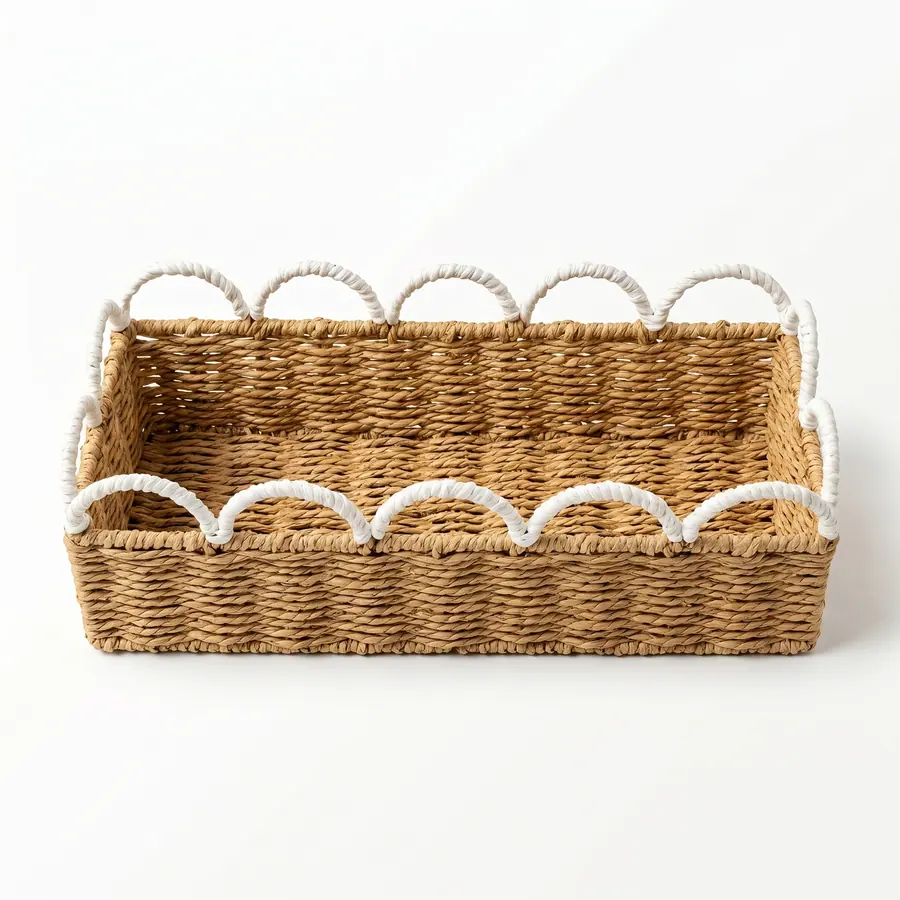
JZ10169 is a visible natural-tan paper rope three-piece desktop organizer set comprising one two-cubby organizer, one two-compartment basket, and one three-compartment basket. Its product page supports that identity and component relationship. It does not establish any buyer SKU, retailer code, artwork, order quantity, price, pack count, inspection result, or shipment record, and none is inferred here. Buyers can send a project-specific product-code matrix through the RFQ form.
8. Frequently asked questions
Should the buyer SKU and supplier product code be identical?
No. They may be different because they serve different systems. The control is an approved one-to-one or explicitly documented one-to-many mapping that identifies the same product, variant, component role, and selling unit across the order records.
Can one supplier code cover several buyer color SKUs?
Only when the approved matrix clearly maps each buyer color SKU to the shared supplier code plus an unambiguous variant field. If production, labels, inspection, inventory, or replenishment controls colors separately, each row must remain separately identifiable.
How should a three-piece basket set appear in the matrix?
Create a parent row for the complete selling set and linked component rows for each controlled piece. State which code is ordered and invoiced, which codes support component control, and whether any component may be sold or replaced separately.
What should happen when carton marks use an old SKU?
Block the affected carton-mark revision, identify the cartons and order lines involved, and compare the old and current mappings. Correct the marks or obtain a documented buyer decision before shipment release; do not silently edit the master history.
Is a packing list enough to prove the SKU mapping is correct?
No. A packing list is one supplier record. Buyers should reconcile it with the approved cross-reference, purchase order, acknowledgment, artwork, inspection record, carton matrix, shipment record, and invoice using the same product identity and selling unit.