Wholesale buyers should define a lidded paper rope storage box as a matched body-and-lid system, not an open basket with an added cover. Specify intended contents, outside and usable dimensions, the lid interface, opening and closure behavior, material and appearance references, labels, retail protection, carton pack-out, sample evidence, QC checkpoints, and quotation assumptions before approving production.
1. What decision does the lidded box need to support?
Start with what will be stored, where the box will sit, and how it will be sold. A wardrobe box for folded textiles, a shelf-display trunk, and a private-label ecommerce item can share a rectangular outline but require different usable space, lid access, label placement, protection, and pack-out. State the destination channel, intended contents, shelf or furniture constraints, selling unit, and whether shoppers will normally open the lid while the box remains in place.
Create a contents list with the largest relevant dimensions and the intended loading orientation. Then define whether the project is one box, a size family, or a coordinated assortment. The home organization category can help buyers shortlist forms, but a catalog image cannot establish internal clearance, lid alignment, or a new order's approved construction.
This use statement becomes the reason for every critical dimension. If the box must fit a shelf, outside size matters. If it must hold folded goods or packaged items, clear internal length, width, and height matter. If it will be opened in a confined space, the lid movement and access zone must be reviewed in the sample.
2. How should buyers use JZ10112 as a reference?
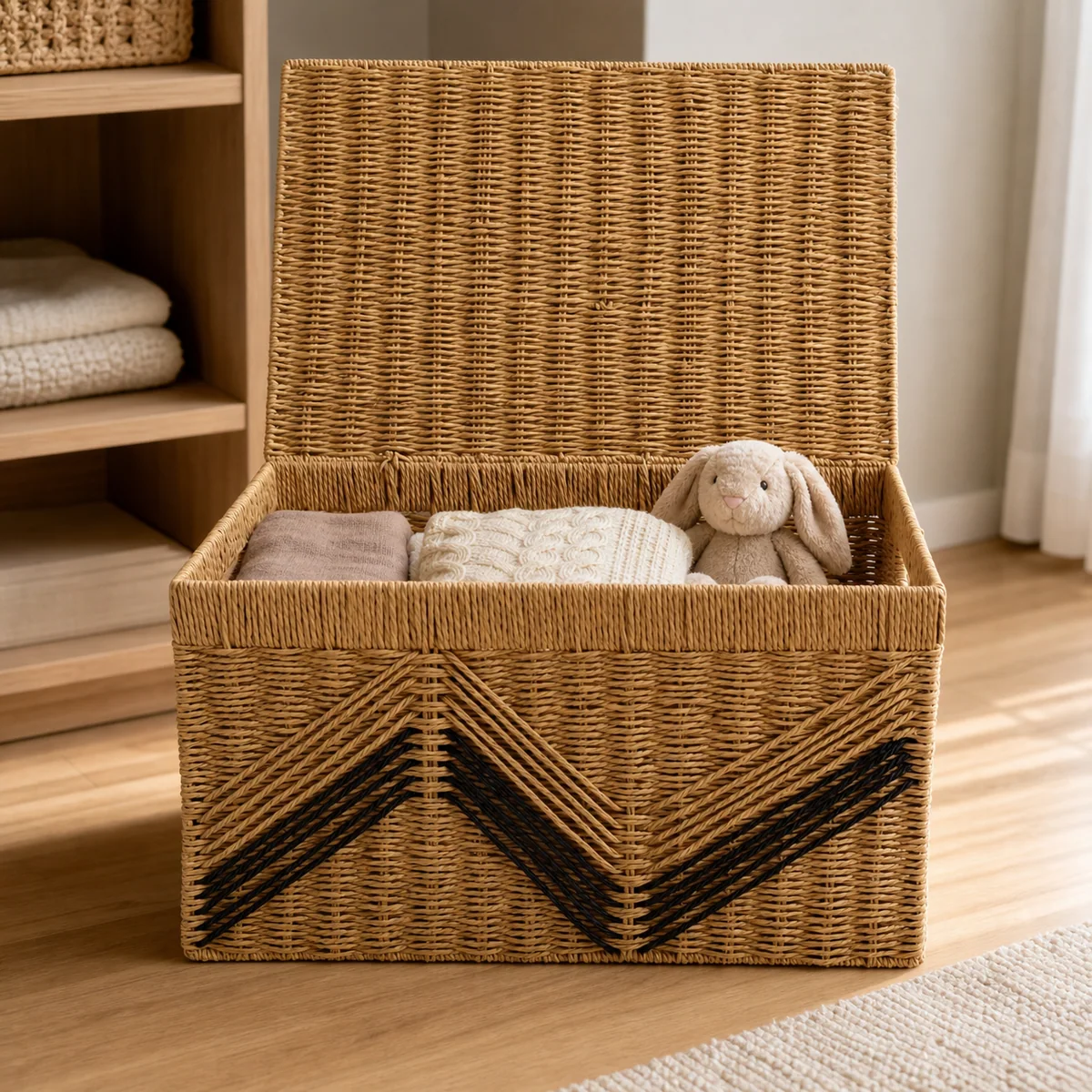
The current JZ10112 lidded paper rope storage trunk is a concrete visual and dimensional reference. Its CMS record identifies a natural-brown rectangular paper rope trunk with a hinged lid, a black V-pattern accent on the front, and recorded outside dimensions of 54 × 38 × 35 cm. The approved scene image shows the lid open and the interior visible. The paper rope category can be used to compare adjacent woven forms and color directions, but it does not replace this controlled product reference.
Those facts describe this catalog item only. They do not establish the usable inside dimensions, lid clearance, acceptable alignment range, hinge construction for a changed design, packaging method, or commercial terms for another project. A buyer can reference JZ10112 to communicate the product family and the details to retain, then list every requested change separately.
Use a two-column change log: “reference feature” and “buyer revision.” If color, dimensions, accent pattern, lid construction, label, or packing changes, ask the supplier to state what must be resampled and what changes in the quotation basis. This keeps a visual reference from becoming a bundle of unstated assumptions.
3. Which measurements define lid fit and usable capacity?
Record outside length, width, and height using marked measurement points. Separately record clear internal length and width, usable height with the lid closed, opening dimensions, rim thickness, lid overlap, and any internal frame or attachment that reduces space. If the walls taper, identify both the opening and base footprint. Do not calculate usable capacity from outside dimensions alone.
Treat the lid interface as its own measurement zone. Mark the body rim, lid edge, overlap, attachment position, closed alignment, and the space required to open the lid. The sample record should show the box on a level surface, the lid open, the lid closed, and the agreed measuring method. A buyer-defined range should follow feasibility and sample review; no universal handmade tolerance should be copied from another construction.
Test the buyer-controlled contents in the sample. Confirm that the lid closes without pressing the contents, the opening provides practical access, and the box can be placed in its intended shelf or display position. These are observable project decisions. They do not support an unverified load, durability, safety, or service-life claim.
4. What belongs in the lidded-box specification table?
Use one table to connect each decision to evidence. Replace the JZ10112 reference values with approved project values when the order differs.
| Decision point | Catalog reference or buyer input | Evidence required before release |
|---|---|---|
| Product identity | JZ10112 is a rectangular natural-brown paper rope lidded trunk with a black V-pattern front accent | Dated reference image, SKU, revision, and written list of retained and changed features |
| Outside dimensions | JZ10112 CMS record: 54 × 38 × 35 cm | Annotated length, width, and height measurement photos for the sampled revision |
| Usable space | Buyer states intended contents and loading direction | Clear internal dimensions and a loaded sample view with lid closed |
| Lid interface | Buyer defines required overlap, alignment, attachment, access, and opening space | Top, front, side, open, and closed views plus marked interface measurements |
| Appearance | Buyer supplies material, color, weave, accent, and acceptable-variation references | Controlled sample, close views, and dated approval comments |
| Branding | Buyer supplies artwork, label type, position, barcode data, and selling-unit identity | Artwork proof and labeled sample in open and closed views |
| Pack-out | Buyer defines unit protection, lid position, pieces per carton, and assortment | Step-by-step pack-out images and verified carton-data sheet |
| Release basis | Buyer and supplier agree checkpoints, owners, and change control | Signed or otherwise traceable sample and specification revision |
Add a status column during development: open, approved, conditionally approved, or revise. “Appearance approved” should not silently approve usable dimensions, lid function, labels, or packing.
5. What must the approval sample prove?
The sample file should identify the SKU, revision, date, intended contents, current drawing, material and color reference, actual measurements, and every open decision. Photograph the complete box from front, side, top, interior, and three-quarter views. Add close views of the body rim, lid edge, attachment, corners, base, accent, label area, and any point that changes between open and closed positions.
Operate the lid in the intended setting. Record how the lid reaches the closed position, whether the agreed edges align, whether the body remains stable on the review surface, and whether the buyer's contents can be inserted and removed as planned. Describe the required result without inventing a universal cycle count or performance threshold.
Consult the sample acceptance framework before closing the development unit. The additional record for a box with a cover should identify the exact body-and-lid pair, their common revision, and the outcome of the fit check. If either component is substituted, reopen the paired assessment; approving its look does not settle how it mates with the other part.
6. How should retail protection and carton pack-out be planned?
Define whether the lid is packed open, closed, detached, or otherwise arranged only after the sampled construction and protection plan are reviewed. Show where surfaces, edges, attachment points, labels, and accents could contact another component or the carton. State the protective material, placement, sequence, and removal experience required by the selling channel.
For every proposed carton, request pieces per carton, orientation, inner protection, carton dimensions, net and gross weight, assortment coding, and marks. If boxes or components are nested, show the insertion and removal sequence and identify the areas that must remain separated. The export carton planning guide provides a broader pack-out framework, but the lidded-box record still needs its own approved sequence.
Keep packaging observation separate from transport-performance claims. If the buyer requires a handling, compression, drop, moisture, abrasion, or other shipment check, the project must state the method, sample, conditions, acceptance rule, responsibility, and evidence. A styled image or closed-carton photograph alone does not verify those results.
7. Which QC checkpoints should follow the approved sample?
Build the QC sheet from the approved decisions. Check product identity, revision, outside and usable dimensions, body profile, base condition, rim, lid edge, overlap, closed alignment, attachment area, material and color reference, accent placement, surface condition, label and barcode position, and the defined pack-out. Use the same measuring points and product position used during sample approval.
Separate fit-related checkpoints from appearance checkpoints. A lid that does not reach the approved closed position is a different issue from natural visual variation in the woven surface. Write each observation against a named criterion so that “poor lid” or “wrong shape” is not the entire record.
The buyer and supplier should agree who checks each point, what evidence is retained, and which conditions block packing or release. Any change to the body frame, lid, attachment, material, dimensions, label, or protection method should return to the appropriate approval owner. Similar appearance does not prove that the paired fit or pack-out remains unchanged.
8. What should the RFQ request for a comparable quotation?
Send one controlled RFQ to every candidate supplier. Include the reference product, retained and changed features, outside and usable dimensions, lid-interface drawing, intended contents, material and appearance references, quantity by SKU and color, branding files, unit protection, carton plan, sample deliverables, QC evidence, and destination.
Ask each supplier to quote the same revision and state assumptions, exclusions, setup or development charges if applicable, currency, payment terms, quotation validity, and the requested Incoterm with named place. MOQ, sample timing, and production timing must be confirmed for the actual construction, quantity split, artwork, packing, and approval status; do not import fixed numbers from a catalog field or another order.
Use the structured RFQ form when these inputs and open questions are ready. Require the supplier to flag any dimension, lid detail, material choice, or packing arrangement that remains provisional. The most useful quotation is not the one with the fewest notes; it is the one that makes its product and commercial basis comparable.
Frequently asked questions
What dimensions should buyers specify for a lidded paper rope storage box?
Specify marked outside length, width, and height, plus clear internal length and width, usable closed height, opening and base dimensions, rim thickness, lid overlap, attachment position, and required opening space where relevant. State how the box is placed and measured, then approve project-specific ranges through the sampled construction.
Can JZ10112 dimensions be used as a standard for every lidded storage box?
No. The recorded 54 × 38 × 35 cm dimensions describe the current JZ10112 catalog reference. A new program must confirm its own measurement points, usable space, intended contents, lid interface, material and appearance references, labels, protection, pack-out, and commercial assumptions through a controlled specification and sample.
What should a lid-fit sample review include?
Review the matched body and lid in open and closed positions. Record the rim and lid edges, overlap, attachment, alignment, opening space, agreed measuring method, intended contents, and the box's placement in its planned shelf or display setting. Retain dated photographs and disposition for every open point.
How should a lidded storage box be packed for wholesale shipment?
The project should define the approved lid position, inner protection, contact-point separation, packing sequence, pieces per carton, orientation, carton dimensions and weights, assortment coding, and marks. Any required shipment test needs its own method, conditions, acceptance rule, responsibility, and evidence rather than an assumed result.
What can change MOQ, sample timing, or production timing for this product?
The answer can change with body and lid construction, dimensions, material and color, quantity split, artwork, labels, protective packing, carton purchases, sample revisions, buyer approvals, and required inspection or testing. Ask for project-specific figures tied to one specification revision and require assumptions and start conditions in writing.