Buyers should define a five-piece laundry hamper set as five controlled components, not one generic basket repeated at different sizes. Assign an intended role, component code, dimensions, contents, selling configuration, label, sample evidence, and pack position to each piece. Then approve the shared material and visual direction across the complete set before comparing quotations or releasing production.
1. Does every component in the five-piece set have a clear job?
Start by deciding why the program contains two tall hampers and three smaller baskets. A buyer may intend the tall pieces for one placement and the smaller pieces for another, sell all five together, split them into separate selling units, or use selected sizes for different channels. Those choices affect specification detail, barcode structure, labels, photography, pack-out, quotation quantities, and inspection. A supplier cannot infer the correct commercial architecture from a group image.
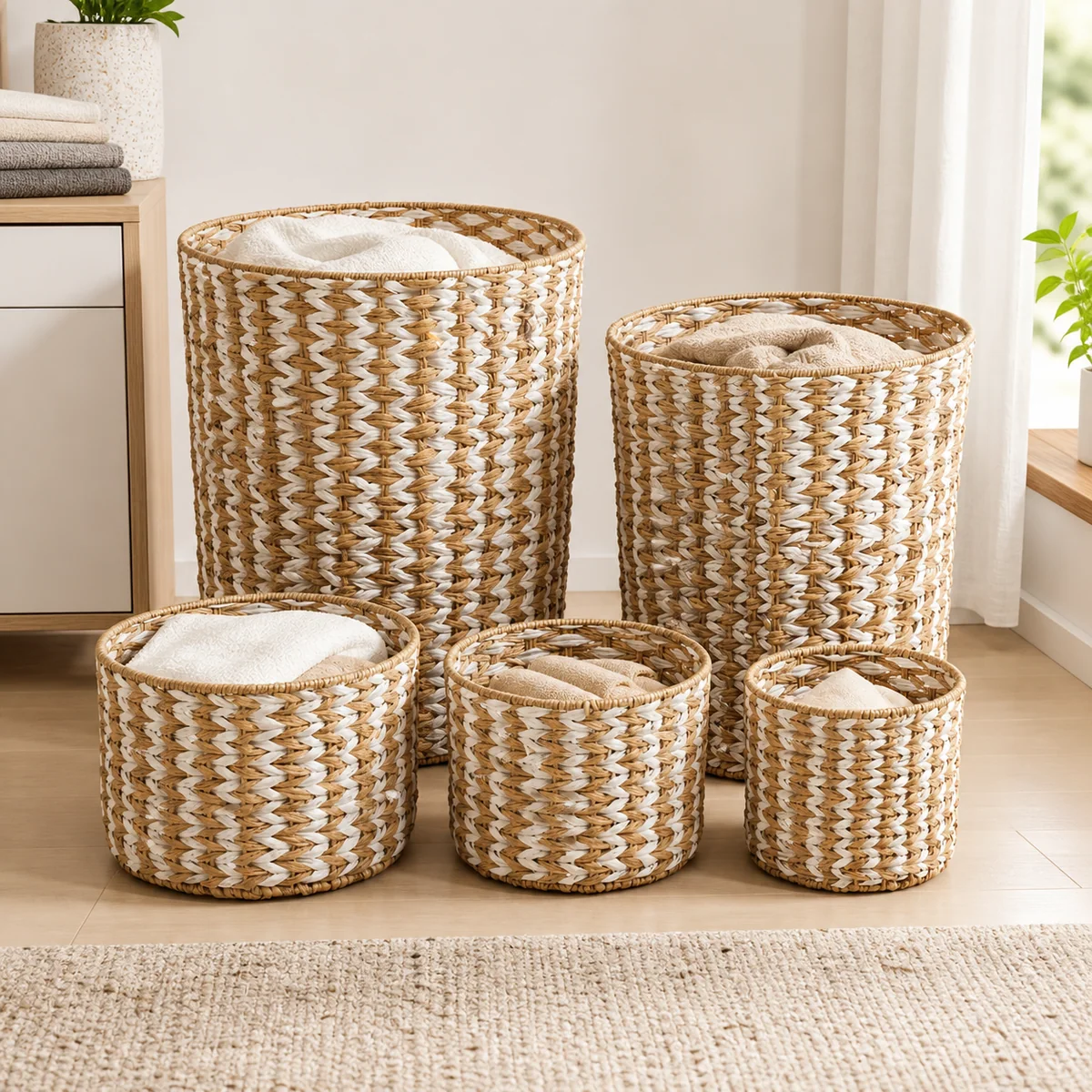
The current JINZHAO CRAFT catalog includes JZ20049, a natural tan and white paper rope five-piece set. Its CMS record identifies two tall round hampers and three round baskets with a shared chevron-style visual direction. That record provides a useful reference for a mixed-format program, but it does not establish the correct role, contents, selling unit, load, care, or market claim for another buyer's order.
Create a one-line role statement for each component. Name the intended room or merchandising position, representative contents, access direction, display condition, and whether the component is sold alone or only as part of the set. Use the laundry basket category to compare available forms, then turn the chosen direction into a project-specific brief rather than relying on a category label.
2. Which dimensions define the relationship between the five pieces?
Record each component separately. JZ20049's current CMS data lists two tall sizes: an XXL with a 42 cm top diameter, 37 cm bottom diameter, and 55 cm height, and an XL with a 37 cm top diameter, 32 cm bottom diameter, and 55 cm height. The three smaller baskets are recorded as L at 28 cm diameter by 25 cm height, M at 24 cm diameter by 23 cm height, and S at 20 cm diameter by 21 cm height. These are reference-product outside measurements, not universal tolerances, usable volume, or proof of nesting clearance.
For a new order, add top opening, bottom footprint, maximum outside width, usable inside opening, usable height, rim build-up, base condition, and agreed measurement points. A buyer who plans shelf display should also record the required footprint and presentation height. A buyer who plans nesting should record insertion order, contact points, protection, removal sequence, and the actual nested stack dimensions.
Do not approve only a graduated size list. Check whether the step between sizes is commercially meaningful and whether the hierarchy remains obvious in photographs, labels, retail copy, and the packed set. The laundry hamper functional specification can help connect intended use to opening, footprint, structure, handling, and packing evidence without inventing a universal acceptance number.
3. What should a component-role matrix contain?
A role matrix prevents one approval from being applied vaguely to all five pieces. Complete it before sample quotation and update it whenever the selling configuration changes.
| Controlled field | Tall hamper 1 and 2 | Smaller basket 1 to 3 | Evidence required |
|---|---|---|---|
| Identity | Set SKU plus unique component code | Set SKU plus unique component code | Controlled SKU and component list |
| Intended role | Buyer-defined placement, contents, access, and display | Buyer-defined placement, contents, access, and display | Role statement and representative contents |
| Geometry | Top, bottom, height, usable opening, rim, and base | Diameter or length/width, height, usable opening, rim, and base | Dated measurement sheet |
| Visual system | Approved material name, color reference, weave direction, and rim treatment | Same fields, with size-specific exceptions identified | Full-set sample photographs and references |
| Selling configuration | Set, pair, individual, or channel-specific bundle | Set, individual, or channel-specific bundle | Barcode, label, listing, and order matrix |
| Pack position | Nesting order, protection, orientation, and removal | Contact points, wraps, separators, and label visibility | Approved pack-out and packed dimensions |
| Release status | Approved, conditional, revise, or rejected | Approved, conditional, revise, or rejected | Signed exception and disposition log |
Every row should have an owner. If the buyer has not decided whether components will be sold individually, mark that as an open commercial decision instead of allowing different suppliers to quote different assumptions. The matrix is also the basis for determining which change requires a new sample, a label update, or a carton review.
4. How should buyers control the shared visual system?
A coordinated set needs a controlled relationship, not an expectation that handmade pieces will be visually identical. Record the approved material terminology, component construction, natural tan and white references, chevron direction, repeat logic, rim treatment, transition points, and acceptable handmade character for each size. Use front, side, top, base, and full-set views so comments are tied to locations.
The JZ20049 scene image visibly supports a five-piece natural-and-white assortment with two tall and three smaller forms. It does not prove fiber percentage, colorfastness, abrasion resistance, load, washability, sustainability, or compliance. Any such requirement must be stated separately and supported by evidence appropriate to the actual product, destination, and claim.
Approve the five pieces together under consistent viewing conditions. Check whether the visual rhythm scales intentionally, whether color blocks begin and end at controlled areas, and whether the set reads as one program when arranged in the buyer's planned display. Record size-specific exceptions rather than asking for a vague instruction such as "make every piece the same."
5. How should SKU and selling-unit data be structured?
Use one parent program identifier, one set SKU for every approved selling configuration, and one component code for each physical piece. The purchase order, quotation, sample labels, barcode file, packaging artwork, product listing, carton marks, invoice description, and inspection report should use the same relationships. If a component can be reordered separately, define its own selling-unit quantity, pack, barcode status, and replacement rule.
Keep set quantity and order quantity distinct. "500 sets" and "500 pieces" are not equivalent when a set contains five components. State quantity by set, total component count, color allocation, and any spare or replacement basis requested by the buyer. Ask suppliers to quote against the same matrix so unit prices, tooling or artwork charges, labels, inserts, and carton assumptions can be compared.
If channels use different bundles, do not reuse one barcode or pack instruction across them without review. A five-piece direct-to-consumer set, a two-hamper retail bundle, and three individually sold baskets are separate data and pack configurations even when the physical components share one approved construction.
6. Which samples and revisions must be approved?
Approve at least the component relationship, the full-set visual direction, and the proposed pack-out. The buyer should decide whether every size needs a physical sample or whether a documented construction family and selected boundary samples can support the project. That decision depends on the differences between components, open risks, intended use, artwork, packing, and the buyer's evidence requirements; it should not be assumed from the number of pieces.
Give every sample a program code, component code, revision, date, and status. Record outside and usable dimensions, material/component notes, color reference, visual pattern, rim and base details, intended role, label position, and pack relationship. Use the golden-sample change-control standard to separate approved evidence from later proposals.
A change to one component may affect the whole set. Changing a tall hamper diameter can alter nesting, carton dimensions, visual hierarchy, and set photography. Changing a smaller basket label can affect component identity and separate-sale data. Require a written impact review before replacing the approved revision.
7. What packaging evidence is needed before quotation and production?
Define whether the set nests, stacks, ships side by side, or uses more than one carton. For every contact point, identify wraps, separators, rim protection, handle or trim protection, label visibility, and removal sequence. Record actual packed dimensions and gross/net weight only after the approved physical arrangement is available; do not estimate them from product photos.
The nesting, carton and CBM framework provides fields for measuring the real stack and carton instead of treating nesting as automatic proof of logistics efficiency. Confirm whether unpacking requires reshaping, whether components rub or catch, and whether the buyer accepts the presentation after removal. If the selling configuration changes, repeat the pack review for that configuration.
Request project-specific MOQ, sample scope and charges, revision allowance, quotation validity, production timing after approval, payment terms, packing basis, Incoterm and named place from the current quotation. None of those commercial values should be copied from a different order or inferred from the five-piece reference product.
8. What belongs in the RFQ and pre-shipment release checklist?
- Identify the parent program, selling-unit SKU, five component codes, set quantity, and order quantity basis.
- State the intended role, representative contents, placement, and selling configuration for each component.
- Attach the dimension table, measurement method, visual references, construction notes, and approved exceptions.
- Define full-set and component sample requirements, revision control, photographs, and decision owners.
- Provide label, barcode, insert, artwork, attachment, language, and carton-mark data by selling configuration.
- Define nesting or packing orientation, protection, removal, packed measurements, and any channel-specific distribution evidence.
- Ask suppliers to list assumptions, exclusions, alternatives, current commercial terms, and open decisions separately.
- Before shipment, match purchase order, components, dimensions, appearance, labels, pack-out, inspection findings, exceptions, disposition, and written release.
Send the controlled matrix through the RFQ form. A quote is comparable only when each supplier prices the same five physical components, the same selling configuration, the same evidence scope, and the same pack basis.
Frequently asked questions
Can buyers treat a five-piece hamper set as one SKU only?
The selling set can have one SKU, but each physical component still needs a stable component code, dimensions, intended role, sample status, label rule, and pack position. Component identities are necessary for quotation, approval, inspection, replacement decisions, and any channel that later sells pieces separately.
Do graduated dimensions prove that all five pieces will nest?
No. Nesting must be shown with the approved physical components and a documented insertion order, contact points, protection, removal sequence, stack dimensions, and post-unpacking condition. Outside dimensions alone do not prove clearance or acceptable presentation.
Must every component receive a separate physical sample?
The buyer should decide this from construction differences, size boundaries, intended roles, artwork, pack interaction, and open risk. If selected samples represent a controlled construction family, document that rationale and identify which evidence applies to each unsampled component.
How should quantities be written in a five-piece set quotation?
State the number of selling sets, five-piece composition, total component count, quantity by component and color, and whether any component can be ordered separately. Suppliers should also identify their packing and commercial assumptions so "sets" cannot be confused with individual pieces.
What evidence should release a five-piece set for shipment?
Release should reference the current order and revisions, matched component identities, agreed measurements, full-set visual evidence, labels and barcodes, approved pack-out, inspection scope and findings, exceptions, disposition, and written authorization by the responsible party.