Direct answer
A usable loading estimate starts with measured product dimensions, nesting orientation and insertion depth, set composition, sales-unit count, carton inside and outside dimensions, gross weight, compression limits, and the actual transport equipment. Carton CBM equals external carton length multiplied by width and height in metres. Theoretical volume utilization compares total external carton volume with confirmed usable container volume, but it is not a loading guarantee. Whole-carton orientation, integer floor counts, door opening, internal protrusions, payload, axle and floor limits, stack strength, bracing, mixed cargo, and loading sequence can reduce the result. Buyers should approve the pack architecture; suppliers should document trials; the forwarder or carrier should confirm the specific equipment and operating constraints.
Direct answer: calculate the pack hierarchy before estimating the container
- Container planning for nested baskets should move through four evidence levels: product and set geometry, nesting behavior, sales and shipping pack, then specific transport equipment. Starting with a catalog product size and dividing a nominal container volume creates a number that may ignore nesting clearance, carton walls, unused orientation space, weight, door access, and the actual equipment supplied.
- This reference covers measurement units, nesting depth, pack count, carton inside and outside dimensions, carton CBM, gross and net weight, theoretical volume utilization, integer orientation checks, trial packing, and responsibility. It does not provide a fixed 20GP, 40GP, 40HQ, truck, pallet, or airfreight quantity for an unapproved product and pack.
- The supplier measures representative products, proposes nesting and carton arrangements, performs documented pack trials, and records variation. The buyer confirms sales-unit architecture, protection, presentation, channel, allowed orientation, and acceptance. The freight forwarder, carrier, or packing specialist confirms the specific equipment, payload, loading, restraint, and route limitations. Arithmetic does not transfer these responsibilities.
Separate product, nesting, sales-unit, carton, and equipment dimensions
- Record product maximum outside length, width, and height in the specified conditioning state, plus opening, base, taper, handle, lid, liner, frame, and protrusion dimensions that affect nesting or packing. For a set, identify every member and quantity. Natural and handmade variation requires a defined measurement sample and allowance rather than using one convenient piece.
- Nesting data includes allowed orientation, first-piece height, incremental height added by each additional member, insertion depth, clearance, separators, handle position, liner treatment, deformation limit, and removal method. A nested stack dimension should come from a controlled trial across representative units. It is not necessarily the sum of nominal heights and should not assume unlimited compression.
- Pack data distinguishes product or set, consumer sales unit, inner pack, shipping carton, and pallet or load unit. Record carton inside dimensions for fit analysis and carton outside dimensions for CBM and spatial layout. Equipment data should identify actual internal clear dimensions, door opening, protrusions, payload, floor limit, tie points, and loading rules rather than relying only on a nominal container name.
Calculate carton CBM with external dimensions and controlled units
- For one rectangular shipping carton, carton CBM = external carton length in metres x external carton width in metres x external carton height in metres. If dimensions are recorded in centimetres, divide each by 100 before multiplication; if recorded in millimetres, divide by 1000. State rounding rules and retain unrounded values so purchasing, packing, and freight documents can be reconciled.
- Total stated carton volume = carton CBM x whole carton quantity. This is a geometric total, not the volume occupied by the basket material and not proof that the cartons can be arranged in a container. Irregular cartons, overhang, bulging, straps, pallets, corner boards, and protective frames require their maximum shipping envelope rather than a nominal board drawing.
- Use NIST SI guidance to keep units explicit and conversions reproducible. Record measuring method, carton condition, closure and compression state, equipment, operator, date, and sample. Re-measure after changes to product, nesting, count, protection, board grade, sealing, palletization, or allowed compression. A quotation should identify whether CBM is preliminary, trial-confirmed, or production-verified.
Use the Loading Feasibility Sheet instead of a single utilization percentage
- The sheet begins by checking all buyer-permitted axis-aligned arrangements, up to six permutations of carton length, width, and height. Exclude any arrangement prohibited by do-not-invert or allowed-orientation constraints before calculation. For each remaining arrangement, calculate whole-carton counts along usable length, width, and height using floor division, then multiply the integer counts. Record every tested and excluded arrangement, and reject layouts that fail door opening, handling, label visibility, this-side-up, strength, or damage constraints. Evaluate mixed SKUs as a packing problem rather than simply adding their separate theoretical maxima.
- Theoretical volume utilization = total external carton volume divided by the confirmed usable internal volume of the specific equipment. Label it theoretical because nominal dimensions, door opening, corner posts, floor shape, payload, load distribution, bracing, voids, loading sequence, mixed cargo, and operational practice affect feasibility. CBM alone does not establish a container count or guarantee loading utilization.
- The approval gate combines geometry, weight, protection, and execution: confirm whole-carton layout; compare gross cargo weight with the carrier-confirmed payload and other applicable limits; verify stack and compression evidence; check loading access and restraint; run a physical or digital trial appropriate to risk; record voids and dunnage; and obtain forwarder or carrier review for the specific equipment.
Detect false precision in nesting ratios and nominal container counts
- A common product-level error is treating the smallest basket opening as proof that the next basket can enter to a calculated depth. Frames, taper, weave variation, handles, liners, finish, and friction can stop insertion or cause damage. Another error is assuming the first nesting trial represents production. Record sample spread, difficult combinations, removal force observations, and any visible deformation.
- Carton errors include mixing inside and outside dimensions, omitting lid or handle protrusion, calculating an unclosed carton, ignoring bulge, rounding each dimension too early, and multiplying by a pack count that has not been trialled. Weight errors include using net product weight where gross carton weight is required or ignoring moisture, packaging, pallet, and restraint components.
- Equipment errors include dividing by published nominal volume, ignoring the door opening, using maximum internal dimensions at every point, exceeding payload before volume is full, and presenting one forwarder's estimate as a guarantee for all equipment. ISO 668 supplies classification and external-dimension context; ISO 1496-1 covers general-purpose freight-container specification and testing. Actual supplied equipment and carrier rules still control.
Preserve measurements, nesting trials, carton trials, and loading assumptions
- The evidence package should contain product and set drawings, measured sample list, conditioning state, maximum envelopes, nesting orientation, incremental nested-stack measurements, photographs, allowed compression, separators, sales-unit and carton BOM, carton inside and outside dimensions, closure state, gross and net weight, CBM calculation, rounding, candidate layouts, equipment data source, and approvals.
- Add trial records that show who packed, sample identity, carton count, loading direction, pack time, damage or deformation observations, ease of removal, stack behavior, voids, bracing, and deviations. After actual shipment, compare booked CBM, loaded quantity, equipment identity, unused space, exceptions, arrival condition, and claims with the estimate. This creates a project-specific feedback loop rather than a universal utilization factor.
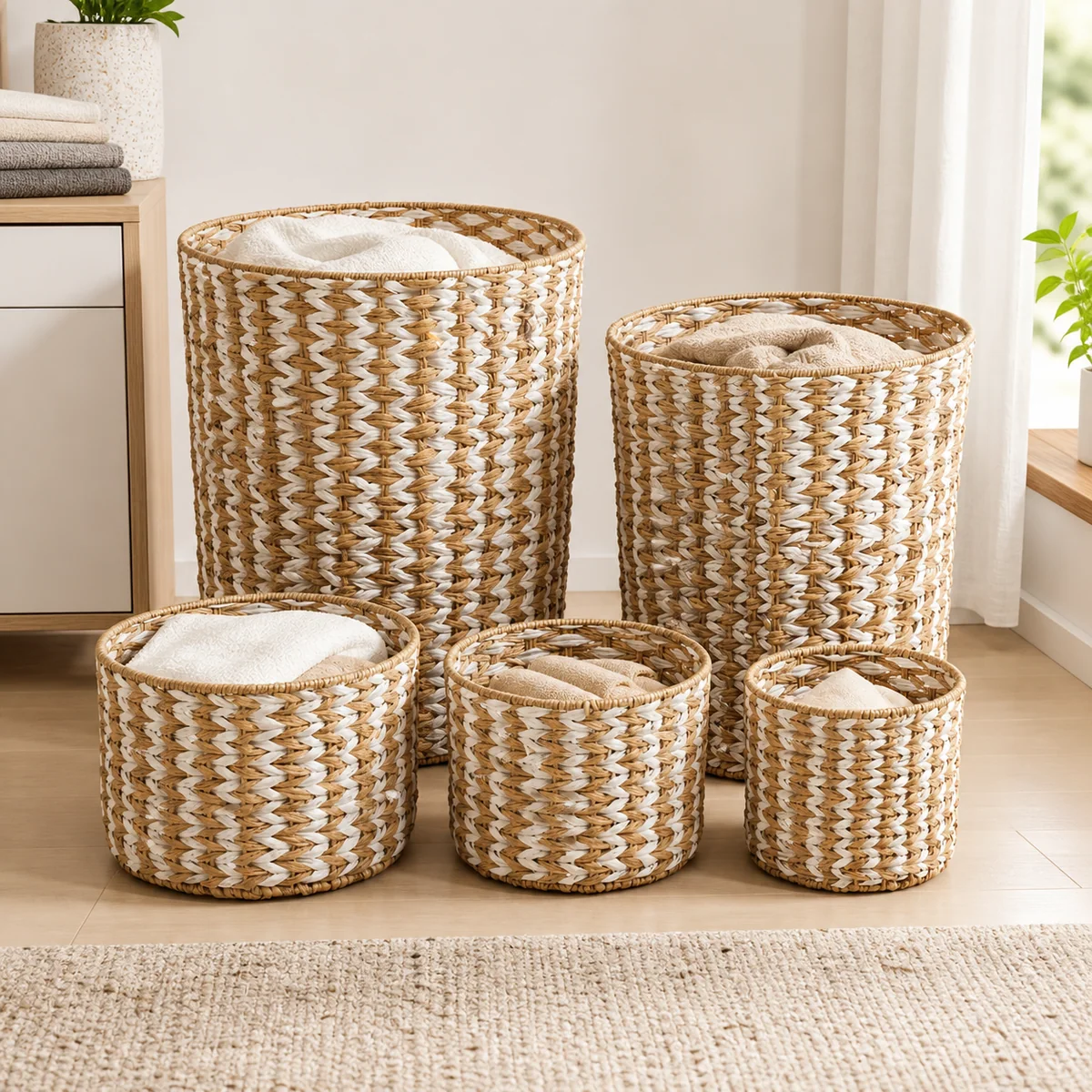
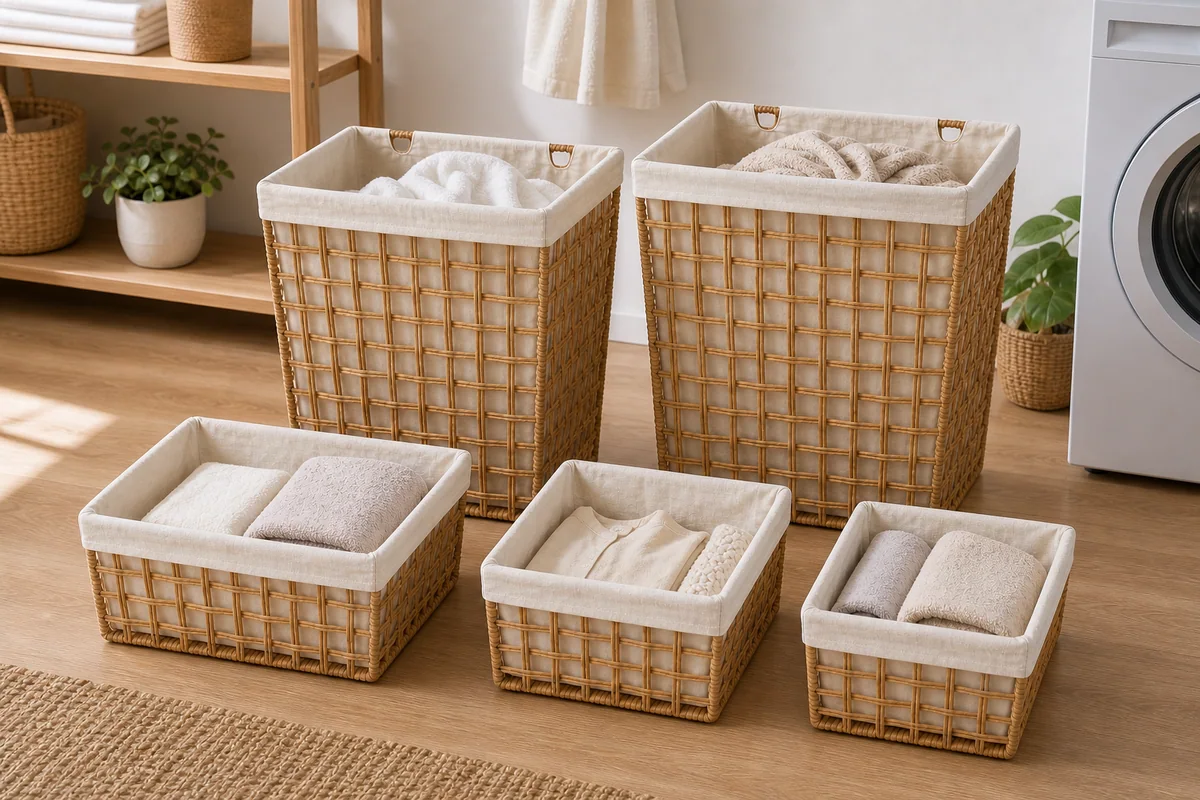
- The catalog shows a five-piece nested paper-rope set and a five-piece rectangular nested hamper set. These illustrate why member identity and nesting evidence matter. They do not publish approved carton dimensions, loading quantity, transit performance, or carrier confirmation.
Treat the CTU Code as safety guidance and the estimate as conditional
- The 2014 CTU Code is non-mandatory global guidance for packing cargo transport units and is under revision. It supports attention to planning, distribution of loads, securing, documentation, and responsibilities; it does not supply a woven-basket utilization factor. A proposed or future revision should not be described as the current rule until formally adopted and applicable.
- A loading estimate is not a freight booking, verified mass record, safe-packing certificate, carton-performance result, moisture guarantee, customs decision, or delivery commitment. Separate regulatory, carrier, port, road, rail, sea, warehouse, retailer, and insurer requirements may apply. Named responsible parties should review the project facts and retain the approved basis.
- JINZHAO CRAFT can measure products, propose nesting, prepare carton options, calculate stated CBM, and perform agreed pack trials. It cannot guarantee the equipment supplied by a carrier, final integer loading, utilization percentage, safe restraint, or arrival condition without the complete approved logistics plan. Use the RFQ route to submit product, pack, route, and equipment assumptions.
Buyer comparison table
JINZHAO CRAFT factory recommendation
For a practical factory quote, share a reference image, target dimensions, material direction, expected order quantity, logo or label needs, retail/export packaging requirements and destination market. JINZHAO CRAFT can then discuss material feasibility, sample direction, MOQ, production timing and export carton planning for the woven storage product.
Primary sources
These references support the defined standards, regulatory context, or buyer process described above. Product-specific obligations and commercial terms still require confirmation for the actual order.
- ISO 668:2020 Series 1 freight containers - Classification, dimensions and ratings — International Organization for Standardization
Supports freight-container classification, dimensions, and ratings context; it does not provide order-specific usable space or basket loading quantity.
- ISO 1496-1:2013 Series 1 freight containers - Specification and testing - Part 1 — International Organization for Standardization
Supports general-purpose freight-container specification and testing context; it does not replace confirmation of the actual equipment supplied.
- IMO/ILO/UNECE Code of Practice for Packing of Cargo Transport Units — United Nations Economic Commission for Europe
Supports non-mandatory global guidance on safe CTU packing, load distribution, securing, documentation, and responsibilities; it supplies no basket utilization factor.
- SI Units — National Institute of Standards and Technology
Supports consistent SI-unit use and conversion; it does not establish carton dimensions, CBM inputs, equipment capacity, or loading results.
FAQ
Should carton CBM use inside or outside dimensions?
Use closed external carton dimensions for CBM and spatial loading. Use inside dimensions separately to evaluate product, set, protection, and sales-unit fit.
How should nesting depth be recorded for handmade baskets?
Trial representative identified units, record orientation, first-piece height, incremental heights, insertion clearance, protection, deformation, removal, difficult combinations, and the approved variation basis.
Why is theoretical volume utilization not the same as loading utilization?
It omits or simplifies integer layout, door access, internal protrusions, payload, load distribution, stack limits, bracing, voids, mixed cargo, and operating practice.
When is a physical carton or loading trial necessary?
Use risk, novelty, pack complexity, compression sensitivity, channel requirements, shipment value, and unresolved geometry to decide. A new nested set normally needs evidence beyond arithmetic.
Who confirms the container dimensions and final loading quantity?
The forwarder or carrier should confirm the specific equipment and applicable limits; the packing party confirms execution. The buyer approves the commercial plan and assumptions.
Products relevant to this guide
Review current factory product examples, then send target dimensions, quantity and customization requirements for an exact quotation.
Continue learning
General Storage Basket Functional Specification Matrix
Translate intended storage use into controlled fields for usable space, access, handles, contact surfaces, closure, liner, nesting, and pack verification.
Read guide →OEM/ODM & SourcingSupplier Quote Normalization and Cost-Driver Matrix
Normalize woven-basket supplier quotes to one sell unit, specification, pack, quantity, currency, and delivery point while keeping duty assumptions separate.
Read guide →Packaging & LogisticsMoisture-Control, Desiccant, Liner and Ventilation Decision Framework
A route-based framework for choosing and documenting moisture-source controls, packaging barriers, desiccants, ventilation, monitoring, and shipment responsibilities for woven baskets.
Read guide →Packaging & LogisticsEcommerce and Retail Transit-Test Planning Reference
A distribution-path method for selecting candidate ISTA test procedures, representative samples, damage criteria, deviations, retest triggers, and responsibility for woven basket packaging.
Read guide →