Direct answer
Moisture control for woven baskets is a route-specific system, not a universal desiccant recipe. The decision must connect material and component condition, production and packing environment, time before sealing, carton and liner permeability, voyage duration, temperature change, container condition, destination climate, storage, and acceptance evidence. Source reduction and verified pre-packing condition come before deciding whether a barrier, ventilation, desiccant, or monitoring device is appropriate. A sealed liner and active ventilation can work against each other unless their functions and airflow paths are defined. Desiccant type and dose need a packaging or logistics owner’s calculation and approval; no generic dose or moisture threshold is supplied here. Records must preserve material lots, instrument status, packaging BOM, sealing time, approved controls, photographs, route assumptions, and arrival feedback.
Direct answer: control the moisture route, not one symptom
- A wet, stained, softened, odorous, mould-affected, or deformed basket at destination can result from material condition, production environment, incomplete drying, wet packaging, humid loading, temperature cycling, condensation, container condition, storage, or water ingress. Adding desiccant without identifying sources may consume capacity early while leaving the actual exposure unchanged.
- This framework covers natural and paper-based woven products, textile components, cartons, liners, desiccants, ventilation, container checks, monitoring, and evidence. It does not set one moisture-content limit, relative-humidity limit, equilibrium target, desiccant dose, ventilation opening, drying time, storage period, or guaranteed arrival condition for every material and route.
- The buyer or packaging owner defines product condition, route, destination, acceptance, and evidence requirements. The supplier controls approved materials, processing, packing environment, timing, and records. A packaging specialist, forwarder, or carrier confirms barrier, desiccant, ventilation, container, and route assumptions where needed. Responsibilities should remain visible instead of being reduced to add bags inside container.
Map material, package, storage, transit, and destination inputs
- Material inputs identify woven substrate, frame, liner, handles, labels, adhesives, coatings, carton board, and protective components, with lot, storage, processing, and known moisture sensitivity. Record whether a value describes surface reading, material moisture content, ambient relative humidity, or temperature. These terms are not interchangeable and require a stated method and purpose.
- Packaging inputs include sales unit, inner pack, carton, holes, films, bags, liners, seals, desiccant format, placement, contact risk, saturation indication, and pallet or container arrangement. Storage inputs include time, temperature and humidity history, floor and wall clearance, rain exposure, ventilation, and the interval between final process, measurement, packing, and sealing.
- Transit inputs include mode, origin, season, route duration, transshipment, temperature ranges, container ownership and condition, loading environment, and destination storage. Destination inputs include climate, unloading delay, warehouse conditions, retail or ecommerce channel, and acceptance evidence. Where these facts are unknown, the record should show uncertainty and escalation rather than inventing a generic control.
Remove sources before selecting barrier, desiccant, or ventilation
- Start by preventing avoidable water and humidity load: protect raw materials and cartons, control wet processes, complete the project-approved conditioning or drying step, keep packed goods away from damp floors and walls, inspect roofs and containers, avoid rain loading, limit exposure between measurement and sealing, and reject visibly wet packaging. Record corrective action instead of concealing it with extra desiccant.
- Then define the package's intended moisture logic. A barrier or sealed liner limits exchange but can trap moisture already inside. Ventilation permits exchange and may reduce some condensation conditions, yet it can also admit humid air. The liner and ventilation interaction can conflict; do not combine them without defining the source, airflow path, barrier continuity, expected environment, and monitoring method.
- Only after the package and route are characterized should the responsible specialist select desiccant chemistry, unit capacity, quantity, placement, containment, replacement, disposal, and safety instructions. The approved desiccant dose must be project-specific and tied to package volume, barrier properties, initial moisture load, exposure duration, conditions, and safety. This page supplies no universal dose.
Use the Moisture Risk Route and Control Gate
- The route has six nodes: Material Release, Packing Environment, Package Exchange, Transport Exposure, Destination Handling, and Feedback. At each node, record the moisture source, evidence, responsible party, uncertainty, control, verification, and trigger for escalation. A control is accepted only when it addresses a named source and does not undermine another approved control.
- Decision options include source elimination, additional conditioning, delayed sealing, improved dry storage, carton replacement, barrier or liner, controlled ventilation, approved desiccant, separation from container surfaces, container inspection, route or season change, monitoring, and destination handling instructions. Multiple controls may be selected, but each needs a rationale, owner, verification, and incompatibility review.
- The release gate asks: are materials and packaging within the project-approved condition; is the measuring process identified and credible; is the packing environment acceptable; are the barrier, ventilation, and desiccant functions compatible; is the route current; are container checks complete; are quantities and placements documented; and are destination and exception actions assigned? A missing answer creates a hold or qualified risk decision.
Avoid trapped moisture, contradictory controls, and misapplied wood rules
- Typical source failures are packing freshly processed or damp goods, using cartons stored against a wet wall, loading during rain, sealing before measured condition stabilizes, and relying on one convenient surface reading. Instrument failures include unknown resolution, no status record, inconsistent locations, different product states, and comparing values taken by unrelated methods.
- Package failures include placing desiccant where it leaks or touches product, using an unapproved dose, closing ventilation holes with film, perforating a barrier without documenting the effect, assuming liner means waterproof, and failing to account for air initially enclosed. An indicator or logger can record conditions but does not itself remove moisture or prove root cause.
- ISPM 15 concerns regulated wood packaging material and dunnage within its defined scope. It should not be represented as a moisture rule for cartons or woven plant-fibre baskets themselves. A wood pallet may require separate assessment, but an ISPM 15 mark does not prove the product is dry, mould-free, safe, compliant, or protected from container condensation.
Retain measurements, packaging BOM, route assumptions, and arrival feedback
- The evidence package should contain material and component lots, process and storage history, packing-area conditions, product measurement method and results, instrument identity and status, carton and liner condition, packaging BOM, desiccant specification and approved dose, placement map, ventilation plan, seal time, container inspection, loading photographs, route assumption, and named approvals.
- The CTU Code supports attention to climatic stresses, condensation, cargo suitability, CTU condition, and packing responsibilities but provides no basket moisture threshold or desiccant recipe. ISO 10012 supports confidence in measurement processes without choosing a limit. ISTA procedures may include defined conditioning in particular test programs, but laboratory conditioning does not guarantee actual voyage conditions or arrival.
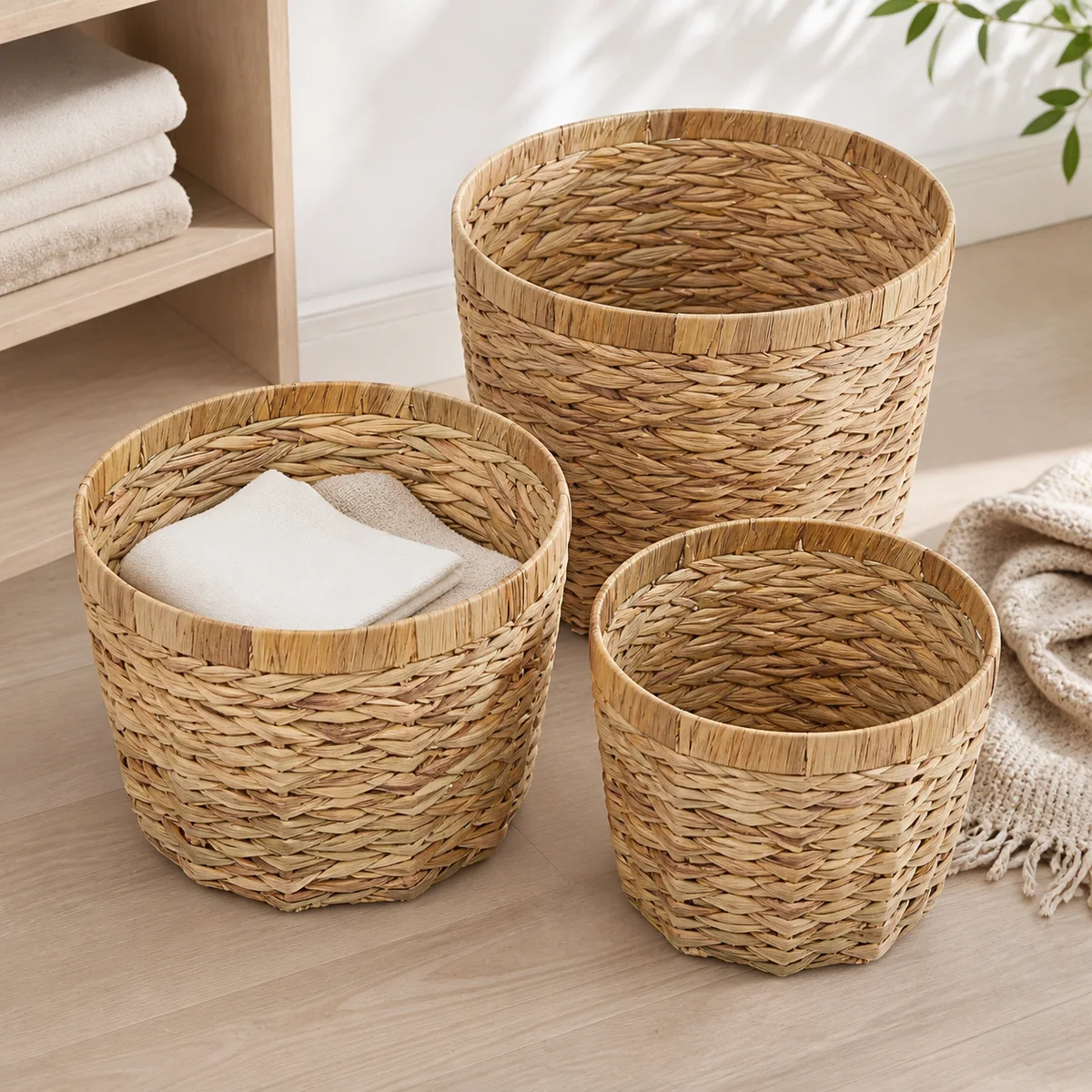
- The catalog includes a water-hyacinth nested storage set and a water-hyacinth laundry hamper. They illustrate material and pack contexts that require project-specific moisture records. Their pages do not publish moisture limits, desiccant doses, transit tests, or arrival guarantees.
Keep route controls separate from biological, performance, and compliance conclusions
- A recorded moisture value is not automatically a mould test, microbial assessment, safety conclusion, product-performance result, or legal limit. An absence of visible mould at packing does not guarantee later condition. If a market, retailer, material, claim, or incident creates a biological or chemical question, use competent testing and current requirements rather than extending this logistics framework.
- ISTA testing can help evaluate a defined packaged-product test plan, but a test result applies to the identified specimen, packaging, procedure, conditions, and acceptance criteria. It does not certify every production pack or every route. Likewise, the CTU Code is guidance, and ISPM 15 scope should be checked only for qualifying wood packaging material and dunnage.
- JINZHAO CRAFT can document material lots, packing conditions, approved packaging steps, measurements, desiccant placement, carton condition, and photographs. It does not promise dry arrival on every route, prescribe universal moisture values, or replace a packaging engineer, carrier, laboratory, or responsible market operator. Route assumptions and exception ownership must be confirmed before release.
Buyer comparison table
JINZHAO CRAFT factory recommendation
For a practical factory quote, share a reference image, target dimensions, material direction, expected order quantity, logo or label needs, retail/export packaging requirements and destination market. JINZHAO CRAFT can then discuss material feasibility, sample direction, MOQ, production timing and export carton planning for the woven storage product.
Primary sources
These references support the defined standards, regulatory context, or buyer process described above. Product-specific obligations and commercial terms still require confirmation for the actual order.
- IMO/ILO/UNECE Code of Practice for Packing of Cargo Transport Units — United Nations Economic Commission for Europe
Supports climatic-risk, CTU-condition, cargo-protection, packing, and responsibility context; it does not prescribe moisture limits or desiccant quantities.
- ISO 10012:2026 Quality management - Requirements for measurement management systems — International Organization for Standardization
Supports confidence in managed measurement processes; it does not establish material moisture thresholds, methods, instruments, or acceptance results.
- ISTA Test Procedures — International Safe Transit Association
Supports the existence and published scope of packaged-product test procedures, some with conditioning; it does not guarantee actual transit or arrival.
- International Standards for Phytosanitary Measures — International Plant Protection Convention
Supports checking the defined scope of ISPM 15 for wood packaging material and dunnage; it is not a moisture standard for woven baskets.
FAQ
Who should set the moisture limit for a woven basket shipment?
The buyer and responsible material, quality, packaging, or market specialist should approve a project-specific value, method, state, sample, timing, and acceptance basis.
How should a container desiccant dose be selected?
Use package and route inputs, initial moisture load, barrier behavior, exposure duration and conditions, product safety, supplier data, specialist calculation, and documented approval.
Can a sealed liner and ventilation be used together?
Only with a defined moisture logic. Their functions can conflict, so document barrier continuity, airflow path, source, expected environment, monitoring, and approval.
When should temperature and humidity be recorded?
Choose points relevant to the risk route, such as storage, conditioning, packing, sealing, loading, transit, unloading, and destination, with identified instruments and time.
Does ISPM 15 apply to woven plant-fibre baskets?
ISPM 15 applies to qualifying wood packaging material and dunnage within its defined scope, not automatically to cartons or woven plant-fibre products themselves.
Products relevant to this guide
Review current factory product examples, then send target dimensions, quantity and customization requirements for an exact quotation.

Continue learning
Natural Fiber Basket Terminology, Customs and Claim Evidence Notes
A buyer reference for naming woven materials, documenting composition, reviewing customs descriptions and controlling environmental claims.
Read guide →Materials & ConstructionWater Hyacinth and Seagrass Identity, Moisture and Variation Specification
A buyer reference for declaring water hyacinth and seagrass identity, approving natural variation, and controlling material, moisture, storage, and pack condition without invented universal limits.
Read guide →Packaging & LogisticsNesting, Carton, CBM and Container-Utilization Calculation Reference
A calculation and evidence reference for converting product, nesting, pack, carton, weight, and equipment inputs into reviewable loading estimates without promising container quantities.
Read guide →Packaging & LogisticsEcommerce and Retail Transit-Test Planning Reference
A distribution-path method for selecting candidate ISTA test procedures, representative samples, damage criteria, deviations, retest triggers, and responsibility for woven basket packaging.
Read guide →