Buyers should approve paper rope basket appearance limits with a controlled reference set: one target sample or image, paired acceptable and unacceptable boundary examples for each important feature, written viewing conditions, and a disposition rule. Link every reference to the product revision and inspection instruction, then require unclear or new conditions to be held for buyer review instead of judged from memory.
1. What problem does a boundary sample solve?
A target sample shows the intended product, but it may not explain how much visible variation the buyer will accept. Paper rope baskets are built from many visible elements: rope color, weave path, rim wrap, joins, pattern placement, shape, handles, liners, and finishing details. If reviewers have only a polished target, they can disagree about a production unit that is close to the target but not identical.
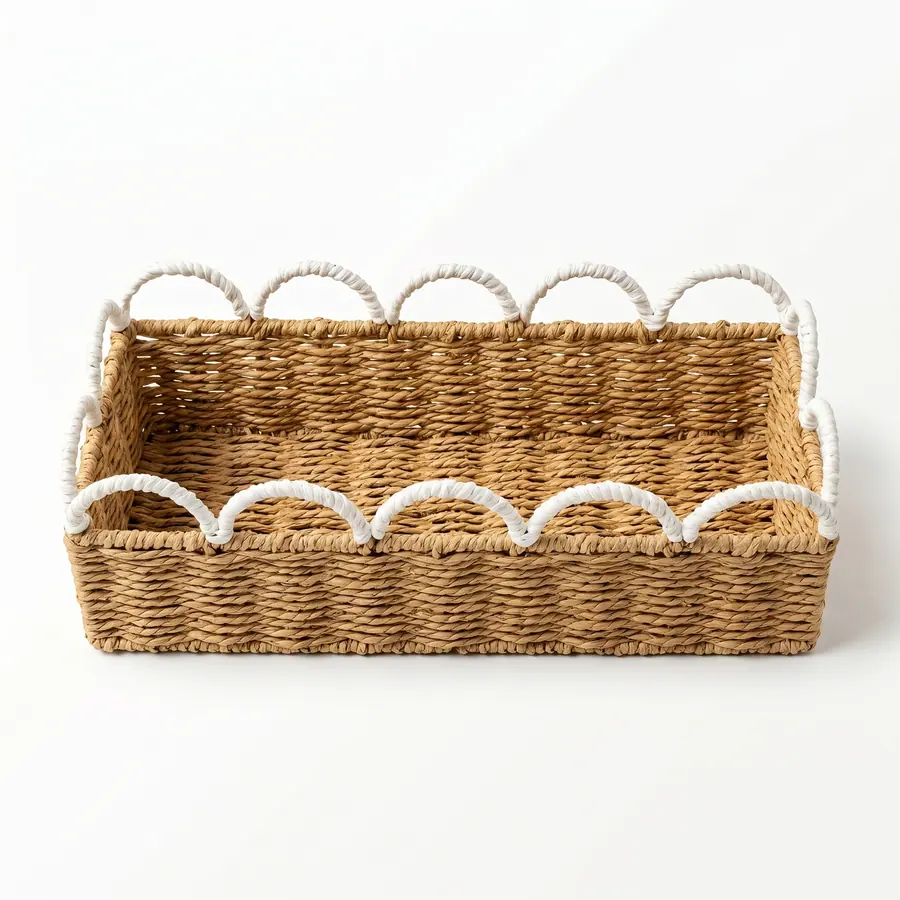
A boundary reference answers a narrower decision: where is the buyer's project-specific limit between acceptable and unacceptable for one named feature? It can be a physical sample, a marked component, or a controlled photograph when the image is sufficient for the decision. It should not be presented as a universal tolerance or as proof that every handmade difference is acceptable. Buyers browsing the paper rope basket range should build limits around the exact selected construction, colorway, size, and selling unit.
Boundary references also reduce vague language. Words such as neat, even, natural, slight, or obvious are difficult to apply consistently without a visible comparison and a written decision rule.
2. How is a boundary reference different from the approved target sample?
The target sample defines what production should aim to reproduce. A boundary reference defines the last approved condition or the first rejected condition for a specific characteristic. These roles should remain separate. A basket should not become the new target simply because it was accepted as the outer limit of one feature.
The pre-production sample review guide helps buyers record construction, dimensions, appearance, packing, and open decisions before bulk work. Add boundary references only where the target and written specification still leave a realistic inspection question. For example, the target may establish the overall white-and-natural pattern, while a boundary pair clarifies when a local pattern interruption at a join must be held.
Name the role on every reference: target, acceptable boundary, unacceptable boundary, or information-only example. Record the product code, revision, feature, viewing side, approval date or event, and approver. Without that identity, an old sample can quietly control a new product.
3. Which appearance characteristics need their own decision?
Do not create one general appearance limit for the entire basket. Break the review into characteristics that can be observed and dispositioned independently. Select only those that matter to the product presentation or use; a long uncontrolled defect vocabulary creates more argument, not more control.
| Characteristic | What the buyer should define | Useful reference evidence |
|---|---|---|
| Material and color range | Governing color or material reference and the viewing condition | Target plus range examples photographed together |
| Weave route or motif | Expected repeat, direction, transition, and visible face | Marked front, side, and join images |
| Rim finish | Wrap continuity, join location, exposed ends, and transition points | Close-up acceptable and reject boundaries |
| Shape and opening | Named datum, viewing angle, product condition, and interface that matters | Target view plus measurement instruction |
| Handle appearance | Pairing, placement, orientation, attachment visibility, and clearance | Annotated handle-zone views |
| Surface finish | Loose ends, gaps, marks, adhesive residue, or other named conditions | One feature per boundary pair |
| Set coordination | Which size, color, pattern, and finish relationships must match across components | Full selling-unit lineup |
| Packed recovery | When appearance is reviewed after unpacking and any buyer-defined conditioning step | Before-and-after sequence with timestamps or events |
The table is an approval framework, not a list of claimed defects in a JINZHAO CRAFT order. Each project should identify the applicable rows and mark the others not applicable rather than inventing observations.
4. What makes an appearance photograph usable as evidence?
A photograph should answer one inspection question without hiding the comparison. Capture the target and boundary under the same stated lighting, background, camera distance, angle, and product condition where those factors affect the decision. Include a full-product identity view and a close-up that shows the feature in context. A close crop without product code, side, or location can be mistaken for another SKU.
Avoid using retouched marketing images as limit evidence. Lifestyle photographs can establish product identity and visible design direction, but perspective, styling, compression, and lighting may prevent a reliable comparison. Keep the original controlled files, preserve the image sequence, and annotate the exact area without covering the feature.
If scale matters, include the buyer-approved measurement method or a visible reference used by the inspection instruction. A photograph alone should not imply an unrecorded numerical tolerance. If color matters, write the viewing condition and governing physical or digital reference; the image is supporting evidence, not automatic color measurement.
5. How should buyers build acceptable and unacceptable boundary pairs?
Start from an actual review question raised during development or a realistic risk identified in the specification. Describe one characteristic in neutral language. Then compare examples against the target and decide which condition is still acceptable, which condition must be rejected or held, and why that distinction matters to the selling unit.
Use paired examples whenever possible. An acceptable boundary without an adjacent reject example may still leave the decision open. A reject example without an acceptable outer limit can encourage reviewers to reject harmless variation. If no representative physical example exists, create a controlled annotated photo set from reviewed samples rather than modifying an image to simulate evidence.
Do not combine several differences in one pair. If the acceptable basket has a different color, rim, shape, and pattern from the reject basket, the reviewer cannot know which feature caused the decision. Keep one controlling characteristic per pair and reference the other specifications separately.
Approval should state whether the boundary applies to every unit, a buyer-selected inspection sample, one visible face, a matched pair, or the complete selling set. These are buyer choices for the actual order, not fixed industry rules.
6. How can a five-piece set be controlled without demanding identical pieces?
A coordinated set needs both component-level limits and set-level relationships. Review each size for its own rim, weave, shape, and finish, then review the complete lineup for pattern direction, color relationship, component identity, and the visual hierarchy expected in the selling unit. The goal is controlled coordination, not an unsupported promise of perfect sameness.
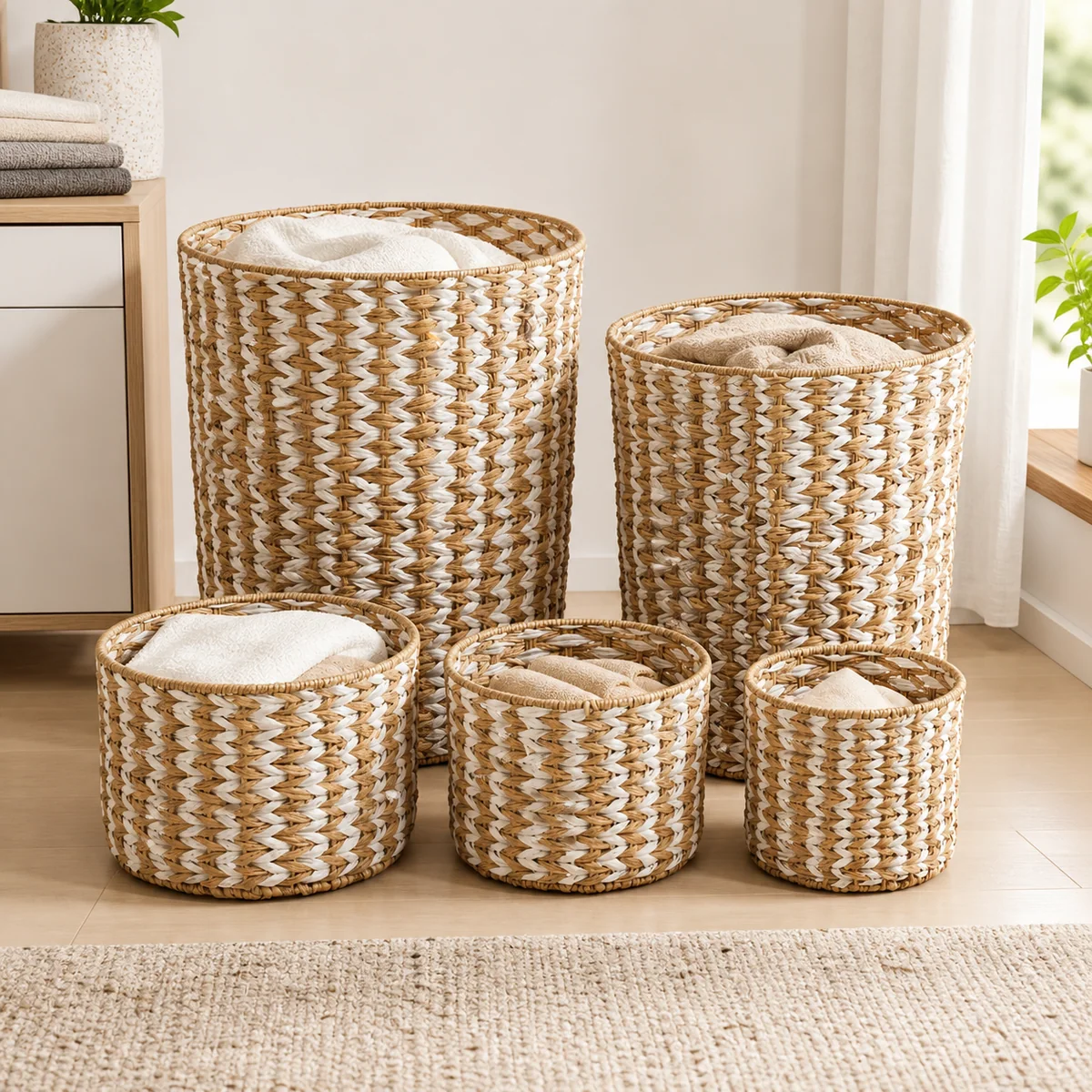
The current CMS identifies JZ20049 as a natural tan and white round five-piece paper rope hamper and basket set with chevron weave. Its approved scene image visibly shows two taller and three smaller round open baskets with alternating natural and white woven areas. Those observations support product identity for this guide. They do not establish an actual order's appearance limits, material tolerance, color standard, inspection result, performance, MOQ, sample timing, lead time, or pack-out result.
For a similar set, a buyer could map which motif direction should be consistent, where size-related changes are expected, and which component relationships are checked together. The actual decisions still require reviewed project samples.
7. How should appearance limits enter an inspection instruction?
Translate every approved boundary into a short instruction with five fields: characteristic, reference ID, review condition, decision rule, and evidence to retain. The inspector should be able to locate the feature, compare it with the correct reference, and record pass, reject, or hold without searching through email.
Connect the instruction to the current product specification, target sample, and order revision. The common woven basket quality guide can help buyers organize prevention topics, but the order-specific instruction must state which conditions apply. Do not copy a generic defect list into a release plan without mapping each item to the product.
If a condition is between examples, appears in a new location, or combines several features, the instruction should route it to hold and review. A boundary library cannot safely decide a condition it does not describe. Record the product code, quantity or sample identity, photos, reference used, and reviewer decision so later teams can understand the disposition.
8. What should happen when a new appearance condition is found?
First preserve product identity and the observation. Photograph the full unit, the affected side or component, and the close-up under the stated review condition. Record where and when it was found, which reference was consulted, and why the existing boundary did not resolve it. Segregate or hold the affected scope according to the buyer's agreed process while the decision is open.
The buyer should then decide whether the condition is acceptable for the identified scope, requires correction or sorting, or needs a new controlled boundary for future reviews. A one-time acceptance should be labeled as a deviation for that defined order or quantity; it should not silently revise the permanent specification. If the condition reveals that the target or instruction is unclear, update the controlled documents through the agreed change process.
Do not erase the original evidence after a decision. Keep the rationale, affected scope, effective point, and superseded reference so a repeat order does not inherit an unexplained exception.
9. How can buyers avoid over-controlling handmade appearance?
Only control characteristics that affect the agreed product identity, presentation, interface, or buyer requirement. The guide to avoiding over-specification explains why absolute uniformity can conflict with the way a handmade product is built. Boundary samples should make a necessary limit clearer, not convert every visible difference into a defect.
Prioritize the feature as critical to the project, important to selling-unit consistency, or informational. Use neutral descriptions instead of emotional labels. Review the product in the condition in which the decision matters: opened after the agreed pack-out, placed on the defined surface, assembled as a set, or viewed from the named retail face.
Retire boundaries that no longer match the current construction, material, colorway, size, or packaging state. More reference images do not automatically create better control; a smaller current set with clear ownership is safer than a large folder of conflicting examples.
10. Copy this boundary-sample approval checklist
- Identify the exact product, component, colorway, size, set, and revision.
- Name the target sample or image separately from every boundary reference.
- Define one observable characteristic for each acceptable and unacceptable pair.
- State lighting, angle, viewing side, distance, product condition, and measurement method where relevant.
- Record the reference ID, owner, approval event, applicability, and effective order.
- Map the boundary to the inspection instruction and required evidence.
- Route unclear, combined, or new conditions to hold and buyer review.
- Label one-time acceptances as scoped deviations instead of permanent specification changes.
- Retire superseded references and preserve the decision history.
- Send the product revision and proposed appearance-control plan through the RFQ form for a comparable sourcing discussion.
11. Frequently asked questions
Is a boundary sample the same as a golden or target sample?
No. A target sample shows the intended product configuration. A boundary sample or controlled boundary image shows an acceptable outer limit or an unacceptable condition for one named characteristic. Both should identify the product revision, but the boundary should not replace the target.
Can buyers use photographs instead of physical boundary samples?
Yes, when the characteristic can be judged reliably from a controlled image and the viewing conditions, product identity, location, and reference role are recorded. Physical references may still be necessary when texture, color, shape, fit, or another feature cannot be decided reliably from photographs.
Should every handmade variation receive a boundary sample?
No. Create boundaries for characteristics that affect the agreed product identity, presentation, interface, or another buyer requirement and that cannot be decided clearly from the target and written specification. Do not build a separate limit for every harmless visual difference.
What should an inspector do when a unit falls between two examples?
Record the product identity, location, observation, photos, and references used, then place the defined scope on hold for the authorized buyer decision. The inspector should not invent a midpoint rule unless that rule already exists in the approved instruction.
Does accepting one shipment condition change the permanent appearance limit?
Not automatically. Record whether the decision is a one-time deviation for a defined order or a controlled specification change. A permanent limit changes only when the authorized owner updates the applicable reference, instruction, revision, and effective point.