Before bulk packing, buyers should approve one versioned packaging bill of materials, or BOM, that identifies every selling-unit, inner-pack, and master-carton component; its reference, artwork or data owner, quantity basis, placement, approved alternative, and verification evidence. Link that BOM to the approved product, pack-out sample, carton matrix, and inspection plan, then block unrecorded substitutions or leftover materials from entering the run.
1. Why does packaging need its own controlled BOM?
A product specification describes the basket, but it does not automatically control every item that travels with or around it. A paper rope basket program may involve a fabric label, hangtag, barcode label, care card, protective wrap, separator, selling-unit band, inner carton, master carton, tape, and carton mark. If those items are scattered across emails, artwork folders, and supplier notes, a correct basket can still enter an incorrect retail pack.
The packaging BOM should be the index that connects each component to an approved reference. It does not replace artwork, a physical pack-out sample, or the carton plan. It tells reviewers which controlled file or sample governs each item and which revision is current. Buyers comparing the paper rope basket range can use the same structure across different shapes and sets while keeping the actual component list specific to each SKU.
Existing packaging decisions still happen before BOM release. The private-label packaging options guide helps buyers choose formats from the selling unit outward. The BOM begins after those formats have been selected: it turns the choice into an identifiable, countable, reviewable release record.
2. Which packaging levels and selling units must be named?
Start with the commercial selling unit. State whether the buyer sells one basket, one nested set, one hamper plus accessories, or another approved configuration. Then map every packaging level around that unit: product-attached items, direct protection, selling-unit packaging, inner-pack components, master-carton components, and any shipment-level identification required by the buyer.
Do not use one word such as carton for several levels. Name the exact level and describe what it contains. A barcode assigned to a selling set is not automatically the right identifier for each component or the master carton. A protective sheet between nested baskets is not the same component as an outer wrap. When a five-piece set nests during packing, define whether each piece receives its own label, whether the set has one shared identifier, and where the smaller pieces are recorded.
Create a simple packaging hierarchy diagram in the controlled file: component to selling unit, selling unit to inner pack if used, and inner pack to master carton. That hierarchy gives artwork, procurement, packing, inspection, shipping, and receiving teams the same vocabulary.
3. What fields belong in an actionable packaging BOM?
Use one row for every distinct component. A component that changes by SKU, language, color, size, market, or artwork revision needs a distinct identity or an explicit applicability rule. Avoid descriptions such as normal label or standard carton because they cannot distinguish the approved item from a leftover or similar-looking item.
| BOM field | Buyer decision | Release evidence |
|---|---|---|
| Pack level | Product-attached, direct protection, selling unit, inner pack, master carton, or shipment level | Approved packaging hierarchy |
| Component code and name | Unique reference that packers and inspectors can identify | Component register or labeled sample |
| Applicable SKU or set | Exact basket, size, color, set, or market using the component | Product-code cross-reference |
| Construction reference | Material, dimensions, finish, closure, or approved physical reference | Drawing, specification, or approved sample |
| Artwork and data revision | Current file name, revision, language, barcode data, and owner | Approved proof and data release |
| Quantity basis | Units per basket, selling unit, inner pack, carton, or another stated level | BOM quantity and pack-out record |
| Placement or orientation | Attachment point, readable panel, facing direction, or sequence | Annotated image or pack-out sample |
| Approved alternative | Named substitute and conditions, or none without written approval | Deviation or substitution approval |
| Verification method | Visual identity, count, placement, scan check, measurement, or another buyer-defined check | Inspection instruction and result |
| Effective revision | Order, date, lot, or release event that starts use | Signed or otherwise authorized release record |
The table should show unknown values as open, not silently convert them into supplier assumptions. Assign an owner and due event to each open row. Bulk packing should not rely on a reviewer remembering which message contained the missing answer.
4. How should artwork, barcode data, and component identity stay aligned?
Artwork approval and BOM approval are related but different. Artwork review confirms the visual and data file; the BOM confirms which physical component uses that file, for which product, at which level, and in what quantity and position. Link the artwork revision directly in the BOM instead of using a folder called final. If a file is replaced, record what it supersedes.
The buyer or other authorized data owner should provide and approve product names, buyer item numbers, language, care wording, barcode data, and market-specific content where applicable. The supplier should not infer a missing code from a similar SKU. The retail label and barcode planning guide separates data ownership, physical label placement, and verification; the BOM should carry those decisions into the released pack.
Use images of the approved printed component and its placement, but keep the source file and revision in the record. A photograph can show appearance and position; it cannot prove that the underlying barcode data or wording belongs to the correct selling unit.
5. How should quantities and units of issue be controlled?
A BOM quantity is meaningful only when its basis is explicit. One per item, one per selling set, one per inner pack, and one per master carton are different instructions. For nested sets, state whether protectors are counted between components, around the completed set, or both. For mixed-SKU cartons, identify which component follows the SKU and which follows the carton.
Reconcile the component requirement against the approved order and carton matrix before release. The purpose is not to publish a universal allowance or waste factor. Buyers should define how issued, used, damaged, returned, and remaining controlled materials are recorded for the actual project. A shortage should trigger review before an unapproved replacement appears. An unexplained surplus of printed labels should not be treated as evidence that every selling unit was labeled correctly.
Record the unit of issue in plain language and keep any conversion visible. If labels arrive on rolls, cartons are received flat, or sets use several protectors, packing instructions should translate the purchasing unit into the pack-level quantity without changing the approved BOM basis.
6. What should the pack-out sample prove before bulk packing?
The pack-out sample tests whether the released components work together around the approved product. Review component identity, product identity, nesting sequence, protection at contact points, label position, barcode or data presentation, insert order, closure, carton arrangement, readable marks, and the condition of the basket after unpacking. Record any product-specific check that the buyer requires rather than relying on a generic pass statement.
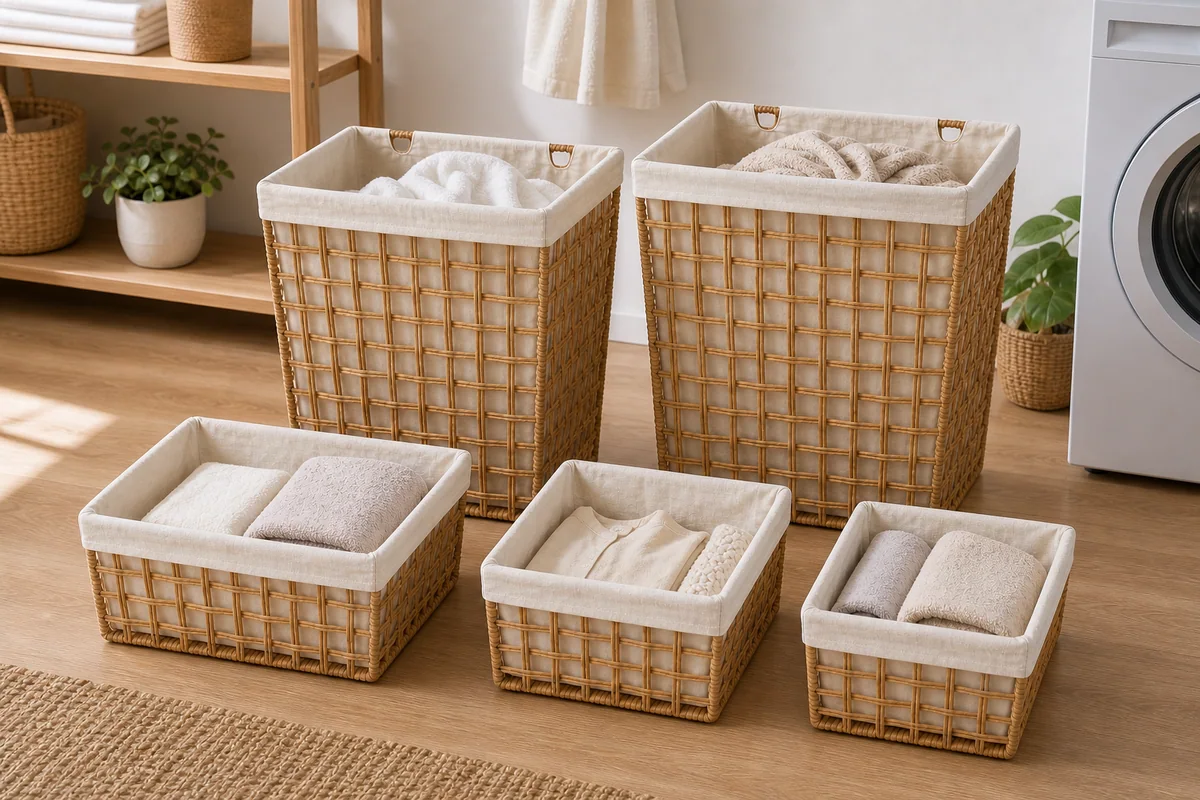
For example, the current CMS identifies JZ10032 as a natural tan rectangular five-piece paper rope hamper and basket set with cream fabric liners. Its scene image visibly shows two tall and three shallow rectangular baskets. Those facts establish a useful product reference; they do not establish an actual buyer-specific packaging BOM, label set, protection method, carton quantity, packing result, tolerance, or shipment performance. Any order based on that reference needs its own approved packaging record.
Photograph the approved pack-out in a sequence that another reviewer can understand: empty components, product protection, nesting or assembly, selling unit, carton arrangement, closure, and finished marks. Cite the BOM and artwork revisions visible in that approval.
7. How should line clearance and the first packed unit be released?
Before the run begins, the packing area should contain the correct released product and components for the identified job. Buyer requirements can ask the responsible team to record removal or segregation of obsolete labels, cartons, inserts, and samples from previous work; confirmation of the current BOM and artwork revisions; product and component identity; and the status of measurement, scan, or inspection equipment required by the approved plan.
This is a buyer control framework, not a claim about a specific factory's routine. Define who completes the check, who reviews exceptions, and what evidence is retained. Then build and review the first packed selling unit and, where relevant, the first completed carton against the approved pack-out. Mark any blocked or conflicting check as open or hold rather than assuming it passed.
The first-unit record should cite the exact order, SKU, BOM revision, artwork revision, pack-out sample, date or event, and reviewer. Approval of one first unit does not remove the need for the agreed in-process and final checks.
8. How should the BOM connect to cartons and mixed-SKU packing?
The BOM owns component identity and quantity, while the carton matrix owns what selling units or SKUs enter each carton pattern. Connect the two without merging them into an unreadable file. For every carton pattern, identify the applicable selling-unit BOM, carton component code, labels or marks, protection, count basis, and pack-out reference.
Use the export carton planning guide to document packed dimensions, pressure points, readable panels, and physical pack-out evidence for the actual project. When several SKUs share one carton, reconcile the exact assortment and the SKU-specific printed components. A correct total label count cannot prove that the correct label reached each variant.
Inspection and receiving records should use the same component codes and carton-pattern names. This makes a mismatch traceable to a specific item and revision instead of a vague packaging issue.
9. How should substitutions and late changes be handled?
Treat every proposed material, dimension, artwork, label, protection, carton, quantity basis, placement, or pack sequence change as a controlled decision. Record the requested change, reason, affected SKUs and orders, comparison evidence, owner, approval status, and effective point. If evaluation requires a revised component proof or pack-out sample, keep the current release on hold until that evidence is reviewed.
Do not let verbal urgency rewrite the BOM. A named approved alternative can be listed in advance with clear conditions, but similar appearance alone is not approval. Keep withdrawn revisions and identify which packed quantity, if any, used each version. The objective is traceability and a clear buyer decision, not a claim that every change is unacceptable.
10. Copy this packaging BOM release checklist
- Define the selling unit and every packaging level around it.
- Give each component a unique name or code and an exact applicability rule.
- Link construction, artwork, barcode data, language, placement, and quantity to controlled references.
- State the quantity basis and unit of issue for every component.
- Name any approved alternative and require written review for all other substitutions.
- Reconcile the BOM with the order, product-code map, carton matrix, and inspection plan.
- Approve a physical pack-out and record the product and packaging revisions used.
- Complete line clearance and first-packed-unit evidence before bulk packing release.
- Keep mismatches, blocked checks, and late changes open until an authorized owner closes them.
- Send the controlled product and packaging brief through the RFQ form when requesting a comparable quotation.
11. Frequently asked questions
Is a packaging BOM the same as a packing instruction?
No. The BOM identifies every approved packaging component, applicability rule, revision, quantity basis, and evidence reference. The packing instruction explains the sequence and method used to assemble those components around the product. The two records should reference each other and the approved pack-out.
Should every label or protector have its own BOM row?
Use a separate row when a component has its own identity, applicability, revision, quantity, placement, or verification rule. Components that differ by SKU, market, language, size, color, or artwork should not be hidden behind a generic description.
Can a photograph replace packaging artwork or a component specification?
No. A photograph can support appearance, placement, and pack sequence, but it does not preserve editable artwork data, exact wording, barcode ownership, construction details, or revision history. Keep the controlled source file or specification linked to the BOM.
How should buyers control packaging for a nested basket set?
Define the selling set, identify every component, state the nesting sequence and protection between contact points, assign labels to the correct item or set, and connect the BOM to the carton matrix. Approve the physical pack-out with the exact revisions before bulk packing.
What should happen if an approved packaging component is unavailable?
Record the shortage and proposed alternative, identify affected SKUs and orders, compare construction, artwork, placement, quantity, protection, and verification needs, and obtain the authorized decision. Do not treat similar appearance or an urgent packing date as automatic approval.