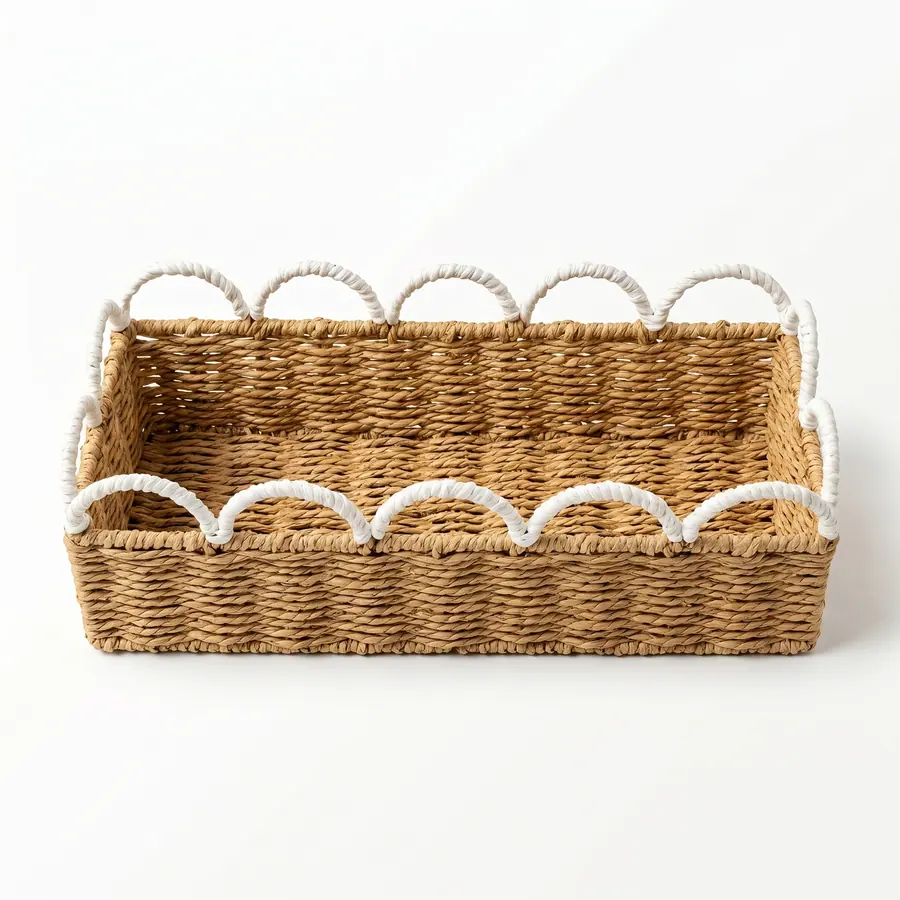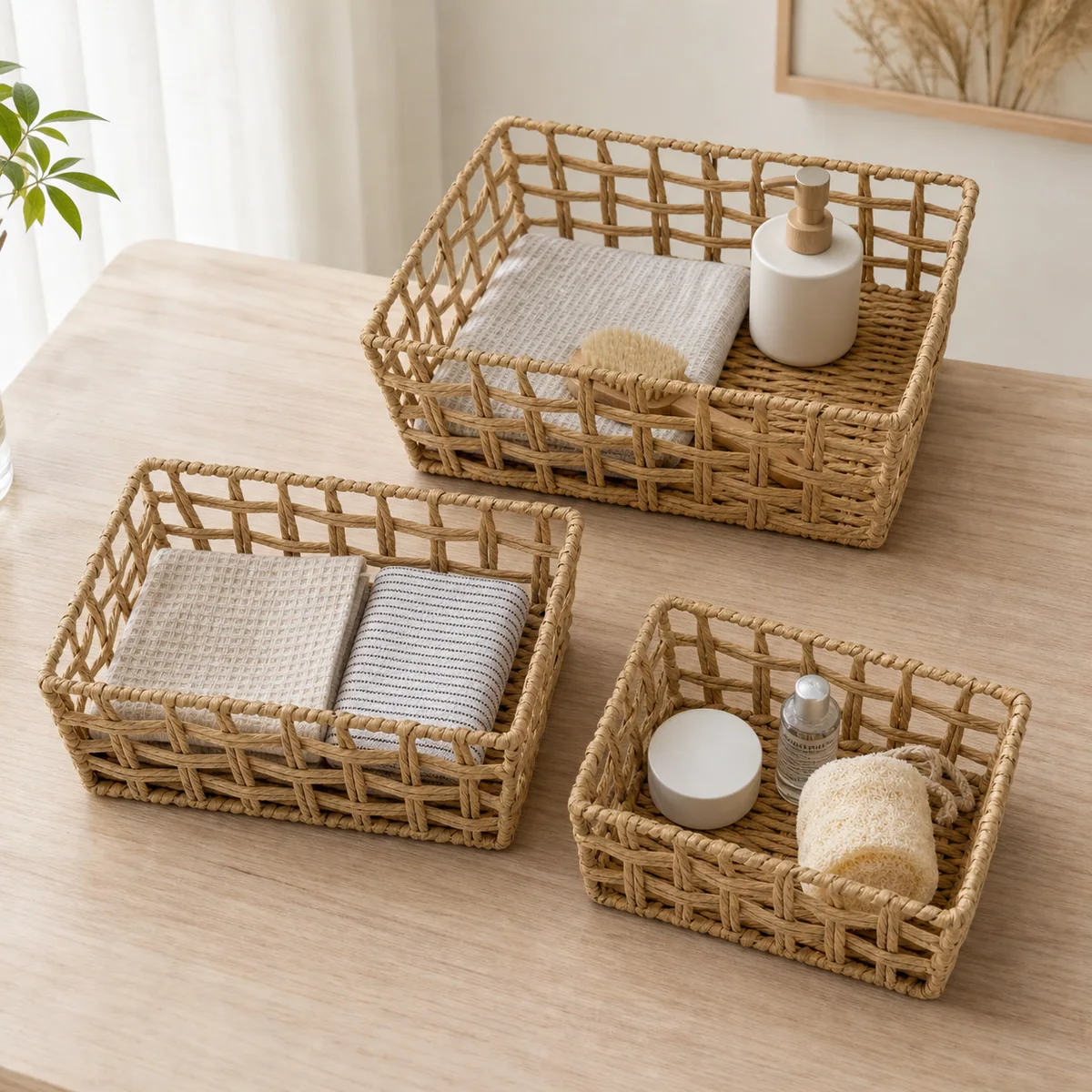
Buyers should specify an open-rail paper rope basket by recording the intended contents, usable inside dimensions, every rail opening, rim and corner construction, and an item-retention trial on the approved sample. The RFQ should also control the three-size set relationship, nesting, labels, pack-out, inspection evidence, and project-specific commercial terms instead of assuming that an attractive open weave will suit every item.
1. Is an open-rail basket right for the intended assortment?
Start with the contents, not the weave name. List representative items by SKU, dimensions, orientation, quantity, fill level, access direction, and whether they are sold with the basket or used only for photography. An open rail can create a light visual presentation, but the buyer must determine whether the actual contents can protrude, fall through, catch, or make the basket difficult to lift from its intended shelf or counter.
JINZHAO CRAFT's current catalog includes JZ10160, a natural tan paper rope three-piece shallow basket set with open rail sides. Its CMS record identifies a rectangular three-piece set, wrapped paper rope rims, open rail side panels, and outside dimensions for each size. The approved scene image shows towels and personal-care items, but styling is not proof that every small item will be retained or that the construction has passed a load, impact, abrasion, or transit test.
Use the paper rope category to compare the current material and form direction, then define the exact use case in the RFQ. If the selling story depends on visible contents, shelf presentation, airflow, drainage, child use, food contact, or another special function, treat that statement as a separate requirement that needs applicable evidence and responsible-market review. Do not infer it from the open appearance alone.
2. Which dimensions and rail openings belong in the RFQ?
Outside length, width, and height are only the starting points. Add usable base length and width, inside opening length and width, internal height to the lowest rim point, rim build-up, corner radius, base thickness, and any taper. For each open side, number the horizontal and vertical rails and identify the largest clear opening after the construction is finished. A photograph without reference points cannot establish these dimensions.
JZ10160's current CMS record lists three outside sizes: 35 × 27 × 17 cm, 31 × 24 × 15 cm, and 27 × 19 × 11 cm. These are product-specific catalog values, not tolerances or usable internal dimensions. Buyers should ask the supplier to confirm the measurement condition, tools, datum points, and actual sample readings. The handmade basket dimensional measurement and tolerance framework provides a structure for setting project-specific rules after sample data exists.
Draw the rail pattern on front, side, and corner views. Record opening width and height at agreed locations, the distance from the base to the first opening, rail spacing near the rim, and the treatment where horizontal and vertical members cross. If several openings differ by design, mark them separately. Do not set an arbitrary universal tolerance: the practical rule must reflect the approved construction, intended contents, measurement repeatability, and the buyer's risk.
3. How should buyers approve item retention?
A useful trial matches the actual assortment rather than using whichever objects are nearby. Prepare a controlled kit of representative contents, including the smallest and most flexible items that the buyer expects the basket to hold. Identify every item, record its dimensions and condition, place it in the basket using an agreed arrangement, and document what happens during the intended handling sequence.
The goal is not to create a universal performance claim. It is to decide whether one defined basket revision is suitable for one defined use. If contents, gap geometry, rail construction, basket size, fill level, handling, or packaging changes, review whether the trial must be repeated. Keep raw observations and photographs; a summary marked simply "pass" does not reveal what was tested.
| Approval field | Buyer must define | Evidence to retain |
|---|---|---|
| Contents kit | Item codes, dimensions, flexibility, quantity, and smallest relevant item | Dated item list and scale-referenced photographs |
| Basket identity | Supplier code, size, drawing, material/component record, and sample revision | Labeled sample and controlled specification |
| Rail openings | Measurement locations and clear opening dimensions | Annotated front, side, corner, and top views |
| Use sequence | Fill, access, lift, carry, place, remove, and any agreed movement | Written method and continuous photo or video record |
| Acceptance | Protrusion, escape, catching, deformation, presentation, and other buyer-approved criteria | Actual observations, exceptions, and disposition |
| Change control | Which content, construction, size, or pack changes trigger review | Approval log linked to the latest revision |
4. What sample evidence shows the open-rail construction?
Ask for a complete sample record rather than one front view. Include top, bottom, all sides, every corner, the rim, the base-to-side joint, rail intersections, terminations, splices, and the transition between dense lower weaving and open upper rails. Identify component codes and approved color references. If an internal frame, reinforcement, adhesive, coating, or other component is proposed, record it explicitly instead of inferring it from appearance.
Use the general storage basket functional specification matrix to connect the intended use to dimensions, structure, contact surfaces, handling, and packing inputs. Add the gap and item-retention appendix described above. Approval should name the drawing, sample, construction record, color reference, and pack instruction that production must follow.
Write comments as controlled actions: approve, approve with listed conditions, or revise and resubmit. A direction such as "make the openings more even" is not measurable. Mark the affected locations, target geometry, observation method, owner, due date, and superseded revision. If the supplier proposes a change to improve nesting or production, the buyer should assess its effect on usable space, gap geometry, presentation, and the retention trial before accepting it.
5. How should the three sizes and nesting relationship be controlled?
Treat the set as one selling unit and as three individual functional products. Assign a buyer SKU to the set and a component code to each size. Record the size order, quantity, color, intended contents, outside and usable dimensions, rail pattern, and label location for every component. Check that images, barcode data, product-page copy, carton quantity, and invoices all describe the same set composition.
For nesting, define insertion orientation, maximum permitted contact points, separators or wraps, rim protection, removal sequence, and whether labels remain readable after unpacking. Record the nested stack dimensions and actual packed arrangement. A set that nests physically may still rub rims, snag open rails, distort corners, hide component labels, or require an unapproved consumer reshaping step. These are sample and pack-out decisions, not conclusions that follow from the word "nested."
If the buyer plans to sell sizes separately as well as in a set, create separate pack and data records. Confirm whether the same sample evidence covers both configurations. Changes to component count, assortment, color split, retail band, insert, or carton orientation can alter packing and presentation even when the individual baskets are unchanged.
6. Which packaging, labeling, and commercial terms prevent quote gaps?
Give every supplier the same selling-unit definition, product and component codes, size table, opening measurements, construction questions, item-retention method, color and artwork status, quantity by set and color, destination, packing request, and inspection evidence. Ask suppliers to state assumptions and exclusions. Otherwise, quotations may compare different rail density, reinforcement, label scope, separators, carton counts, or approval work.
For labels, define product name, set and component codes, color, size representation, quantity, barcode data, country-of-origin input, responsible-business details, languages, care or warning status, artwork owner, revision, attachment method, and location. The responsible buyer, importer, brand, or retailer should determine the claims and destination requirements for the actual product and channel. A paper rope catalog description does not establish fiber percentage, sustainability, washable, food-contact, child-use, load, or compliance claims.
Request current project-specific MOQ, sample scope and charges, revision allowance, quotation validity, payment terms, production timing after approvals, packing basis, Incoterm and named place, and quantity or color-break conditions. These values must come from the current quotation. Submit the controlled brief through the RFQ form only after the open decisions are listed, so suppliers can separate confirmed inputs from proposals that still require approval.
7. What should the pre-shipment checklist contain?
- Match the purchase order, buyer SKU, supplier code, set composition, color, and current revisions.
- Confirm outside and usable dimensions using the approved condition, tools, datum points, and project-specific rules.
- Measure agreed rail openings and retain annotated photographs of front, side, corner, rim, and base details.
- Compare construction, intersections, terminations, splices, reinforcements, and color against controlled references.
- Run only the approved item-retention method on the specified sample or inspection units; record actual observations.
- Verify labels, barcodes, inserts, attachment, position, readability, and component-to-set data relationships.
- Check nesting orientation, protection, removal, packed presentation, carton inputs, and unpacking instructions.
- Record sample basis, findings, affected quantity, exceptions, disposition, rework or sorting, release owner, and evidence links.
The pre-shipment inspection evidence framework can organize sampling boundaries, report inputs, and shipment-release responsibility. Final release should stay with the responsible buyer or authorized party named in the order. If inspection finds a construction or pack revision that was not approved, escalate it instead of treating an appearance-only check as evidence that the change is acceptable.
Frequently asked questions
Is outside basket size enough to quote an open-rail set?
No. Suppliers also need usable internal dimensions, the rail pattern and clear opening measurements, intended contents, set composition, measurement method, construction details, color, labels, pack-out, quantity, destination, item-retention evidence, and current commercial-term requests. Outside size alone can hide different functional and cost assumptions.
Does an open weave prove that a basket is suitable for small items?
No. Suitability depends on the actual item dimensions and flexibility, clear rail openings, fill arrangement, handling method, and buyer-approved criteria. Use a controlled contents kit and the identified sample revision, keep raw observations, and reassess when the contents or construction changes.
Can buyers copy one gap tolerance across all three sizes?
Not automatically. Buyers and suppliers should first define measurement locations and collect sample readings for each size. The acceptance rule should reflect the approved rail pattern, construction, intended contents, measurement repeatability, and risk rather than an unsupported universal number.
Does nesting prove that the set is ready for ecommerce or retail shipment?
No. Buyers must still approve nesting orientation, contact protection, label visibility, packed dimensions, carton arrangement, removal and unpacking steps, presentation, and any distribution evidence required by the actual channel. A physical nesting demonstration proves only the arrangement shown.
What should buyers request before releasing an open-rail basket order?
Request matched order and revision records, dimension and gap measurements, construction photographs, item-retention observations, color and appearance references, label and barcode checks, nesting and pack evidence, inspection scope, findings, exceptions, disposition, and written release by the responsible party.