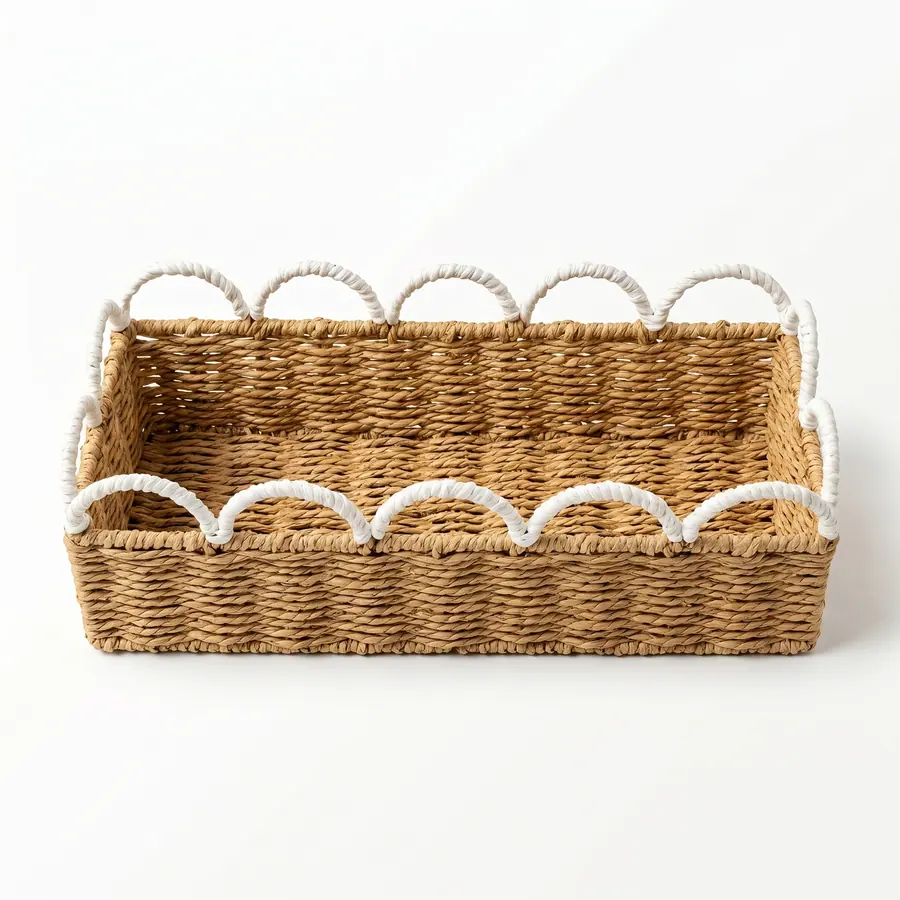
Wholesale buyers should approve a scalloped-rim paper rope hamper with a controlled rim map, not a beauty photo alone. Define the scallop count, high and low points, top-opening datum, rim height range, transition to the body, join location, color boundary, packed position, and project-specific inspection evidence. The approved sample should show which handmade variation is acceptable and which changes fit, presentation, or pack-out.
1. What exactly is being approved at the rim?
A scalloped rim is both a visible design feature and a dimensional boundary. It can affect the opening buyers measure, the height consumers see, the way a liner or insert sits, the product silhouette in listing images, and the points that touch protection inside a carton. An RFQ that says only "wavy edge" leaves the number, depth, spacing, orientation, finishing, and measurement method open to interpretation.
Start with the paper rope category, select the construction direction, and state which rim attributes are identity-critical. A useful control record separates the continuous woven body from the shaped top boundary. It identifies the material terminology, body shape, rim construction, visible color, intended use, selling channel, and components that meet or cross the rim. The buyer then marks which features are fixed by drawing, which are controlled by the approved sample, and which may vary within an agreed visual boundary.
The current CMS lists JZ10036, a pale pink round paper rope laundry hamper, as a tapered form with a scalloped rim. Its recorded dimensions are a 42 cm top diameter, 36 cm bottom diameter, and 27 cm height. These are product-record facts, but they do not define scallop count, peak-to-valley depth, spacing, tolerance, load performance, or durability. Those open fields must be established for the buyer's actual specification.
2. How should buyers turn the silhouette into a rim map?
Create a top-view and developed side-view rim map. Give each high point and low point a reference number, show the direction considered the front, and mark any weave join or finishing transition. If the profile repeats, record the intended repeat count and how the last repeat closes around the circumference. If the pattern is intentionally irregular, replace the repeat rule with an approved outline and clearly labeled visual limits.
Do not use a single front photograph as the entire map. Perspective can hide the far edge, and soft contents can change the visible outline. Retain front, rear, left, right, and top views of an empty sample positioned on a level surface. Add a scale or annotated dimension only where the image is meant to support measurement. A scene image can confirm visible design direction; it cannot establish the unseen side, production range, or bulk consistency.
The map should also identify the rim wrap or finishing path, its start and end location, and the relationship between the rim and body weave. Buyers do not need to prescribe an unverified factory method. They do need one shared description so quotation, sampling, pre-production approval, inspection, and repeat orders all refer to the same visible boundary.
3. Which measurements need fixed datums?
A scalloped product has more than one possible "height." Define whether the nominal height is measured to a high point, a low point, an average reference line, or another annotated datum. Record the product condition: empty or filled, shaped or as-unpacked, and measured after any stated preparation. The top opening should likewise state where diameter or length and width are taken when the edge rises and falls.
For a tapered round form, distinguish the top opening, bottom footprint, maximum outside profile, rim high-point height, rim low-point height, and any fit-critical inside opening. If a shelf, insert, liner, label, or carton creates the constraint, identify that interface beside the measurement. A number without its business reason is easy to measure differently; a datum tied to an interface is easier to review and release.
Use the current JZ10036 measurements only as reference inputs for that listed item. They do not automatically transfer to a new size, color, weave, rim depth, or private-label version. The buyer should ask the supplier to propose realistic project limits after a physical sample exists, then approve or revise those limits against the intended display and pack-out.
4. What belongs in a scalloped-rim approval table?
| Control field | Buyer must define | Evidence to retain | Release question |
|---|---|---|---|
| Product identity | SKU, revision, material wording, body form and color | Controlled specification and labeled sample | Is the inspected item the approved revision? |
| Rim map | Front direction, high and low points, repeat count or approved outline | Annotated top and side views | Does the complete circumference follow the approved map? |
| Datums | Top opening, base, high-point height, low-point height and measurement condition | Drawing plus actual sample readings | Were all readings taken from the same reference points? |
| Finish | Rim wrap, join location, end treatment and body transition | Close-up views of the approved sample | Are joins and transitions in the permitted locations and condition? |
| Interfaces | Liner, handles, labels, lid, insert or shelf constraints | Interface photos and fit observations | Does the rim still allow the intended component or use? |
| Pack position | Orientation, contact points, protection and carton relationship | Approved packed sample and reopening views | Does pack-out preserve the approved selling silhouette? |
| Inspection | Observation quantity, actual findings, exceptions and disposition | Dated report linked to the revision | Can a release decision be traced to recorded evidence? |
Copy this table into the RFQ and sample comment sheet. Replace general adjectives such as "even" or "nice wave" with a defined observation, datum, or reference view. The table should not invent numerical limits before sampling; it should show which decisions need evidence and who will approve them.
5. How should the rim be reviewed with the body and other components?
The rim cannot be approved in isolation from the body. Check whether the high and low points remain aligned with the intended front, whether the tapered wall meets the rim without an unintended step, and whether the base sits in the condition used for the rim review. Examine the complete circumference, not only the camera-facing side. Record any permitted join location so a visually prominent front does not receive an unexpected finishing transition.
Use the laundry basket category to define the commercial use and related options before adding liners, lids, handles, labels, or decorative components. Each added interface can change the rim decision. A liner may need an attachment position below the low points. A handle may interrupt the repeat. A lid would require a separate fit definition. A label or hangtag may pull the edge during packing. None of those outcomes should be assumed from an unmodified sample.
If the buyer changes rim depth, color boundary, body taper, component position, or finishing method, review the affected dimensions and packed condition again. The golden-sample change-control standard can connect the physical sample, drawing, photographs, label files, packing record, and inspection revision so an old approval is not silently applied to a changed product.
6. How should packing protect a shaped rim?
Map every planned contact point in the selling unit and master carton. A scallop high point may contact a bag, insert, another nested item, carton wall, or top protection differently from a straight rim. Record the actual orientation and protection used in the approved packed sample. If units are nested or stacked, show how the upper item bears against the lower item and which surface is intended to carry contact.
After unpacking, place the product in the same condition used for approval and compare the full rim map. Record whether manual shaping, an insert, or a waiting period is part of the agreed procedure. Do not write "returns to shape" unless the project defines the initial packed condition, reopening steps, observation time, acceptance rule, and actual result. A listing image is not evidence of repeated shipment performance.
Private-label teams can use the OEM/ODM development page to discuss color, size, logo, and packaging changes, but every change needs an impact check. A new belly band, hangtag position, inner protector, or carton orientation can alter contact at the rim even when the woven body has not changed. Confirm pack dimensions and quantity from a real approved pack rather than estimating from the open product image.
7. What should QC record before release?
Build the inspection record around observable fields. Identify the SKU and revision, sample reference, viewing condition, measurement datums, rim-map points, join location, body transition, component interfaces, pack state, and reopening procedure. Record actual measurements where the specification requires them, plus photographs that show the full circumference and any exception.
Avoid a one-line result such as "rim passed." The record should show what was examined, how the observation was made, what was found, which units or cartons may be affected, and who decided acceptance, rework, sorting, reinspection, or hold. The buyer must define any sampling rule and acceptance thresholds for the order; this guide does not supply a universal inspection level.
Keep visual variation and functional defects separate. A small handmade shift inside an approved visual boundary is not judged the same way as a rim that changes a fit-critical opening, exposes an unfinished end, blocks a liner, misidentifies the front, or arrives in a pack condition outside the controlled record. This classification lets buyers control the commercial risks that matter without demanding machine-made uniformity from a handmade form.
8. What should go into the RFQ and release checklist?
- State the finished SKU, revision, intended contents, selling channel, destination, and responsible approval owner.
- Attach top, front, rear, and side views showing front direction, every rim high and low point, repeat rule or approved outline, and join location.
- Define top-opening, base, high-point, low-point, and fit-critical datums together with the product condition used for measurement.
- List every liner, handle, lid, label, hangtag, insert, protector, or nested item that meets or changes the rim.
- Approve one real packed sample, contact-point map, reopening procedure, and post-pack observation record.
- Require quotation exceptions, sample changes, inspection findings, and release disposition to reference the same controlled revision.
Send the complete package through the RFQ form. Suppliers can then quote the same rim, body, component, and pack assumptions. Keep MOQ, sample timing, production timing, and commercial terms as current written quotation fields rather than copying an old product value into a new program.
Frequently asked questions
Is a front product photo enough to approve a scalloped rim?
No. A front photo can show the visible design direction, but it may hide the rear profile, repeat closure, join location, measurement condition, and pack contact. Retain top, front, rear, and side views plus a controlled sample or drawing for the complete circumference.
Should hamper height be measured at the scallop high point or low point?
The buyer must choose and annotate the datum. If both affect fit or presentation, record both high-point and low-point heights, the empty or prepared product condition, and the exact points used for measurement. Do not compare readings taken from different datums.
Can the JZ10036 dimensions be used for a new private-label version?
They are verified CMS reference values for the currently listed JZ10036 item only: 42 cm top diameter, 36 cm bottom diameter, and 27 cm height. A changed size, color, weave, rim, component, or pack requires its own sample and approved measurements.
Does a scene image prove that the rim will recover after shipping?
No. A scene image does not establish the packed condition, contact pressure, duration, reopening steps, observation time, or acceptance result. Approve a real packed sample and retain before-pack, as-packed, unpacking, and post-opening evidence for the project.
When should buyers reopen scalloped-rim approval?
Reopen the affected checks when the rim depth, repeat, join, finish, body taper, color boundary, liner, handle, lid, label, protection, nesting, or carton orientation changes. Link the revised sample, drawing, photographs, packing record, and inspection instruction.