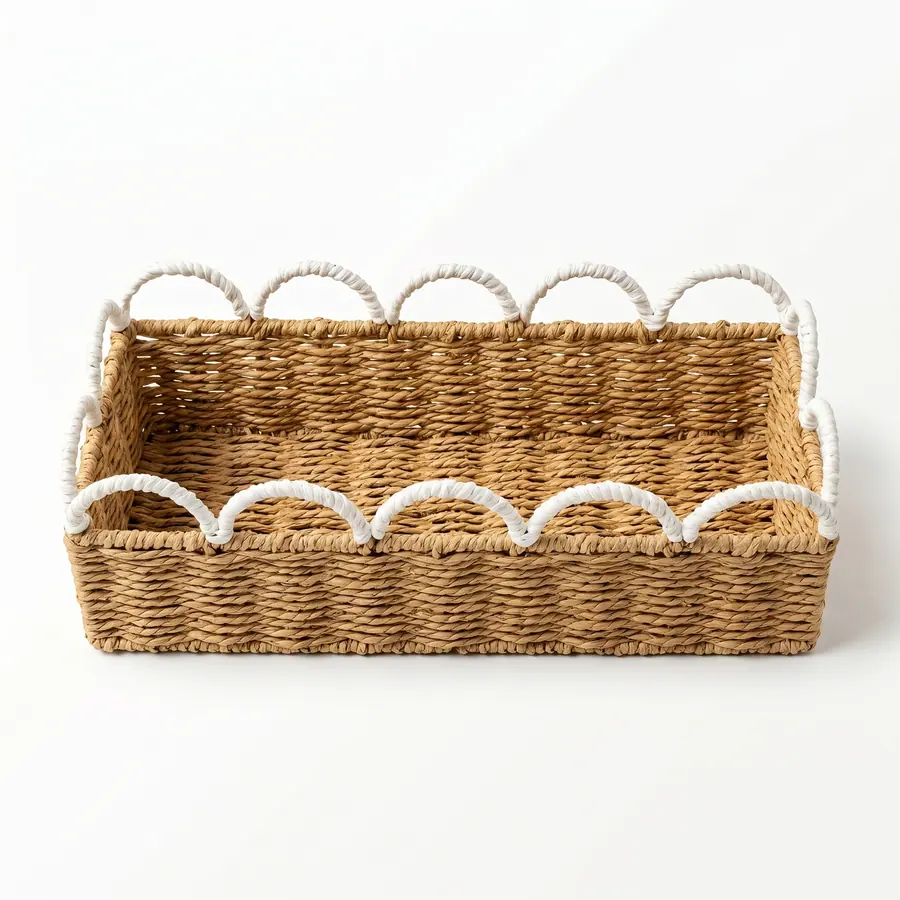
Buyers should approve paper rope basket base contact by defining the intended support surface, the product condition during the check, where the base should contact, what movement counts as unacceptable rocking, and how results will be recorded. Use the same buyer-approved method for samples and production checks. Do not infer stability, load capacity, or retail suitability from appearance, and do not invent a universal tolerance for handmade construction.
1. Separate base contact from general basket appearance
A basket can look round, centered, and visually balanced while its base does not contact the support surface as the buyer expects. Conversely, a visible handmade variation does not automatically create a functional base issue. Treat base contact as its own approval characteristic with a named checking condition and decision rule. Keep it separate from rim geometry, overall height, handle alignment, color, weave appearance, and decorative details.
First identify the structure being checked: a flat woven base, a raised foot, a pedestal ring, separate feet, or another project-specific support geometry. Record the intended contact zone on a drawing, annotated photograph, or sample note. If the buyer expects a continuous ring to contact, say so. If several defined points are intended to contact, identify them. Avoid vague instructions such as “must sit well.”
The handmade basket dimensional tolerance framework explains how buyers can define measurable, project-specific acceptance without demanding impossible visual identity. Use it to separate critical contact dimensions from natural visual variation. This article does not prescribe a universal flatness or rocking limit.
2. Define the reference surface and product condition
A rocking result is only meaningful when the check condition is repeatable. The buyer should state the reference surface used for approval and confirm that it is clean, firm, level for the intended method, and large enough to support the complete base. Do not compare results from a soft cloth, uneven warehouse floor, flexible shelf, and rigid sample table as if they were the same test.
State whether the product is checked empty, with removable packaging removed, after an agreed conditioning or shape-restoration step, or in another buyer-approved condition. If the intended use requires a loaded evaluation, define the load, placement, duration, and safety controls for that project; do not borrow an unverified value from another basket. Empty-base contact and loaded behavior are different decisions.
Record orientation where the base or body is not fully symmetrical. Mark a starting position and, if needed, rotate the basket through buyer-defined positions to distinguish a localized high point from a reference-surface problem. The method should not allow the operator to press, twist, bend, or reshape the basket while judging contact unless that action is explicitly part of the approved procedure.
3. Write an approval table before sampling
A short table turns “check whether it rocks” into a decision that a buyer, supplier, and inspector can repeat.
| Approval field | Buyer-defined requirement | Evidence to retain |
|---|---|---|
| Product identity | SKU, supplier code, size, color, base construction, and sample revision | Approved specification and labeled sample |
| Reference surface | Named surface or fixture and preparation condition | Surface/fixture ID and setup photograph |
| Product condition | Empty or defined project condition; packaging and restoration status | Dated condition note |
| Intended contact zone | Continuous ring, defined points, or annotated area | Base photograph or drawing |
| Rocking action | Where and how the operator applies a light buyer-defined check | Procedure note or short video |
| Acceptance rule | Observable movement, gap, sound, or measurement rule set by the buyer | Recorded result without invented tolerances |
| Orientations checked | Starting mark and any buyer-defined rotations | Orientation labels in evidence |
| Disposition | Accept, hold, recheck, sort, correct, or request a new sample | Named owner and dated decision |
Keep the rule practical enough to execute without improvisation. If the buyer uses a gap measurement, name the instrument, measurement points, resolution, and project-specific limit. If the decision is visual or tactile, describe the exact action and result categories. Do not call an internal method an industry standard unless an agreed specification actually names and supports one.
4. Approve the sample without turning it into an unsupported performance claim
During sample review, verify the product identity first. Then photograph the top view, side views, underside, and contact zone on the approved surface. Record the observed base geometry and any movement using the agreed method. The purpose is to decide whether this sample becomes the reference for base contact, not to prove load capacity, durability, tip resistance, food contact, or suitability for every use.
Compare the base decision with related dimensions such as footprint, pedestal or foot height, body centerline, and overall height where those fields affect the project. Do not “correct” an out-of-scope dimension merely because the basket rocks; record the observation and determine which characteristic is actually outside the approved requirement. The pre-production sample review guide provides a broader approval record for linking observations to revisions.
If the sample fails, state the observable failure and requested next action. Useful dispositions include holding approval, requesting a corrected sample, revising a realistic requirement, adding a fixture or process check, or separating products that meet and do not meet the rule. Do not invent the manufacturing cause from one image. A high contact point, distorted support ring, body lean, packing deformation, or reference-surface issue may require different evidence.
5. Translate the approved method into production QC
After sample approval, copy the same product condition, reference surface, orientation, action, acceptance rule, and evidence fields into the production inspection instruction. Define when checks occur and how the inspection plan selects units. The buyer should set the sampling scope based on the project and inspection arrangement; this guide does not supply a universal sample size or acceptance number.
Ask production and QC teams to keep failed units identified by SKU, size, color, carton or lot reference where available, and the exact observed result. A count without product identity cannot show whether the issue is concentrated in one variant or pack condition. Retain representative photographs or video with the reference surface and orientation visible.
Use the factory QC before shipment guide to position the check within agreed gates. Base-contact acceptance should not replace dimension, appearance, workmanship, packaging, or label checks. Likewise, a passed empty rocking check does not authorize an unstated load or use claim.
6. Control packing and recovery conditions that affect the decision
If baskets are nested, compressed, folded, or tightly restrained for packing, define whether base contact is checked before packing, after unpacking, after an agreed recovery step, or at more than one stage. Record those conditions separately. A result immediately after carton opening may answer a different question from a result after the approved preparation sequence.
Do not let operators permanently reshape a unit and then record only the final pass without noting the action. If an approved recovery method exists, identify it, define who performs it, and record whether repeated intervention is allowed. If no method is approved, hold the unit and request a decision rather than improvising heat, moisture, weights, or tools.
Connect production evidence to the carton plan. If a base-contact problem appears after unpacking, retain the product identity, carton number, packing arrangement, opening condition, and time of observation. These facts support investigation without claiming that packing caused the issue. The shape consistency guide can help teams record related geometry without merging every shape observation into the rocking decision.
7. Use an exception and release workflow
When a unit does not meet the approved base-contact rule, record the SKU, sample or production stage, reference surface, condition, orientation, observed movement or gap, evidence, and current disposition. Keep the description factual. “Rocked at the marked side under the approved empty check” is more useful than “unstable because it was woven badly.”
Name the buyer or quality owner who can accept, reject, request sorting, approve correction, or revise the requirement. If the supplier proposes a correction, verify the corrected unit using the same method and preserve the before-and-after record. Do not apply a concession to other SKUs, sizes, colors, or orders unless the written decision explicitly covers them.
Shipment release should state whether all required checks passed, a defined sort was completed, an exception remains open, or a documented concession applies. The release record should not erase the original result. Keep the approved sample revision, inspection evidence, affected quantity, disposition, and buyer decision connected.
8. Copy this base-contact approval checklist
Before approving the sample or releasing production, confirm that:
- the product, variant, size, base construction, and revision are identified;
- the intended support geometry and contact zone are documented;
- the reference surface and its preparation are defined;
- the product condition, packaging removal, and any approved recovery step are stated;
- the rocking action and operator contact points are repeatable;
- the acceptance rule uses buyer-approved observations or measurements, not a guessed universal tolerance;
- required orientations and evidence views are listed;
- the sample decision does not imply unstated load, durability, tip-resistance, or use performance;
- production QC uses the same method and separately identifies failed units;
- every exception has an owner, disposition, scope, and dated release decision.
JZ10043 is a visible natural-brown round pedestal-style paper rope basket with a raised base and white wave-shaped rim trim. Its product page and scene image support that visible identity and geometry. They do not prove base flatness, rocking performance, load capacity, durability, tip resistance, food contact, production consistency, or any inspection result, and none is inferred here. Buyers can provide a project-specific base-contact method through the RFQ form.
9. Frequently asked questions
Is there one universal rocking tolerance for handmade paper rope baskets?
No universal tolerance is asserted in this guide. Buyers should define a project-specific reference surface, product condition, contact expectation, checking action, observation or measurement rule, and acceptance decision that the supplier and inspector can repeat.
Should a base-contact check be performed with the basket empty?
Only if the approved specification says so. An empty check and a loaded evaluation answer different questions. If a project requires a load, the buyer must define the load, placement, duration, method, and safety controls rather than borrowing an unverified value.
Can an inspector press the basket down before judging rocking?
Not unless the approved method explicitly includes that action. Pressing, twisting, bending, or reshaping can change the observed result. Record the product condition and perform only the agreed preparation and checking actions.
Does a passed rocking check prove that a basket is stable for every use?
No. It only records the result under the stated product condition, reference surface, orientation, and buyer-approved method. It does not establish load capacity, durability, tip resistance, food contact, or suitability for every retail or consumer use.
What evidence should accompany a failed base-contact check?
Record the product identity, revision, stage, reference surface, product condition, orientation, observed movement or gap, and current disposition. Include clear photographs or video that show the contact zone and setup without inventing a manufacturing cause.