Wholesale buyers should specify a rolling paper rope basket as a basket-and-caster system: intended contents, working load, floor and route, wheel module, mounting interface, base reinforcement, dimensions, stability, sample method, pack-out, and inspection evidence. A product image can confirm the concept, but it cannot establish load capacity, rolling performance, brake function, durability, MOQ, sample timing, or delivery terms.
1. What does the JZ10133 reference establish?
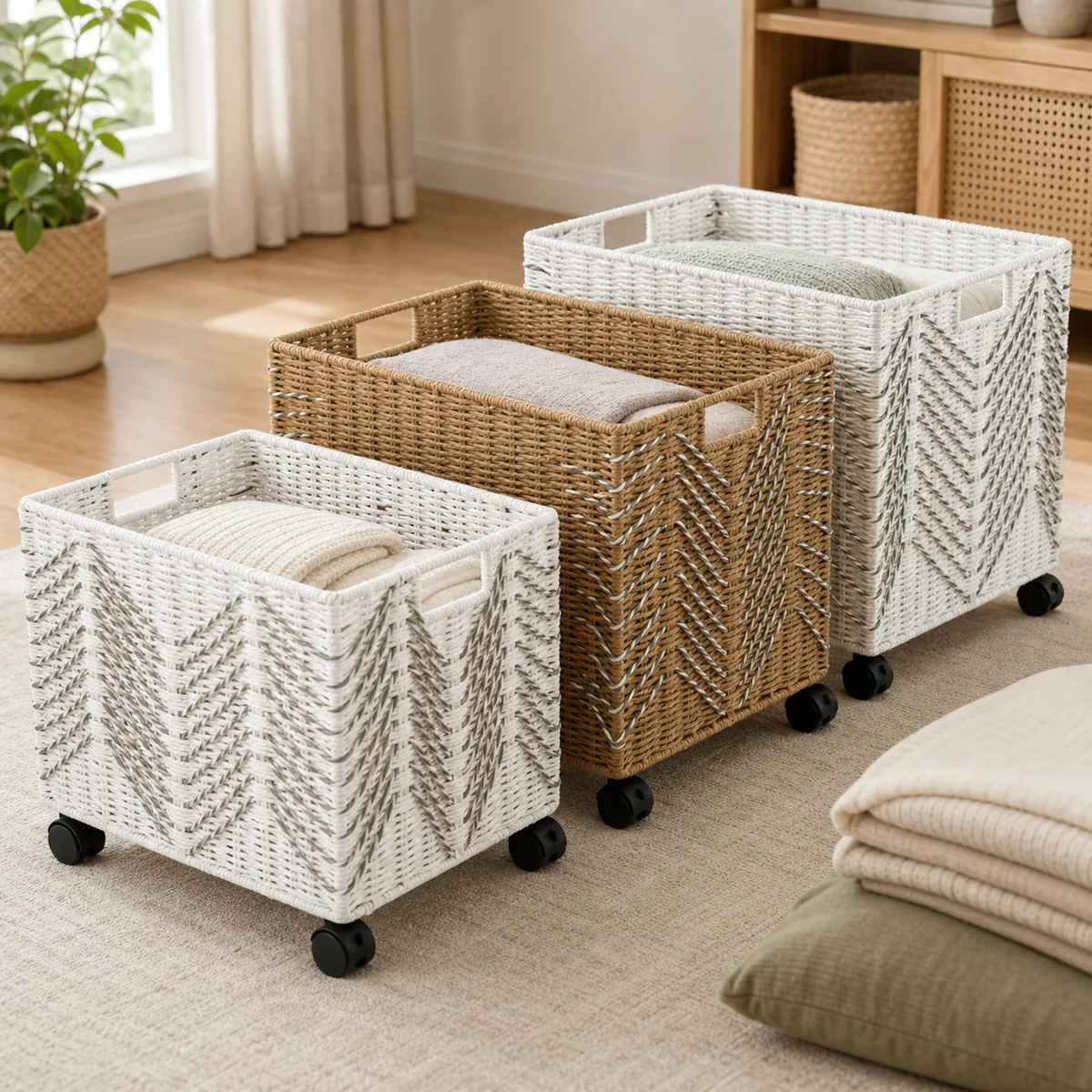
JINZHAO CRAFT's current catalog includes JZ10133, a three-piece rectangular paper rope storage basket set with caster wheels. The CMS record identifies paper rope construction, white and natural-brown colorways, contrasting chevron accents, three graduated sizes, handle openings, and caster wheels shown at the base. Recorded outside dimensions are 49.5 × 37 × 36 cm for the large basket, 45.5 × 33 × 31 cm for the medium basket, and 42 × 29 × 28 cm for the small basket.
These facts make JZ10133 a useful concept reference, not a universal rolling-performance specification. The record does not identify caster diameter, tread material, swivel arrangement, brake design, fastener, base reinforcement, rated load, test surface, cycle count, impact result, stability result, or acceptable wheel play. It also does not prove that every size uses the same mounting detail. Buyers should list each unknown as a decision or supplier question before requesting a production quote.
Use the paper rope category to compare the visual material direction with the current range. If a proposed program changes the size, set composition, contents, wheel count, base construction, color, handles, or pack-out, require new feasibility and sample evidence rather than treating the catalog image as blanket approval.
2. Which use conditions belong in the sourcing brief?
Start with the task the basket must perform. Record the intended contents, maximum buyer-controlled test load, fill distribution, whether the basket is pushed or pulled, expected travel distance, frequency of movement, floor types, thresholds, turns, parking condition, and storage location. A rolling hamper on smooth indoor flooring is a different decision from a basket moved across joints, rugs, elevators, shop floors, or warehouse staging areas.
Describe the user interaction without making a universal safety or performance claim. State whether movement occurs through a handle opening, at the rim, or by another approved point; whether the buyer expects one-handed steering; and whether a brake, directional control, or stationary-use position is required. If children, mobility-limited users, public spaces, or a regulated retail channel are in scope, the responsible business should define the intended-use classification and destination review instead of asking the factory to infer it from styling.
Separate storage capacity from mobility evidence. A basket may physically hold an item yet be unsuitable to move with that item because the load shifts, the base deflects, the caster attachment changes, or the selected floor creates resistance. Quote requests should therefore state the stationary use and the loaded-movement use as two separate requirements.
3. What should the caster specification table contain?
Use one controlled table for every size in the set. Supplier proposals can fill open fields, but the buyer should approve the final values and evidence before bulk production.
| Caster decision | Buyer or supplier must define | Evidence to retain |
|---|---|---|
| Wheel module | Wheel diameter, tread material, color, swivel or fixed arrangement, brake requirement, supplier code | Component data, identified sample, close photographs |
| Mounting interface | Plate, stem, socket, insert, fastener, washer or other method; position and orientation | Base drawing, underside view, component list |
| Basket base | Base panel or frame construction, local reinforcement, clearance and protected edges | Cross-section or construction sketch, sample photographs |
| Intended load | Contents, total test load, distribution, basket size and packed or unpacked condition | Buyer-controlled load plan and actual readings |
| Travel route | Floor surfaces, joints, turns, slope if relevant, distance and repetitions | Written method, route photographs or diagram, raw observations |
| Acceptance decision | Rolling, steering, brake, fastener, base, wheel-play and stability criteria | Dated result, findings, disposition and approver |
Do not accept a generic phrase such as heavy-duty wheel without a component identity and project-specific evidence. Equally, do not prescribe a wheel diameter or cycle count copied from an unrelated trolley. The useful specification is the one linked to the sampled basket, intended load, route, floor, mounting construction, and buyer-approved acceptance rule.
4. How should the basket-to-caster connection be reviewed?
The connection is a system boundary: a woven wall and rim may look consistent while the underside carries concentrated forces through a small mounting area. Ask for an underside view and a simple section showing the wheel, fastener or socket, base member, reinforcement, lining or cover, and clearance from the woven body. Identify which parts are structural, which are protective, and which are decorative.
Review position as well as component type. Record caster center locations from fixed edges, the relationship to corners and base members, ground clearance, wheel sweep, and possible contact with the basket body during swiveling. Confirm that fasteners, edges, or reinforcement are not exposed in a way that conflicts with the approved contents, floor, appearance, or pack-out.
The storage basket functional specification matrix provides a broader framework for connecting use, dimensions, openings, handles, base, packing, and evidence. Add a caster appendix for this program. If the mounting method changes after sample approval, treat it as a controlled construction change, not as an interchangeable component substitution.
5. How should buyers define load and mobility evidence?
Write the method before running the check. Identify the sample revision, basket size, wheel and mounting codes, floor, conditioning state, intended contents or controlled test pieces, total load, distribution, movement path, turns, thresholds, repetitions, operator action, review intervals, and stop conditions. Then define what the reviewer will observe: wheel rotation, steering, brake engagement if applicable, fastener movement, base deformation, tilt, load shift, noise, floor marking, and visible damage.
Record raw observations rather than converting one sample into a broad capacity claim. A result applies to the tested basket, construction, load, route, and method. A larger size, different wheel, different mounting plate, different floor, changed base, extended route, altered pack-out, or different content distribution may require another check. If the buyer needs a formal method or destination-specific performance statement, the responsible party should approve the protocol and qualified evidence source.
The acceptance rule should be explicit. Examples of decision language include approve for the defined method, approve with a named limitation, revise and retest, or reject. Avoid pass/fail labels that have no criterion. Keep actual findings, photographs, readings, anomalies, corrective action, and the reviewer with the sample record.
6. How do set dimensions, stability, and nesting interact?
A three-size set needs both individual and system-level review. Confirm outside basket dimensions, usable internal dimensions, opening, base footprint, handle height, caster projection, and total assembled height for each size. State whether published dimensions include wheels and how each reference point is measured. Do not assume that the recorded basket height includes the same hardware proposed for a new order.
Check stability in the defined empty and loaded states, during straight movement, turning, parking, and buyer-defined uneven transitions. The goal is not to claim universal tip resistance; it is to record how the identified sample behaves under the approved method and whether the result supports the planned use. Contents placed high or unevenly can change the decision even when the basket and wheels are unchanged.
If the baskets nest for export packing, document whether casters remain installed, are protected, are removed, or occupy dedicated clearances. Nesting must not transfer unapproved pressure to wheel modules, mounting points, rims, handles, or decorative front panels. A dimension change to improve pack-out can also alter wheel position, base reinforcement, usable volume, and stability, so review the system again after the change.
7. What must the sample approval file show?
The approval file should connect the product specification, caster component, mounting drawing, intended-use brief, sample photographs, actual dimensions, load and route method, observations, pack-out, open issues, and commercial quotation. Give every item a revision and owner. Photograph the complete basket, underside, each mounting point, wheel clearance, loaded condition, movement route, post-check condition, and packed state.
Use the golden sample change-control standard to distinguish appearance approval from construction and functional approval. A buyer can approve the color and chevron pattern while holding the caster system open. Conversely, a wheel check does not approve label artwork, basket dimensions, pack-out, or every colorway. Record the status of each gate separately.
List changes that trigger review: wheel supplier or code, tread, diameter, brake, fastener, plate or socket, base member, reinforcement, position, basket size, intended load, handle, nesting method, protective packaging, or route. This avoids a common failure in which a visually similar replacement enters production without the evidence tied to the approved sample.
8. Which pack-out and QC controls belong in the order?
For pack-out, state whether wheels are installed at the factory or assembled later, who owns any assembly instruction, how components are counted and identified, how brakes or swivels are positioned, and how the wheel and mounting zones are protected. Record unit sequence, nesting direction, separators, wraps, bags, cartons, quantity, orientation, carton marks, unpacking steps, and any tools or consumer action. A carton image documents one arrangement; it does not prove distribution performance.
Translate the approved evidence into production checkpoints. Incoming component control can confirm the nominated caster and mounting parts. In-process control can verify base construction, reinforcement, position, attachment, clearance, and appearance before access is covered. Final inspection can sample dimensions, wheel identity, movement under the buyer-defined method, brake operation where specified, fastener condition, base condition, set count, labels, and pack-out.
Use the pre-shipment inspection evidence framework to record the lot, sampling basis, selected units, methods, actual findings, defects, photographs, disposition, rework, and release owner. Inspection criteria must come from the approved order file; inspectors should not invent a load rating, wheel-cycle target, or acceptable amount of play on the day of inspection.
9. What should buyers send in the RFQ?
- Identify every set size, target contents, stationary use, loaded-movement use, and destination channel.
- Provide outside and usable dimensions, measurement points, wheel projection, and total assembled-height rules.
- Define the floor and route, buyer-controlled test load, distribution, movement method, turns, thresholds, repetitions, observations, and acceptance decision.
- Request the caster code, wheel construction, swivel or fixed arrangement, brake option, mounting method, fasteners, reinforcement, position, and clearance evidence.
- State which fields are buyer-nominated and which require a supplier proposal.
- Attach sample, change-control, pack-out, production-QC, and pre-shipment evidence requirements.
- Ask for project-specific MOQ, sample scope and charges, revision terms, production timing after approvals, packing basis, payment terms, quotation validity, Incoterm, and named place.
- Require every assumption, exclusion, and open issue to be listed.
Submit the controlled brief through the RFQ form. Comparable quotes depend on suppliers pricing the same basket-and-caster system, not on each supplier silently choosing a different wheel, load assumption, base connection, test route, or packed selling unit.
Frequently asked questions
Does a product photo prove the caster load capacity?
No. A photo can show that wheels are present and may help identify their visible location, but it cannot establish component identity, mounting construction, reinforcement, rated load, route, floor, cycle method, stability, durability, or acceptance criteria. Request a defined method and evidence tied to the exact sampled basket.
Should every basket size use the same caster?
Not automatically. Each size can differ in footprint, base construction, intended contents, load distribution, ground clearance, stability, and pack-out. The buyer and supplier should document the proposed wheel and mounting system for every size, then decide whether one shared component is supported by the project-specific review.
Can caster wheels be removed for nested export packing?
Only if the approved design and selling-unit plan allow it. Define who removes or installs them, component identification, quantity control, tools, instructions, fastener retention, protection, assembly evidence, and final user or retailer responsibility. Validate the exact packed configuration instead of assuming removal is harmless.
What should trigger a new rolling or load check?
Changes to basket size, base construction, reinforcement, wheel code, diameter, tread, brake, swivel arrangement, fastener, mounting position, intended load, route, floor, handle, nesting method, or protective pack-out can affect the result. The approved change-control plan should state which changes require review or retesting.
What commercial terms should accompany a rolling-basket RFQ?
Request the project-specific MOQ, sample scope and charges, revision allowance, component or tooling charges where relevant, production timing after approvals, packing basis, payment terms, quotation validity, Incoterm and named place. These terms must come from the current quotation and should list assumptions and exclusions.