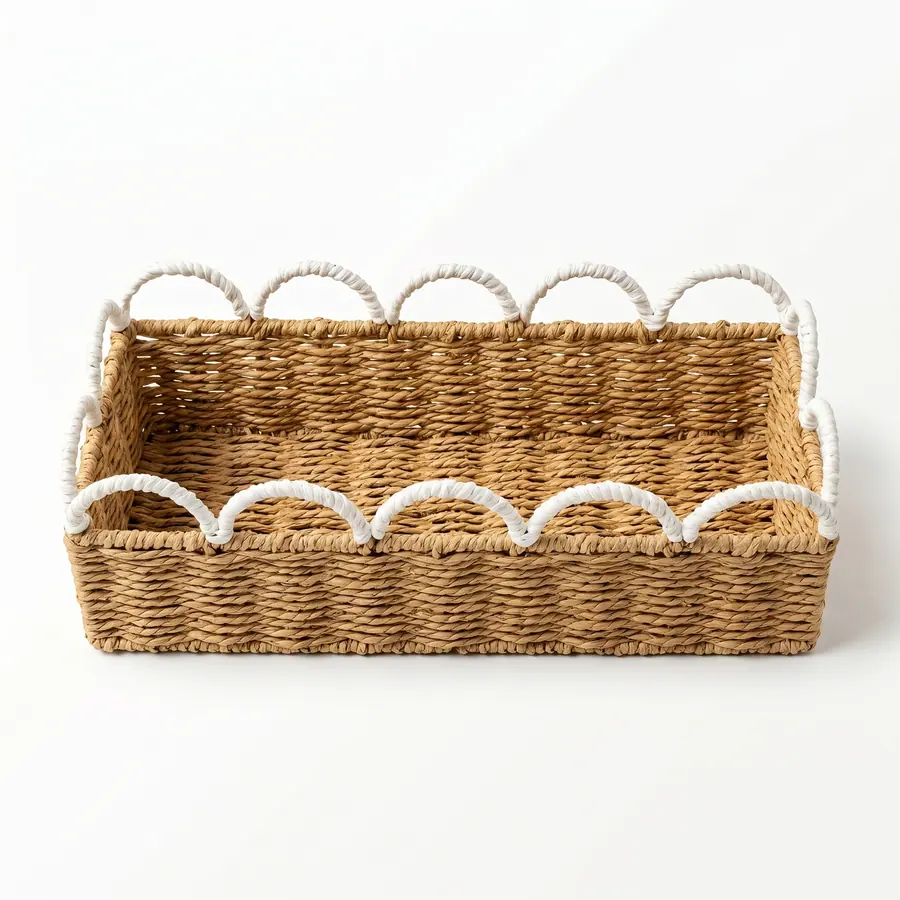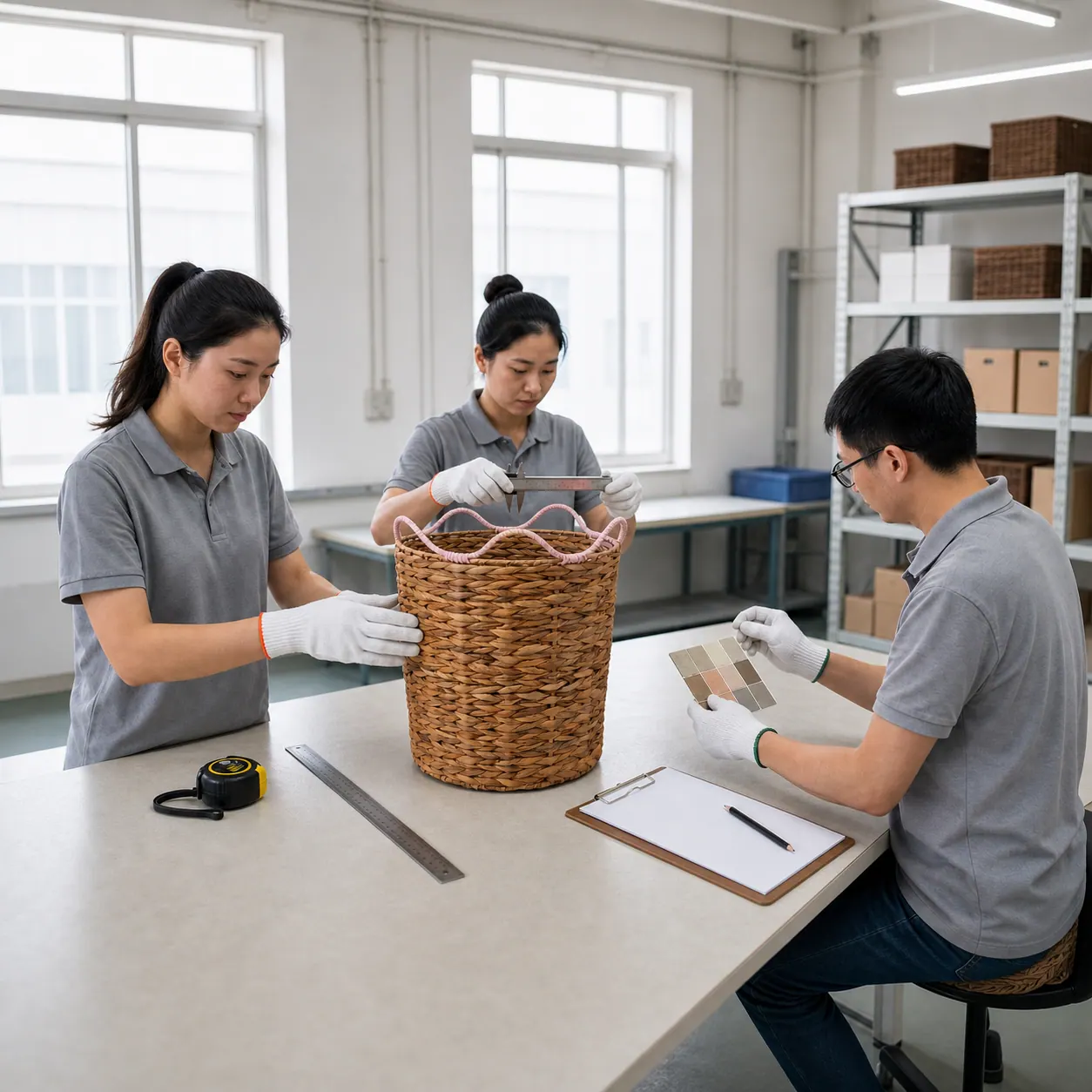
Useful product photos let a remote buyer and supplier answer a defined question without guessing. For woven basket sourcing, that means a planned set showing identity, scale, construction, measurements, color context, labels, and packing. One attractive front image is suitable for merchandising, but it is not enough to quote, approve, or investigate a handmade product.
Photos are evidence attached to a written specification. They do not establish hidden materials, universal tolerances, load performance, certification, or compliance. Every set should identify the SKU, sample or production stage, revision, date, and photographer or responsible sender so that an image cannot be separated from the decision it supports.
Start With an Identity Frame
The first frame should show the complete item with a visible SKU or sample card. Include revision, date, color, size, and stage such as reference, first sample, revised sample, pre-production, or packing trial. For sets, photograph all pieces together and label the order of sizes.
Use a plain, uncluttered background and retain the original file. Avoid filters, portrait effects, automatic color enhancement, and screenshots of compressed messaging previews. Record whether the image is intended to confirm general appearance, construction, a measurement, or a correction. A decision-ready archive is organized by question, not by whichever image arrived last.
When sending an initial inquiry, place the image set inside the quote-ready RFQ package rather than sending disconnected files.
Capture the Six Structural Views
For each basket, take front, side, top, interior, bottom, and three-quarter views. The front and side show profile, wall angle, handle height, and visible weave. The top reveals opening shape, rim, liner, and lid relationship. The interior shows frame coverage and finishing. The bottom shows base construction, feet if present, joining, and label placement. The three-quarter view connects these details into an understandable form.
Add close-ups of rim closure, weave transition, corners, handle roots, lid attachment, liner fixing, stitching, trim ends, and any decorative feature. Do not crop away the connection point that determines how a component is made. If the product nests, photograph the pieces nested, partially removed, and separated.
These views help a factory assess what is visible, but the supplier should still list assumptions about hidden construction.
Make Measurement Photos Reproducible
A tape placed somewhere in the frame is not a measurement record. Show the zero point, end point, measuring tool, product position, and reading in one clear image. Photograph external length, width, height, opening, base, handle drop, lid overlap, or internal usable space only where the specification requires them.
Use the same measurement method in the drawing, sample review, and inspection. State whether the basket is empty, resting naturally on a flat surface, or held in a defined position. Soft or handwoven forms can produce different readings if compressed or pulled. The buyer must define project-specific measurement points and acceptable ranges after feasibility and sample review.
For a disputed result, add one context view and one close reading rather than relying on an extreme close-up with no product identity.
Photograph Color for Comparison, Not Decoration
Color photographs should include the product, approved physical reference where available, a neutral surrounding area, and a label identifying the components being compared. Keep lighting, camera settings, distance, and background as consistent as practical across approval rounds. Do not use a screen image as the sole authority for a critical color decision because displays and processing differ.
Photograph body material, trim, stitching, handles, liner, label, and printed packaging separately when their relationships matter. Also record whether the image represents a swatch, sample, or production batch. The detailed handmade color requirement guide explains how to define the reference and approval method.
Images can reveal an apparent difference; the written record determines whether that difference is acceptable.
Build a Pre-Dispatch Sample Set
Before courier shipment, request a standard evidence sequence:
| Photo | Decision supported |
|---|---|
| Identity card plus full product | Correct SKU, revision, color, and stage |
| Six structural views | Overall construction and completeness |
| Detail close-ups | Rim, weave, handles, liner, lid, and labels |
| Required measurements | Conformance to defined measurement method |
| Color comparison | Relationship to approved reference |
| Provisional packing | Protection and arrangement for shipment |
The buyer can identify an obvious wrong component before paying courier cost or losing transit time. Photographs should not be used to waive a physical sample when tactile, fit, structural, or critical color decisions still require one. Record which decisions are photo-approved and which remain pending receipt.
Use Marked Photos for Revision Control
When commenting, mark the exact area with a numbered callout and pair it with a short required outcome. Keep each comment tied to the sample revision. Avoid messages such as make it better, color is wrong, or handle needs improvement. State whether the issue is a deviation from specification, a new buyer request, or a question.
For the next round, require an after image from the same angle plus enough context to prove that it belongs to the revised sample. Maintain an issue table with comment number, image name, required action, supplier response, evidence, and status. Close comments explicitly; silence should not be treated as approval.
This method supports the sample-development timeline without replacing its formal approval gates.
Photograph Labels, Artwork, and Packing as Systems
Label evidence should show the full product for location, a closer view for attachment and orientation, and a readable artwork view. Barcode quality or regulatory correctness needs the buyer's specified verification; a photograph alone cannot prove every requirement.
Packing evidence should show the empty carton or pack components, each protection step, nesting sequence, final arrangement, closed carton, marks, and carton dimensions where required. For a set, show how pieces are separated to limit contact at rims, handles, trim, or labels. Record the packing revision and pieces per carton.
A single closed-carton photo does not show what protected the product. A single styled unboxing photo may not show the repeatable factory sequence. Ask for evidence that maps to the approved packing instruction.
Separate Sourcing, Approval, and Inspection Photos
A sourcing reference communicates the target direction. A sample approval set documents a specific development unit. An inspection set records selected units and checks from a defined production stage. Do not reuse one type as if it proves the others.
For inspection, the buyer must define sampling basis, required views, measurements, defect evidence, packing checks, and file naming. Include normal examples as well as exceptions so the record does not become a collection of unidentified problems. If third-party inspection is required, align its photo list with the same specification.
The commercial request for photo deliverables belongs in the RFQ form, including timing, file format, original-file access, and any confidentiality restrictions.
Use a Photo Release Checklist
Before making a remote decision, confirm that:
- every image set identifies SKU, revision, stage, color, size, and date;
- full views and key construction close-ups are present;
- measurement images show method, endpoints, tool, and reading;
- color images state the reference and viewing limitations;
- marked comments distinguish deviations, changes, and questions;
- labels are shown in position, attachment, orientation, and readable detail;
- packing images show the sequence rather than only the closed carton;
- photo-approved items and physical-sample items are separated;
- files are retained at useful resolution with stable names;
- the written specification remains the production authority.
The OEM/ODM development service can be used when the photographs reveal open construction choices rather than a fixed product. Delivery terms remain a separate commercial issue: the International Chamber of Commerce Incoterms page explains how delivery tasks, costs, and risks are allocated, but those rules do not determine whether a photo set is sufficient.
Good sourcing photography is not about creating more images. It is about making each image answer a traceable buyer question. When identity, angle, method, and decision are controlled, remote teams can reject wrong assumptions earlier, approve defined details, and preserve a record for the next sample or order.