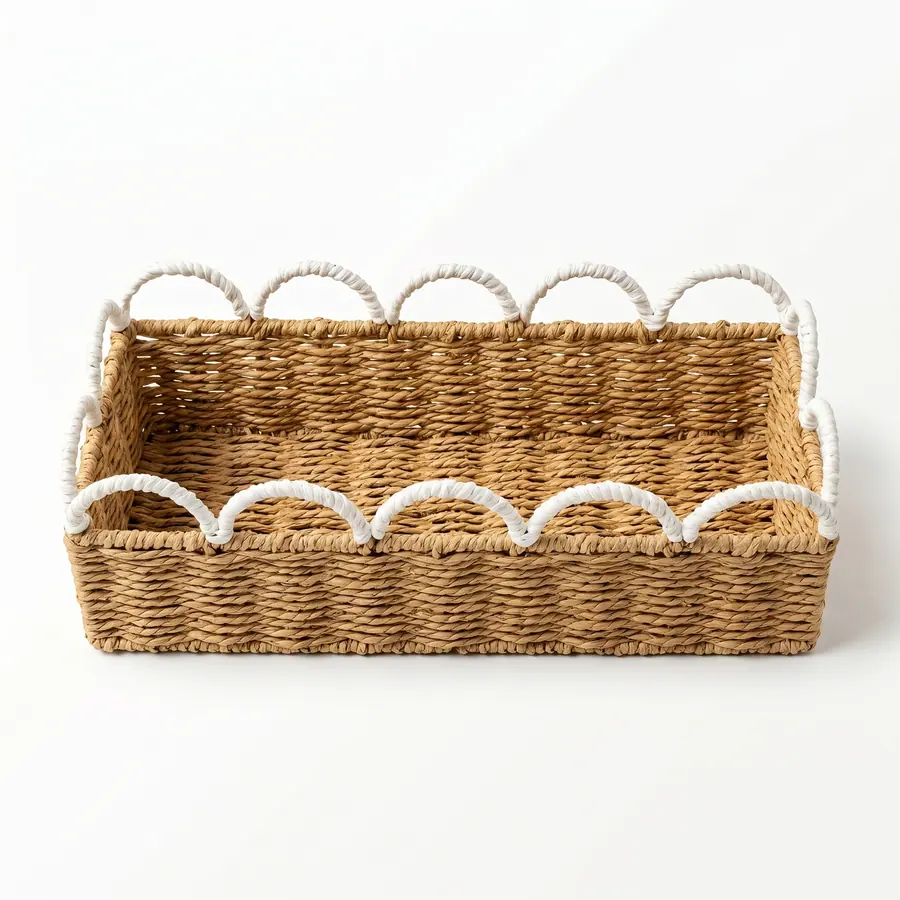
Wholesale buyers should approve a multicolor paper rope basket as a mapped construction, not just a color name. Define the base color, accent material and exact placement, how the motif repeats on every nested size, handle treatment, reference views, acceptable handmade variation, sample evidence, SKU identity, and pack-out before the factory quotes or starts bulk work.
A phrase such as “white and pink basket set” leaves several production decisions open. The accent could sit on the rim, handles, side panels, or several points at once; its repeat could change with basket size; and the visible front could differ after nesting. This guide helps importers, wholesalers, private-label brands, and ecommerce buyers turn the visual idea into a quote-ready and inspectable specification.
1. Why is an approved color name not enough?
A color reference answers only part of the question. It does not show where one color stops, where another starts, how many accent segments appear, which side is the retail-facing side, or how the treatment continues around corners and handles. Those are construction and placement decisions. Two suppliers can follow the same color names and still produce noticeably different basket sets.
Separate the specification into four fields: base color, accent color, accent location, and repeat rule. Then define the viewing orientation used for approval. The color requirement guide for handmade woven products explains how to record references and review conditions; this article adds the placement map needed when more than one color is built into a basket.
Do not describe acceptable variation with words such as “close” or “similar.” Mark which differences require buyer review: a shifted accent start point, unequal spacing, an interrupted rim sequence, a handle wrapped in the wrong color, or a different front-facing pattern. The acceptable boundary remains project-specific and should be approved from physical samples or agreed evidence rather than assumed from a screen image.
2. How should a buyer turn one reference set into a product brief?
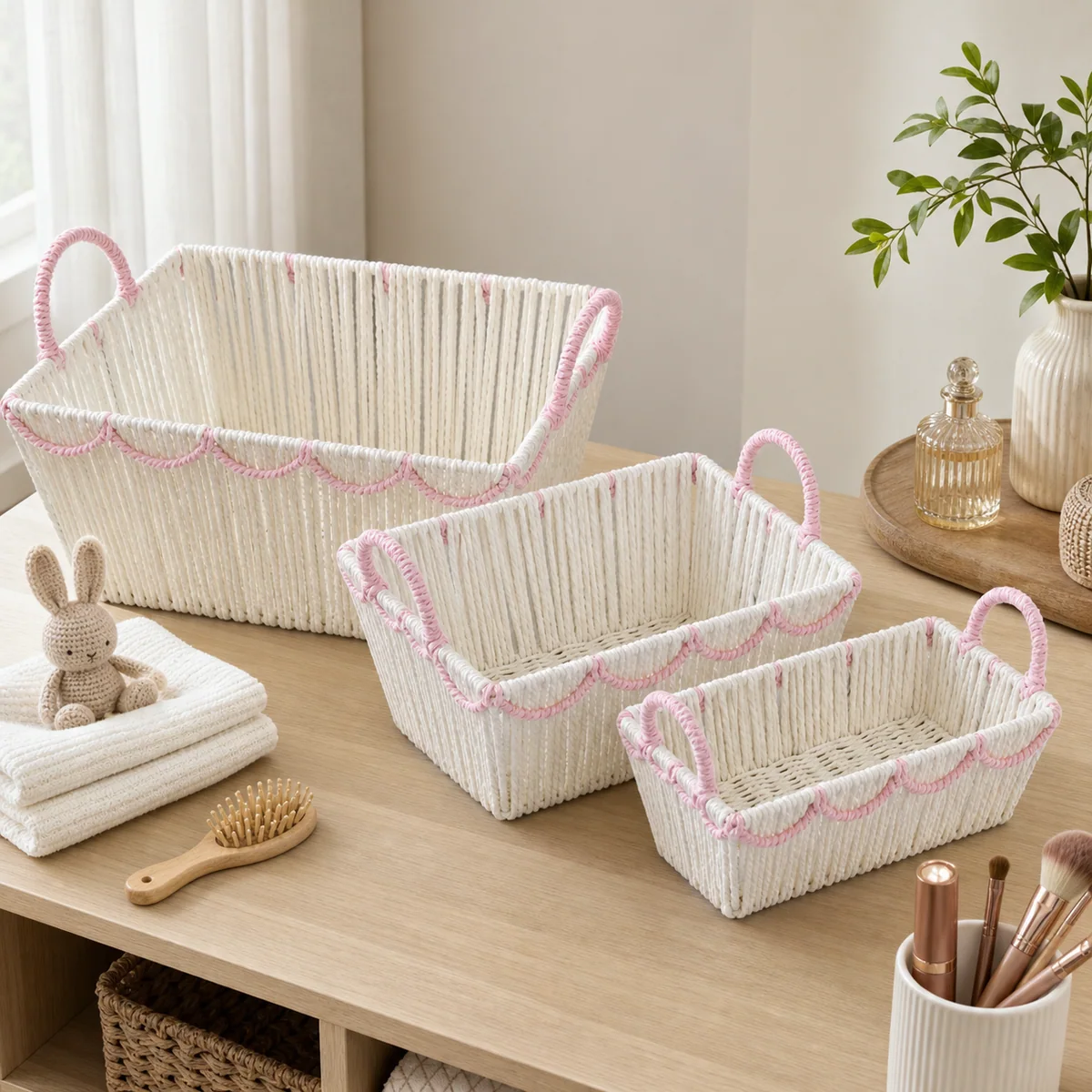
Start with one real product architecture. The current JZ10115 three-piece nested paper rope basket set is recorded in CMS as three rectangular baskets with loop handles. The recorded outside sizes are 36 × 26 × 18 cm for the large basket, 31 × 21 × 16 cm for the medium basket, and 26 × 16 × 14 cm for the small basket; handle-inclusive heights are recorded separately. CMS also lists four base-and-accent combinations, while the selected scene image shows a white body with pink accents.
Treat those fields as a reference, not as a universal offer. A new project may change size, color, set quantity, handle shape, trim geometry, label, or packaging. The buyer should identify every requested change and ask the supplier to confirm its effect on construction, sample scope, quotation unit, and pack-out. Do not infer a fiber percentage, fixed tolerance, performance rating, MOQ, sample duration, or lead time from the image or from this guide.
Use the paper rope product category to shortlist related structures, but do not combine features from several products without a consolidated drawing or sample brief. One controlling brief prevents the quotation from quietly mixing the size of one basket, the trim of another, and the packing of a third.
3. What belongs in an accent-placement map?
Create one annotated view for each selling-unit component. A front view alone is insufficient when the accent continues around the rim, changes at corners, or wraps the handles. Use top, front, side, rear, and handle-detail views, and label the orientation clearly.
| Control point | Buyer must define | Approval evidence |
|---|---|---|
| Base field | Material component in scope, base color reference, and full area covered | Full-basket views under the agreed review conditions |
| Rim accent | Start and stop points, path around corners, segment spacing, and any intentional interruption | Top and four-side annotated photos or drawing |
| Handle treatment | Handle shape, attachment points, wrap color, transition point, and left-right relationship | Close-up of both handles plus an overall front view |
| Nested-size repeat | Whether the motif scales, keeps a fixed interval, or uses a separately approved layout on each size | Large, medium, and small pieces photographed together and separately |
| Retail-facing side | Which face must present the approved composition after labeling and nesting | Packed selling-unit photo with the display face marked |
| Junction quality | How loose ends, color transitions, joins, and wrapped edges should appear | Detail photos from the approved sample |
Number the callouts on the drawing and use the same numbers in the sample comments and inspection checklist. That makes a correction precise: “move callout A3 to the corner reference” is safer than “make the pink line more even.”
4. Should the accent repeat scale across nested sizes?
The buyer must choose one of three rules. A scaled rule keeps the overall visual proportion similar as the basket becomes smaller. A fixed rule keeps a chosen interval or feature size but may create a different number of repeats. A component-specific rule approves a separate layout for each size. None is automatically correct; the retail concept and feasible construction should decide.
For a three-piece set, put all sizes side by side before approval. Check the start point, corner transitions, front symmetry, handle relationship, and the portion still visible when the pieces are nested. If the smallest basket hides a critical accent or the large basket creates an awkward partial repeat, revise the map before bulk production.
Keep this decision distinct from the size plan. The nested basket set planning guide covers selling units, dimensional progression, nesting, and ecommerce pack-out. The accent map should reference that approved size plan without copying or replacing it.
5. How should colorways, SKUs, and approvals be separated?
Build a colorway matrix even when the structure is identical. Give each approved combination a stable working code, and record its base reference, accent reference, placement-map revision, sample ID, label artwork, barcode owner, order quantity, and approval status. Do not let “same as the pink version, but blue” replace the record; a new accent may need its own physical or photographic review.
Decide whether all three nested sizes form one sellable set or can be sold separately. Then decide whether colorways are separate SKUs, one assortment SKU, or buyer-defined case content. This identity must agree across the quotation, purchase order, label file, barcode list, inspection sheet, packing list, and carton marks.
A supplier can quote only the commercial structure it receives. State quantities by piece, set, and colorway without switching units mid-document. If mixed colors are requested in one master carton, list the exact inner selling units and the approved ratio; if mixed cartons are not approved, say so. Do not assume that an available color option automatically authorizes substitution between ordered colorways.
6. What sample evidence should be retained before bulk production?
Approve the complete selling relationship, not only one attractive close-up. Retain an identified sample or sample record for each approved colorway and placement-map revision. The evidence pack should contain dated overall views, all sides, top and interior, both handles, each transition point, every set component, and the fully nested unit.
Record the measurement method and the exact revision reviewed. If comments are made on photos, keep the corrected final views rather than relying on a message thread that contains both rejected and approved versions. The final approval should state what is approved, what remains conditional, and which later evidence is required before bulk packing.
For private-label work, connect the sample to the label and packaging files. The OEM and ODM page describes the available project path, but the buyer still needs to define which elements are being customized and which existing product details remain unchanged. A color sample does not approve a barcode, hangtag, carton ratio, or shipment release by itself.
7. How should first-unit and bulk QC check placement?
Use three decision gates. First-unit review confirms that production instructions can recreate the approved map. In-process review checks whether placement and transitions remain consistent while correction is still practical. Pre-pack review verifies the complete set, SKU identity, label, nesting orientation, and carton content before goods are closed.
The checklist should name observable defects rather than broad judgments. Examples include wrong base or accent assignment, missing or extra accent segment, shifted start point, asymmetric front, inconsistent corner transition, incorrect handle wrap, loose join, wrong colorway label, or mixed components from different approved sets. Define severity and sampling terms in the order-specific inspection plan; this article does not prescribe a universal tolerance or sampling level.
Ask for evidence that matches the risk. Overall photos can confirm set identity, but close-ups are needed for joins and transitions. A top view can show rim continuity, while a nested view shows retail presentation. If the inspection finds a placement difference, the decision should reference the numbered map and approved sample rather than an unrecorded visual preference.
8. How should nesting, labels, and pack-out preserve the approved look?
Run a packing trial with the final selling unit. Confirm the nesting order, orientation, protective contact points, handle position, label location, barcode visibility, inserts, and which face should be seen when the set is opened or displayed. A placement map can be correct on individual baskets but appear wrong if the retail pack rotates one piece or hides the intended front.
Protect accent joins and raised handles from rubbing or pressure identified during the trial. Do not claim a particular material or pack format is sufficient without testing the actual approved set. Record the trial result with open-carton, layer, closed-carton, and unpacked-set views, then carry the agreed method into the packing instruction.
Keep props in lifestyle images outside the selling-unit definition unless the purchase file explicitly includes them. The JZ10115 scene image helps buyers discuss a basket structure and color placement, but the furniture, textiles, brush, decor, and other pictured items are not evidence of supplied components.
9. What should the RFQ say for a multicolor paper rope basket set?
Send one structured brief containing:
- target market, sales channel, intended use, and required delivery destination;
- reference product or drawing, set quantity, size table, shape, and handle structure;
- base and accent references, numbered placement map, repeat rule, and viewing orientation;
- colorway matrix, SKU ownership, order quantity by set and colorway, and substitution rule;
- sample deliverables, approval owner, revision control, and required first-unit evidence;
- label, barcode, insert, retail pack, nesting order, master-carton content, and carton marks;
- defect list, inspection evidence, shipment-release condition, and commercial terms to quote;
- explicit requests for MOQ, sample timing, production timing, price basis, Incoterm, named place, and quote validity rather than assumed figures.
Attach the annotated files through the structured RFQ form. Ask the supplier to identify unclear or conflicting inputs before pricing. A useful quotation should refer to the same structure, colorway matrix, selling unit, evidence scope, and packing basis that the buyer intends to approve.
A multicolor basket program becomes manageable when the visual concept is converted into controlled decisions. The buyer does not need to eliminate handmade character; the buyer needs to identify which color and placement relationships define the product, what evidence proves them, and where project-specific variation requires approval.