Direct answer
A desktop organizer or woven tray should be specified as an interface between contents, work surface, access pattern, set arrangement, and packaging. Buyers should define the allowed footprint, minimum usable envelope, opening and retrieval path, base contact zones, stability scenario, surface-protection requirement, rim and handle interactions, set membership, nesting, labels, and pack state. Outside dimensions do not prove usable fit, and felt, fabric, feet, or a flat base do not prove non-scratch or non-marking performance. Stability and load questions require representative contents and project-specific methods; nesting requires the exact member sequence and protection. The buyer owns intended use and criteria, while the supplier confirms construction and evidence for the approved revision. No universal desktop load, scratch, stability, or nesting threshold applies.
Direct answer: specify the organizer as a work-surface interface
- Desktop organizers and woven trays are compact, but their specification is not simply length, width, and height. The product must fit a defined surface, hold defined contents, permit repeated access, avoid interfering with neighboring objects, and arrive in an approved shape and set arrangement. Begin with the work context rather than selecting a decorative basket and adapting the requirement later.
- This reference covers footprint, usable envelope, opening, retrieval, partitions or set members, base and contact surfaces, stability questions, rims and handles, nesting, retail presentation, and export pack. It does not establish a universal load, tip angle, friction value, scratch resistance, non-marking performance, abrasion limit, durability cycle, dimensional tolerance, stacking capacity, or recovery requirement.
- The buyer supplies intended contents, surface, placement, access pattern, destination, channel, claims, and project-specific verification criteria. The supplier confirms exact materials, construction, dimensions, production feasibility, samples, pack design, and measured or observed evidence. A product image, felt patch, flat base, or nested format is evidence of appearance only unless a controlled method supports a broader statement.
Define contents, zones, adjacency, and excluded uses
- List intended contents by dimensions, count, mass range, shape, rigidity, edges, leakage or staining risk, and retrieval frequency. Examples may include stationery, remote controls, cosmetics, cables, craft items, or accessories, but each program selects its own set. Identify the largest critical item and any item that can snag the weave, tip a narrow organizer, mark the lining, or block a partition.
- Map the placement zone: available footprint, height limit, shelf or drawer clearance, wall distance, monitor or device clearance, cable path, neighboring organizer spacing, opening direction, user reach, and visible orientation. Record the work surface material and finish as represented by the buyer, because wood, glass, paint, laminate, metal, and fabric surfaces can create different contact and marking questions.
- Write exclusions such as no food contact, no liquid containment, no hot-item use, no seating, no step use, no child-care function, no unverified stacking, and no transport above the approved content condition, as applicable. A desktop label does not establish those boundaries. The buyer's product and compliance owners confirm the exact intended and excluded uses.
Control footprint, usable envelope, opening, and retrieval
- Footprint is the maximum occupied area in the approved product state, including taper, projections, relaxed handles, trim, and local weave. Define measurement planes and orientation. Usable envelope is the limiting internal space that contents can occupy or pass through after accounting for taper, frame, liner, partitions, seams, rims, handles, and irregular local construction. Both are needed because a product can fit the desk while rejecting the intended item.
- Record opening and retrieval separately. Define insertion direction, minimum opening, access angle, finger or grip clearance, partition widths, liner interference, and whether contents must be visible or removable one-handed. Use representative item fixtures or samples when geometry alone is insufficient. Preserve the product state, measurement condition, points, instrument, units, sample, and project-specific criteria.
- NIST SI resources support clear quantity and unit communication, and ISO 10012 supports confidence in managed measurement processes. Neither defines desktop organizer dimensions or tolerance. The buyer selects critical interfaces and criteria; the supplier proposes repeatable measurement points and reports raw values for the exact revision without substituting nominal catalog dimensions.
Evaluate stability and contact surfaces without implied guarantees
- Stability begins with a scenario: product orientation, representative contents and distribution, access action, surface, base condition, nearby constraints, and whether the question is empty rest, loaded rest, retrieval, or an accidental interaction chosen by the buyer. Define the method and observable result for that scenario. Do not publish a universal tip angle or load that lacks a product-specific rationale.
- Map every contact zone: base against the desk, exterior against neighboring items, interior against contents, rim and handles against hands, hardware against product surfaces, and set members against one another during nesting. For each zone, record material and construction, exposed ends or hardware, finish boundary, cleanliness, protective element, and project-selected evidence. A felt or fabric layer does not by itself prove non-scratch, non-marking, or stain resistance.
- Surface-protection evaluation should name the buyer-represented surface or approved surrogate, product condition, movement or dwell scenario, contents, environment, cleaning state, observation method, criteria, and limitations. A result on one surface finish does not transfer to every desk. Supplier trials can support design selection, while the brand owner decides whether any consumer-facing claim has adequate scope and evidence.
Define set membership, nesting, and presentation
- A set requires a member schedule with unique identifiers, intended content roles, outside and usable dimensions, orientation, color or material relationship, and selling configuration. State whether members are used separately, aligned in a system, inserted into drawers, or nested only for packing. Do not describe a group as modular, stackable, or space saving without defining the interface and evidence.
- For nesting, record member sequence, insertion orientation, maximum intended depth, contact zones, separators, liner and handle state, extraction method, allowed manual reshaping, and the condition evaluated after removal. Nominal dimension clearance does not capture local weave, taper, flexibility, finish, or rim interaction. Conduct a physical trial with the final product and pack revisions.
- Retail presentation and export packing should identify which member carries labels, how the set is banded or protected, visible faces, barcode ownership, sell-unit and carton quantities, orientation, inner protection, compression, and unpacking. The pack can change shape, contact surfaces, and member appearance, so set approval and pack approval should be linked rather than treated as separate final checks.
Apply the desktop fit, contact, stability, and set matrix
- Create matrix rows for contents, placement, footprint, usable envelope, opening, retrieval, partitions, base, contact zones, stability scenarios, rim, handles, set members, nesting, labels, retail pack, and master carton. Columns should show level, requirement, method, representative condition, project criterion, evidence, owner, supplier response, approver, status, revision, and dependent rows.
- Evaluate in sequence. Contents and work zone define fit. Fit and access define opening and internal layout. Contents distribution and surface define stability questions. Materials and contact map define surface-protection evidence. Set strategy defines member identities and nesting. Retail and export pack define final contact and shape conditions. Reopen dependent decisions when any upstream field changes.
- Use statuses such as Confirmed, Supplier to propose, Buyer to decide, Trial required, Specialist review, Conditional, and Rejected. Every applicable row should be closed with evidence or have an owner and blocked decision. A high completion score cannot offset a failed critical fit, unresolved surface claim, missing set member, or unapproved pack interaction.
Detect footprint, surface, stability, and nesting shortcuts
- Fit failures include relying on outside dimensions alone, measuring at the wrong plane, ignoring taper or liner, and approving a container without the largest critical item. Access failures occur when contents fit internally but the opening, partition, rim, handle, wall, or shelf blocks insertion and removal. A photo of items inside does not replace a defined representative-content trial.
- Surface failures include describing felt, fabric, smooth weave, or feet as scratch proof, testing on one unknown board, using a dirty sample, or failing to record movement and dwell. Stability failures include testing empty products, centering contents unlike actual use, applying arbitrary loads, or transferring one result to another footprint, height, base, surface, or set member.
- Set failures include ambiguous member identities, inconsistent dimensions between specification and label, nesting in a different sequence from production, omitted separators, and unrecorded compression. A product can pass alone but mark, distort, or jam another member in the final pack. Treat observations as project evidence, not universal material or performance claims.
Assemble the desktop interface and set evidence
- The controlled file should contain the contents schedule, placement map, surface representation, footprint and usable-envelope drawing, opening and retrieval method, dimension records, construction and contact-zone map, stability scenarios, surface-protection method, member schedule, nesting and extraction instruction, label data, retail presentation, export pack, trial results, deviations, approvals, and revision history.
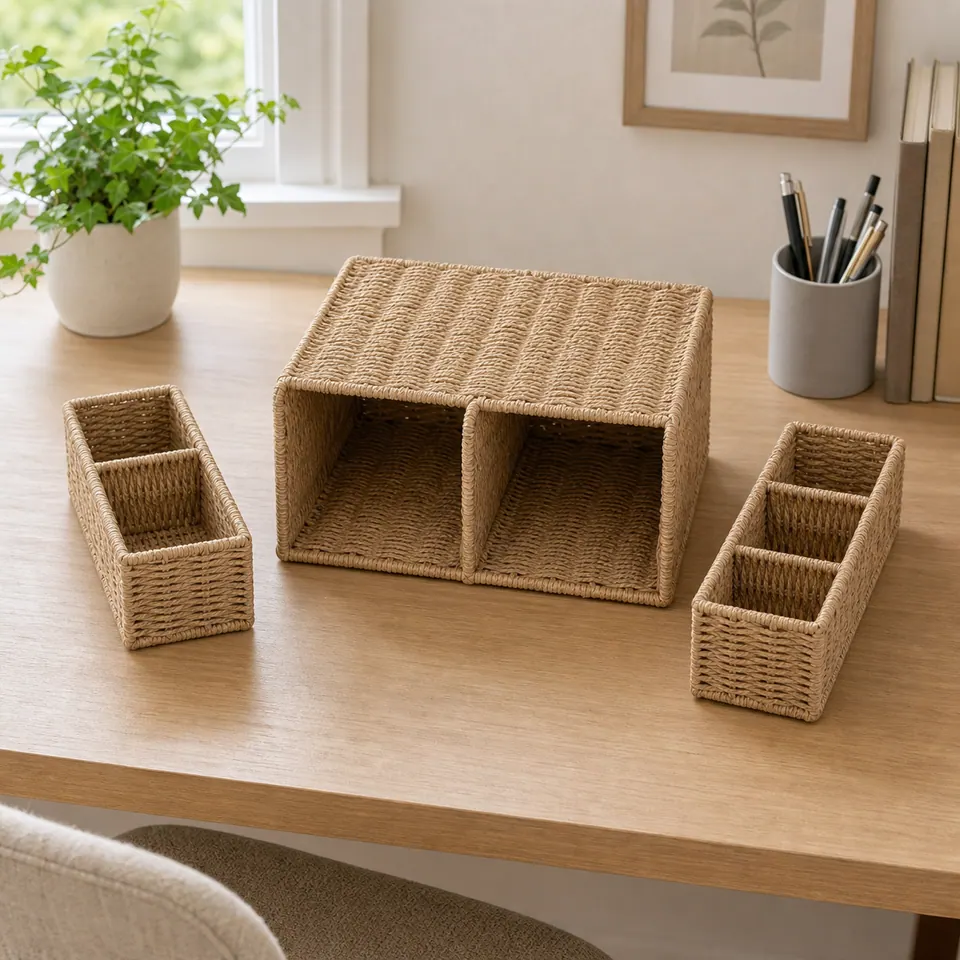
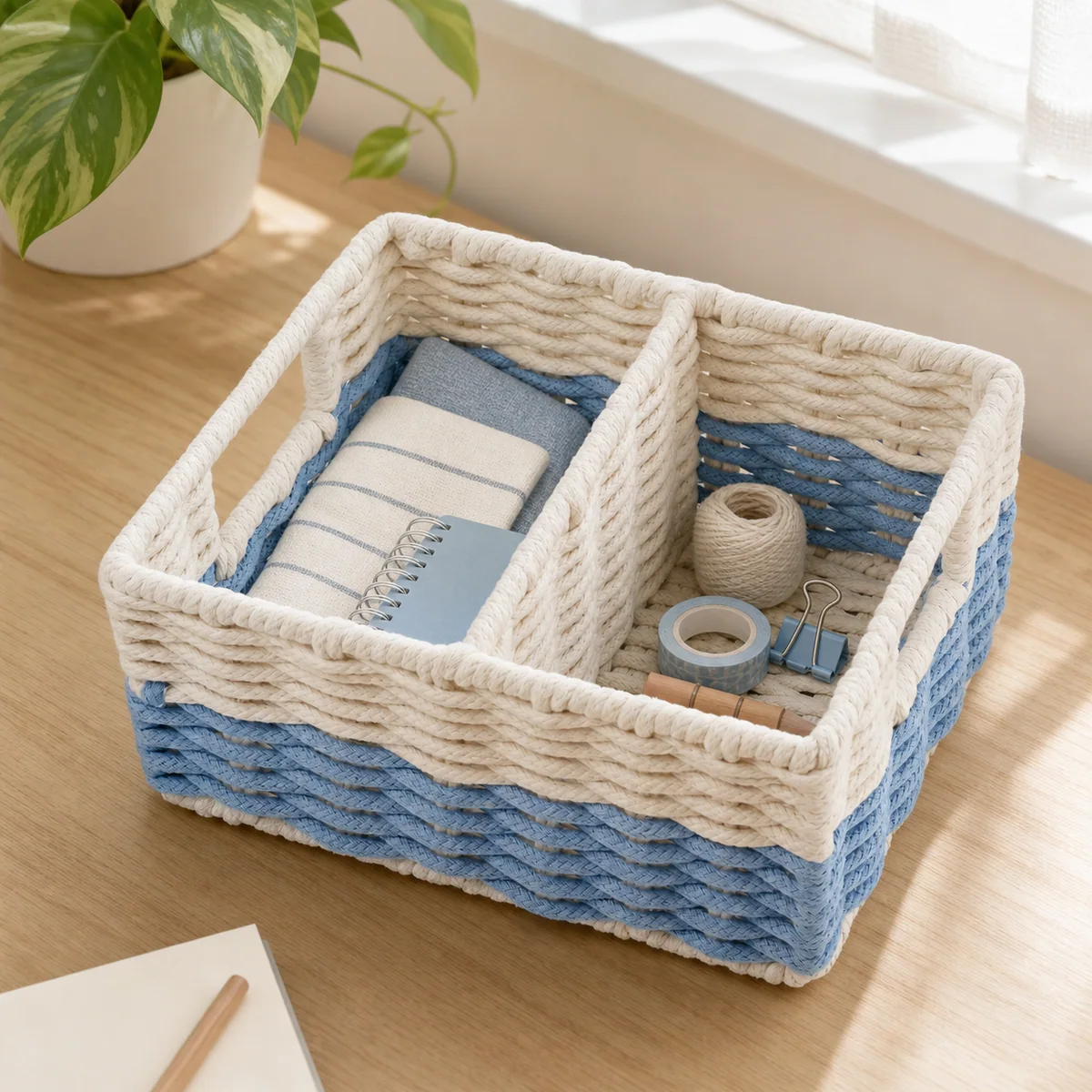
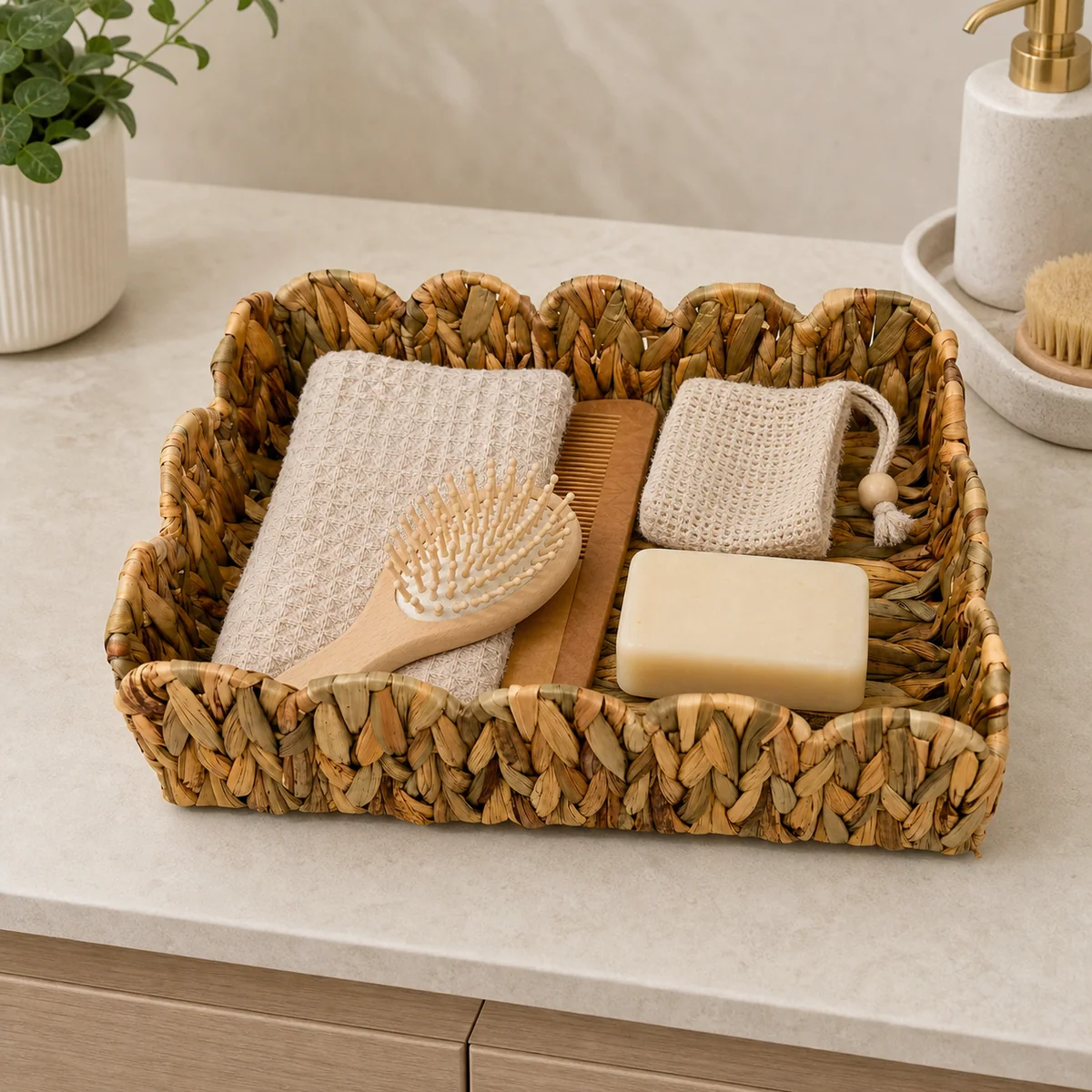
- The current catalog shows a three-piece desktop organizer set, a cotton-rope desktop basket, and a water-hyacinth tray. They illustrate different set, material, and tray questions but do not prove fit, load, stability, non-scratch performance, nesting, or compliance.
- ISO 10013 supports controlled documentation, ISO 10012 supports measurement-management confidence, NIST supports clear units, and GS1 traceability context can help connect member, sell-unit, pack, and evidence identifiers when adopted. None assigns criteria, proves performance, or certifies the product. Preserve the exact evidence level and covered revision.
Separate organized use from load, surface, and safety claims
- This specification does not determine food-contact, children's-product, chemical, flammability, electrical-device proximity, retailer, packaging, or destination-market requirements. Intended contents, user, materials, claims, channel, and placement govern which competent reviewers and methods are needed. A nursery motif or office label is not a legal classification.
- Do not state scratch proof, non-marking, non-slip, tip proof, stable, heavy duty, stackable, washable, waterproof, child safe, or tested unless the wording has a defined scope and approved evidence. Describing a base material, footprint, or trial observation is different from guaranteeing behavior on every surface, load, user action, or environment.
- Use the RFQ route for interface data and the OEM/ODM route for proposed member, construction, or pack changes. Final purchase records should identify exact contents, surface, fit interfaces, project methods and criteria, set members, pack, responsibilities, evidence, deviations, and revision. Supplier confirmation supports execution; the buyer retains intended-use and claim approval.
Buyer comparison table
JINZHAO CRAFT factory recommendation
For a practical factory quote, share a reference image, target dimensions, material direction, expected order quantity, logo or label needs, retail/export packaging requirements and destination market. JINZHAO CRAFT can then discuss material feasibility, sample direction, MOQ, production timing and export carton planning for the woven storage product.
Primary sources
These references support the defined standards, regulatory context, or buyer process described above. Product-specific obligations and commercial terms still require confirmation for the actual order.
- ISO 10013:2021 Quality management systems - Guidance for documented information — International Organization for Standardization
Supports tailored documented-information control and is published with review activity shown; it does not prescribe desktop organizer requirements, criteria, performance, or certification.
- ISO 10012:2026 Quality management - Requirements for measurement management systems — International Organization for Standardization
Supports confidence in managed measurements; it does not define organizer measurement points, tolerances, stability, load, surface, nesting, or results.
- SI Units — National Institute of Standards and Technology
Supports clear quantity values and unit symbols; it does not establish fit, surface protection, stability, or acceptance.
- GS1 Global Traceability Standard — GS1
Supports identify-capture-share and traceability-data context for members and packs; it does not allocate identifiers, prove function, or certify products.
FAQ
What is the difference between desktop organizer footprint and usable envelope?
Footprint is the area occupied on the work surface, including projections and relaxed features. Usable envelope is the limiting internal space and opening available to contents after taper, frame, liner, partitions, seams, rim, and handles.
Does a felt or fabric base prove that an organizer will not scratch a desk?
No. Define the represented surface, product and base condition, contents, movement or dwell scenario, environment, method, project criteria, observation, evidence, and limitations before making a scoped claim.
How should desktop organizer stability be evaluated?
Specify orientation, representative contents and distribution, work surface, base condition, access or interaction scenario, method, project-specific criteria, sample, raw observations, result, and limitations. Avoid arbitrary universal loads or angles.
Can nominal dimensions prove that a nested organizer set will fit?
No. Local weave, taper, flexibility, rims, liners, handles, and protection affect nesting. Approve exact member sequence, orientation, contact zones, separators, depth, extraction, pack state, recovery, and physical-trial evidence.
Can one desktop organizer result cover another surface or set member?
Not automatically. Review differences in material, footprint, height, base, contents, surface finish, contact zones, member geometry, nesting, and pack, then repeat the affected project method where transfer is unsupported.
Products relevant to this guide
Review current factory product examples, then send target dimensions, quantity and customization requirements for an exact quotation.
Continue learning
General Storage Basket Functional Specification Matrix
Translate intended storage use into controlled fields for usable space, access, handles, contact surfaces, closure, liner, nesting, and pack verification.
Read guide →Factory & QualityHandmade Basket Dimensional Measurement and Tolerance Framework
Define measurement condition, points, tools, raw readings, project-specific limits, deviation, conformance, and nesting clearance for handmade baskets.
Read guide →Product SpecificationsWoven Tissue Box Cover Specification and Fit Guide
Specify woven tissue box cover fit, opening, refill access, measurement points, sample approval, and packing without assuming a universal box size.
Read guide →Factory & QualityWoven Basket Visual Defect Classification and Disposition Standard
Classify woven-basket observations, natural variation, defects, zones, severity, boundary references, records, and lot dispositions without inventing a universal AQL.
Read guide →