Direct answer
Specify a woven tissue box cover from the exact target tissue package, not a presumed standard size. Record pack dimensions and orientation, required internal clearance, cover wall and base construction, dispensing-opening geometry, refill route, outside dimensions, measurement state, tolerance, sample fit test, appearance range, labeling, and pack-out. Reapprove fit whenever the tissue pack or cover construction changes. The approval record should preserve the measured tissue pack, dated sample, test orientation, result, and change owner so a later packaging substitution cannot silently invalidate fit.
Use the target tissue package as the controlled input
- There is no safe universal inside size for a woven tissue box cover. Facial tissue packs vary by brand, market, tissue count, carton style, flexible or rigid format, and later packaging revisions. Start by naming the exact pack or range the cover must accept. Record the brand or buyer reference, SKU, version or purchase date, market, pack construction, filled condition, and intended orientation. If several packs must fit, measure each and design against an approved compatibility range rather than one convenient sample.
- ISO 12625-1:2019 establishes terminology for tissue paper and tissue products. It can help teams use consistent tissue-industry language, but it does not prescribe a woven cover size, dispensing opening, or handmade tolerance. The cover specification remains a buyer-supplier engineering document. State whether the insert is a rigid retail carton, a soft pack, a refill stack removed from packaging, or another format, because each creates different support and access requirements.
- Photograph the target package from the default front, top, both ends, and dispensing side. Mark which face becomes the top when installed. Record nominal package length, width, and height with a stated unit and measuring method, plus any bulges, seams, perforated panels, or changing profile after tissues are removed. Do not rely on a marketplace listing when an actual pack or controlled drawing can be supplied.
Separate outside size, usable inside space, and entry clearance
- A woven cover needs three dimensional systems. Outside dimensions control shelf presence, assortment coordination, retail carton, and freight. Usable inside dimensions determine whether the tissue pack can sit without crushing, excessive movement, or distortion. Entry clearance determines whether the pack can pass through the base, lid, side opening, or open bottom used for refilling. These values are related but should never be collapsed into one length-by-width-by-height line.
- Define measurement points on an annotated drawing. For the outside, identify maximum length, maximum width, overall height, top profile, base footprint, and any protruding rim or trim. For the inside, identify clear length and width at the narrowest controlling area, usable height, corner restrictions, frame intrusions, and the clearance beneath the dispensing surface. For entry, record the smallest rigid opening the target pack must pass through and the intended insertion angle.
- GS1's Package and Product Measurement Standard provides a consistent method for identifying orientation and recording height, width, depth, maximum extent, and usable measurements for trade items. Use that source as a measurement-language reference, not as a source of woven-product acceptance tolerances. Buyer and supplier must agree on the actual cover measurement state, tools, rounding, measurement points, and allowable ranges for the approved design.
Design the dispensing opening around tissue behavior and appearance
- The top opening must allow a tissue to emerge and be pulled without the retail carton opening becoming visibly misaligned. Specify the opening shape, maximum length and width, corner radii or end profile, center position relative to the cover, and finished edge construction. An oval, slot, rectangle, or framed aperture can look similar in a photograph while behaving differently with a particular tissue fold and carton opening.
- Test more than the first tissue. Pull tissues from a full pack, a mid-level pack, and near the end because the pull angle and pack profile can change. Record whether tissues tear, fall back, drag the pack upward, catch on fibers, or rub against a rigid edge. These results are product-specific observations, not universal performance claims. If the cover is decorative and the buyer accepts occasional repositioning, state that intended use rather than implying dispenser-grade performance.
- Close-up appearance matters because the opening is handled at short range. Approve the edge wrap, visible frame exposure, loose-end boundary, symmetry, color relationship, and how the woven pattern meets the aperture. If a metal, wood, paperboard, or other insert creates the opening, name its material and attachment method. Any safety, coating, chemical, or destination requirement for that component must be reviewed separately.
Choose a refill route and secure the cover during use
- Common structural directions include an open bottom that lowers over the retail carton, a removable base, a hinged or detachable lid, or a cover that receives unpackaged refills. Each route changes fit, assembly time, retail presentation, and the risk of the cover lifting when a tissue is pulled. Select one route and show the user sequence in the specification rather than asking the sample maker to infer it from an image.
- For an open-bottom design, define whether the cover should rest on the counter, grip the tissue carton, or leave a deliberate bottom gap. For a removable base, specify the closure, orientation, retention method, finger access, and acceptable visible joint. For a removable top, define how it locates and whether users can replace it consistently. A weight, friction feature, or internal stop should not be assumed; document and sample any such component.
- Test installation and refill with the actual target pack and intended user motion. Record the number and identity of packs checked, the insertion route, any compression, whether the pack can be removed without damaging the cover, and whether the cover remains in the intended position during repeated pulls. If the buyer wants multiple market packs, the acceptance record should list which ones passed and which were not evaluated.
Control handmade structure without inventing a universal tolerance
- Woven construction can add wall thickness, corner build-up, pattern variation, and local frame or seam restrictions. The supplier should propose a construction that protects usable space and keeps the cover stable. The buyer should identify critical fit dimensions separately from visual dimensions. Internal clear length, internal clear width, entry opening, and dispensing-opening location may require tighter control than decorative weave alignment, but the acceptable range must come from sampling and intended use.
- Agree on the condition in which measurements are taken: empty, upright, on a flat surface, without hand pressure, at an agreed stage after production and packing. Identify the tool and whether measurements are maximum, minimum clear, or point-to-point. A single outside measurement can hide a tapered wall or intruding corner, so include a go or no-go fixture, target pack, controlled gauge block, or multiple internal points where fit is critical.
- Do not promise absolute uniformity for a handmade product. Create an approval set showing acceptable profile, top-plane relationship, opening centering, weave character, edge finish, and color range. Separate a dimensional nonconformance that prevents fit from harmless natural character. If the material, frame, weave density, base, edge binding, lining, or target tissue pack changes, determine whether fit and appearance approval must reopen.
Build a sample fit protocol that produces reusable evidence
- The sample report should identify the cover revision, target tissue package, package measurements, cover measurements, insertion method, dispensing test, appearance review, and reviewer. Include dated photographs of the empty cover, target pack, installation path, fully assembled condition, top opening alignment, bottom or closure, and any failure. Mark corrections on the controlled drawing rather than relying on chat messages.
- A useful fit protocol checks: the target pack passes through the intended entry; the cover reaches the intended seated position; walls and corners are not visibly forced; the package does not move beyond the accepted range; the dispensing opening aligns; tissues can be withdrawn at full, middle, and low pack states; the cover or closure does not lift beyond the agreed behavior; the base sits as intended; and removal is possible without damaging either item. The buyer sets pass or fail criteria for each line.
- If the sample fits only after squeezing the pack, bending the base, trimming the carton, or changing the insertion direction, record that condition and decide whether it is acceptable for consumers. Do not hide a workaround inside a general 'sample approved' note. Retail instructions, package graphics, and customer-service expectations should reflect the approved refill route when it is not self-evident.
Specify material, surface, care, and close-range quality
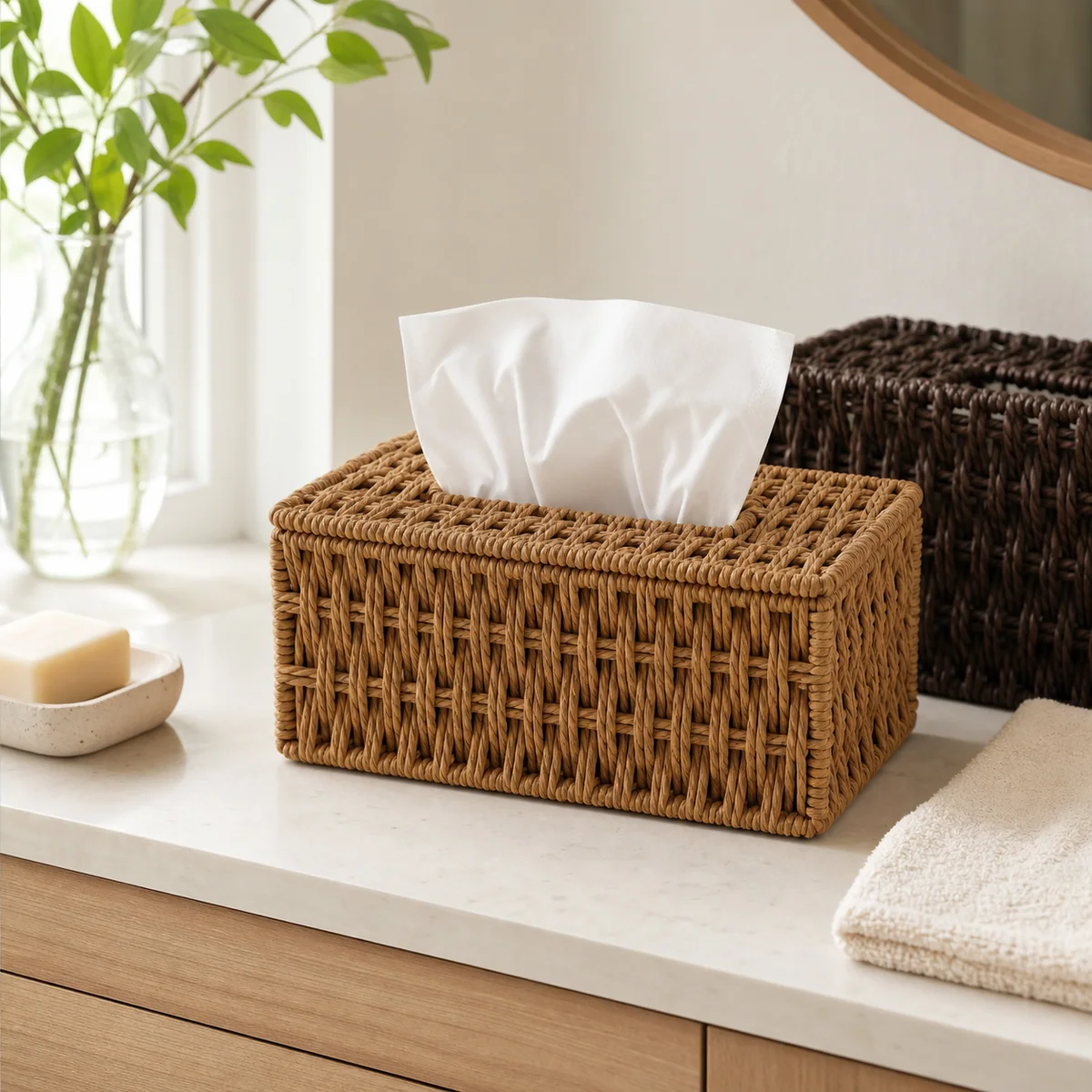
- Material selection changes wall thickness, surface texture, color range, edge finish, and care language. JINZHAO CRAFT's site identifies a natural-brown paper-rope rectangular tissue box cover, product JZ10044, and presents paper rope as a material direction for desktop storage. This is a current site-owned product reference, not a promise that every custom structure will fit the same tissue pack or use the same dimensions.
- Approve surface contact points around the opening and refill path. Check for protruding ends, rough joins, exposed frame, adhesive residue, staining, odor concerns defined by the buyer, and areas that could catch tissue or packaging. If coatings, dyes, wire frames, adhesives, printed parts, labels, or liners are used, collect the component information required by the destination and buyer program. Do not infer certification or food, medical, bathroom, or hospitality suitability from appearance.
- Care copy must match the approved material and finish. Avoid claiming washable, waterproof, stain resistant, antimicrobial, mold resistant, or suitable for wet rooms unless the finished product and claim have appropriate evidence. A conservative care direction may recommend dry indoor use and gentle dust removal, but the buyer should approve final consumer wording after reviewing the actual construction, target environment, and market requirements.
Complete the retail, packing, and change-control file
- A compact tissue cover can still be damaged by nesting, abrasion, top pressure, or an unsupported opening. Specify whether units are individually protected, nested, supported internally, placed in an inner box, or packed with inserts. Record orientation, pieces per carton, protection around the aperture and closure, carton dimensions, net and gross weight, labels, barcodes, marks, and the approved pack-out image. Validate the plan on the final sample rather than a different construction.
- Retail data should distinguish the cover's outside dimensions from the compatible tissue-pack dimensions. If compatibility is limited to named packs or a measured range, say so. Do not print 'fits all standard tissue boxes.' Include the refill method and care instruction where consumers need them. Coordinate the item measurement, retail box, GTIN decision, and ecommerce copy under the buyer's data rules whenever the product or package changes.
- The release file should contain the target-pack reference, dimension drawing, material and structure specification, approved sample evidence, compatibility list, appearance range, closure details, labels and artwork, care copy, pack-out, quality checkpoints, and change log. Submit that controlled information through the RFQ process. JINZHAO CRAFT can review custom size, color, label, and packaging requests conditionally; exact feasibility, tolerance, MOQ, timing, testing, and price require a current project review.
Buyer comparison table
JINZHAO CRAFT factory recommendation
For a practical factory quote, share a reference image, target dimensions, material direction, expected order quantity, logo or label needs, retail/export packaging requirements and destination market. JINZHAO CRAFT can then discuss material feasibility, sample direction, MOQ, production timing and export carton planning for the woven storage product.
Primary sources
These references support the defined standards, regulatory context, or buyer process described above. Product-specific obligations and commercial terms still require confirmation for the actual order.
- ISO 12625-1:2019 Tissue paper and tissue products - Part 1: Vocabulary — International Organization for Standardization
Supports consistent tissue-paper terminology only; it does not provide a universal tissue box cover size, opening, or handmade tolerance.
- GS1 Package and Product Measurement Standard — GS1
Supports consistent orientation and height, width, depth, maximum-extent, and usable-dimension language; project-specific cover tolerances remain buyer variables.
FAQ
What is the standard size for a woven tissue box cover?
There is no universal cover size that safely fits every market and tissue package. Buyers should measure the exact rigid carton, soft pack, or refill format in its filled condition and specify the approved compatibility range. Cover wall thickness, internal frame, corner build-up, entry route, and dispensing opening also affect fit, so outside dimensions alone are insufficient.
Which dimensions should a buyer provide to a tissue box cover supplier?
Provide the target pack's length, width, height, orientation, dispensing opening, seams or bulges, plus the cover's required outside envelope, minimum usable internal dimensions, narrowest entry clearance, opening geometry and position, base or lid construction, and measurement method. Mark every point on drawings and identify which dimensions are critical to fit.
How should a woven tissue cover fit be approved?
Use the exact target package or a controlled equivalent. Record insertion, seated position, wall and corner condition, opening alignment, tissue pulls at full, middle, and low pack states, cover movement, closure behavior, removal, and appearance. Store dated measurements and photographs with the sample revision. List each compatible pack actually evaluated.
Should a tissue box cover have an open bottom or removable base?
Either can work, but the choice changes refilling, retention, stability, appearance, and packing. An open bottom may simply lower over a carton; a removable base needs a defined closure and access method. The buyer should select the user sequence, sample it with the target pack, and state any acceptable lifting or movement during tissue withdrawal.
Can GS1 package measurement tolerances be used as handmade cover tolerances?
Not automatically. GS1's measurement standard is useful for consistent orientation and dimensional language for products and packages. It does not establish the fit tolerance for a custom handwoven cover. Buyer and supplier must derive product-specific ranges from the target package, construction, measurement method, sample evidence, and intended use.
What can JINZHAO CRAFT confirm before quoting a custom tissue cover?
The current site shows paper-rope tissue cover product JZ10044 and offers conditional discussion of size, color, labels, and packaging through OEM or ODM and RFQ routes. A quote still requires the target tissue package, dimensions, construction, quantity, branding, pack-out, destination, and approval requirements. No universal MOQ, tolerance, lead time, or fit result should be assumed.
Products relevant to this guide
Review current factory product examples, then send target dimensions, quantity and customization requirements for an exact quotation.
Continue learning
Paper Rope, Water Hyacinth, Seagrass and Cotton Rope: Buyer Comparison
Compare 8 real matched basket designs in paper rope and water hyacinth. See weave and texture differences, with clear limits on what the photos can prove.
Read guide →Materials & ConstructionMaterial-Aware Care and Use Guide for Woven Baskets
Create accurate care instructions for paper rope, water hyacinth and cotton rope baskets. Check material, frame, finish and cleaning evidence for each SKU.
Read guide →Factory & QualityBasket Factory vs Trading Company: A Verification-First Buyer Guide
Compare basket factories and trading companies through legal identity, production evidence, order control, and accountable handoffs.
Read guide →Product SpecificationsGeneral Storage Basket Functional Specification Matrix
Translate intended storage use into controlled fields for usable space, access, handles, contact surfaces, closure, liner, nesting, and pack verification.
Read guide →